

Scattered across Mars’ northern plains are thousands of curious hills that could unlock secrets about the planet’s watery history. Recent studies reveal that these clay-rich mounds might serve as crucial evidence supporting the existence of a prehistoric ocean that once covered large areas of Mars nearly four billion years ago.
Delving into Mars’ Aquatic Past
Though Mars is now a frigid and arid desert, its ancient terrain hints at a very different climate in epochs past. Scientists have long proposed that the planet’s northern lowlands contained a massive ocean, based on features similar to shoreline patterns and sediment deposits. A research team led by Joe McNeil from London’s Natural History Museum has discovered compelling proof: over 15,000 mounds and hills peppered across the northern plains.
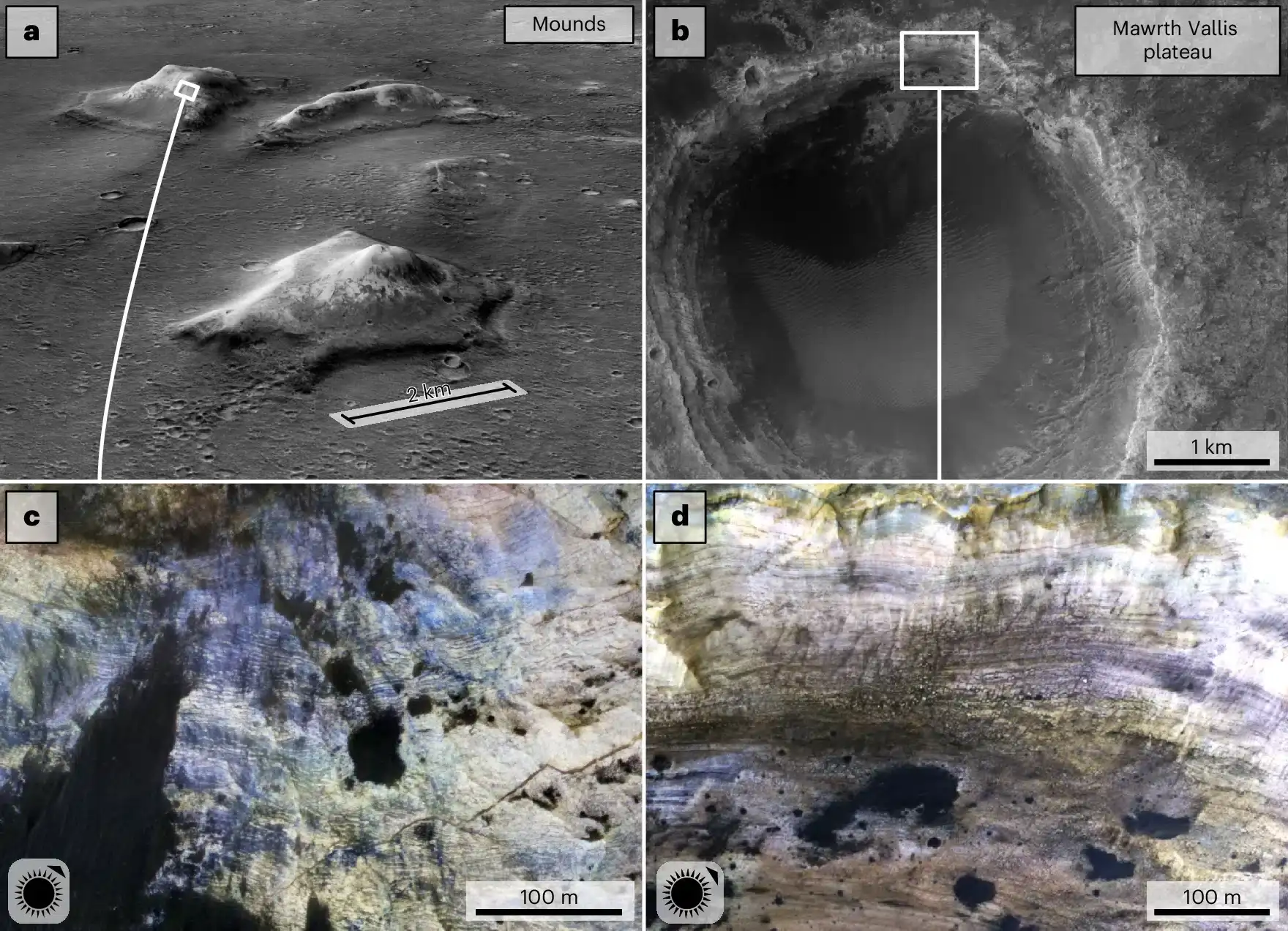
By utilizing detailed imagery and spectral analysis from instruments aboard NASA’s Mars Reconnaissance Orbiter and the ESA's Mars Express, the team examined these landforms, resembling earthly buttes and mesas that develop from long-term erosion and distinct stratification.

They identified significant clay mineral deposits within these mounds, some layers measuring as thick as 1,150 feet (350 meters). Since clays form through prolonged interaction between liquid water and rock, their presence strongly indicates periods of sustained surface water and potentially habitable conditions.
"This discovery indicates that significant amounts of water must have endured on Mars’ surface for extended periods," McNeil stated. "While this could point to an ancient northern ocean, the theory remains debated within the scientific community."
The Dual Nature of Mars
The Red Planet shows a dramatic division between its hemispheres. Its southern hemisphere is dominated by old, cratered highlands, whereas the northern hemisphere consists mostly of smoother lowlands shaped by significant impacts billions of years ago. This geological distinction has intensified debate about a once-present northern ocean fed by rivers and streams during the Noachian period, approximately 4.2 to 3.7 billion years ago.
The investigation targeted a site within the northern lowlands near Chryse Planitia, a vast basin sculpted by water and wind erosion. Notably, Chryse Planitia was also the landing zone for NASA’s pioneering Viking 1 probe in 1976.
The chronological clay layers engraved in these mounds reveal a chapter of Mars' wetter conditions, framed by older and younger rock layers lacking clay minerals. This pattern suggests a distinct wet epoch likely tied to a northern ocean’s existence.
Exploring the Possibility of Past Martian Life
A key question in planetary science is whether Mars ever hosted life. If a northern ocean existed, it might have created a stable environment that supported microbial ecosystems. Clays are particularly intriguing because they help preserve organic signatures, making them prime targets in astrobiological exploration.
This region, including the mounds, is close to Oxia Planum, which is slated to be the landing site for ESA’s Rosalind Franklin rover, scheduled for launch in 2028. The rover’s mission to drill into Martian bedrock aims to detect signs of ancient life, with hopes that the nearby clay-rich terrain will yield vital clues about Mars’ habitability.
"The mounds capture a nearly complete water history in accessible rock formations," McNeil explained. "The forthcoming Rosalind Franklin rover mission could be pivotal in determining if Mars ever sustained an ocean and if life might have thrived there."
A Debate That Continues
Despite these findings lending weight to the northern ocean concept, controversies persist. Some experts argue that subterranean water flows or interactions with the atmosphere might have created the clay deposits without needing a vast standing body of water.
Nevertheless, accumulating data — ranging from ancient river valleys to sedimentary traces and now these clay-rich landforms — depict a Mars that was once significantly more aqueous, warmer, and potentially capable of sustaining active geological and possibly biological processes.
- Categories:
- Space









0 comments
Sign in to Comment