
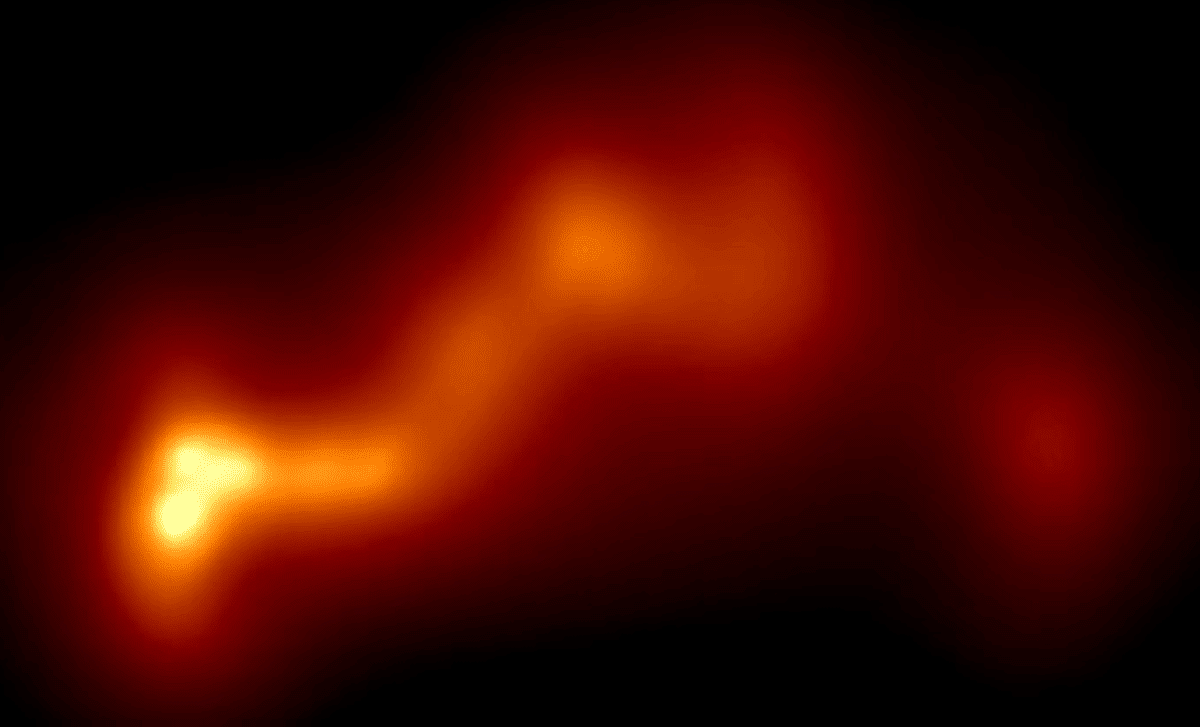
Researchers have achieved a remarkable feat by capturing a high-definition image of the remote galaxy OJ 287, unlocking new clues about its enigmatic phenomena. For over a hundred years, astronomers have been fascinated by the galaxy’s erratic brightness shifts, which have sparked theories that a pair of colossal black holes might be merging at its nucleus. The recent publication in Astronomy and Astrophysics signifies a milestone in unraveling the powerful processes occurring within this far-off galaxy.
OJ 287’s Enigma: Over a Century of Observations and Hypotheses
The galaxy OJ 287, situated roughly five billion light-years from Earth, has captured scientific interest for more than 150 years due to its unpredictable and curious light variations. These brightness changes have been key indicators hinting at unusual internal dynamics, with the leading explanation being an interplay or upcoming merger between two supermassive black holes at its core. Previously, this notion rested primarily on indirect evidence such as cyclical light intensity variations, but the latest imaging provides the first tangible proof supporting this concept.
Known as a blazar, OJ 287 hosts an immensely powerful black hole that drives intense radiation and energetic plasma jets. These jets have long baffled scientists because of their immense power. The new images bring us a step closer to understanding how such colossal energy outputs are generated and their impact on the surrounding galactic environment.

Revolutionary Imaging Reveals Intricate Jet Structure
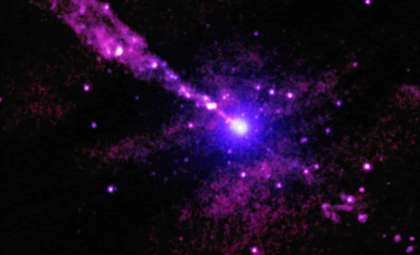
The most remarkable discovery from this study is the high-detail visualization of the plasma jet projecting from OJ 287’s core. Employing sophisticated space-based radio telescopes, the team identified a previously hidden, sharply curved ribbon-like formation within the jet, offering pivotal insights into the extreme physical conditions near the galaxy’s supermassive black holes.
“We have never before observed a structure in the OJ 287 galaxy at the level of detail seen in the new image,” emphasizes Dr. Traianou, who was a key member of the research team.
This detailed imaging feat was made possible through the combined efforts utilizing the RadioAstron mission, a space-based radio telescope, in conjunction with a worldwide array of terrestrial observatories. This virtual telescope, extending up to five times Earth’s diameter in length, enabled capturing extraordinarily fine resolution.
The image has uncovered certain features of the plasma jet, including its staggering temperatures. Some jet regions exceed temperatures of ten trillion degrees Kelvin, emphasizing the massive energy scales involved. These extreme conditions near the black hole provide an unprecedented arena for analyzing plasma physics at the universe’s highest heat and energy levels.
Insights into Supermassive Black Hole Pairs and Their Merger
The findings strongly bolster the binary supermassive black hole theory for OJ 287. The plasma jet’s unusual form implies a dynamic interaction between two black holes, influencing the jet’s direction and shape. The enormous energy discharged by this interaction likely drives the jet’s intensity and the intense electromagnetic radiation associated with blazars.
This research also advances understanding of black hole mergers, a critical area for gravitational wave studies. While gravitational waves from other cosmic collisions have been detected, investigating OJ 287 offers the possibility of finer details about the merger mechanisms of these massive entities.
Moreover, the observations of the jet’s interplay with its surroundings illuminate the volatile processes during black hole coalescence. Such insights could deepen our comprehension of how black holes form, evolve, and affect the architecture of galaxies.
- Categories:
- News






0 comments
Sign in to Comment