
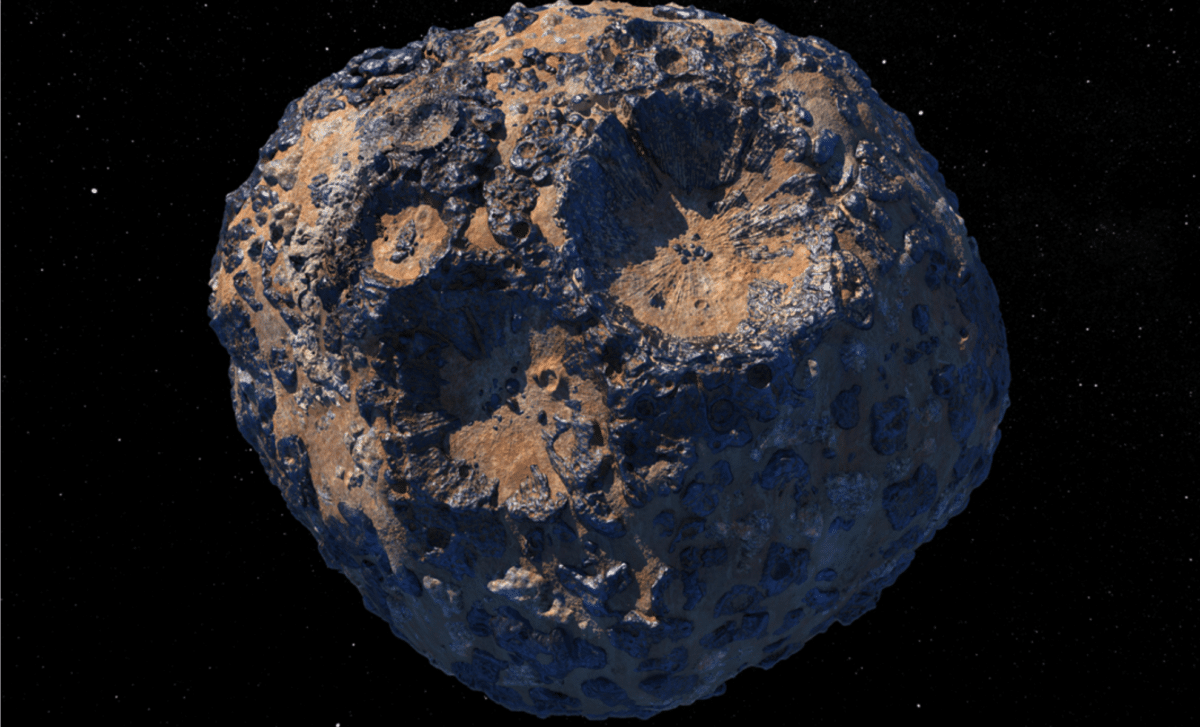
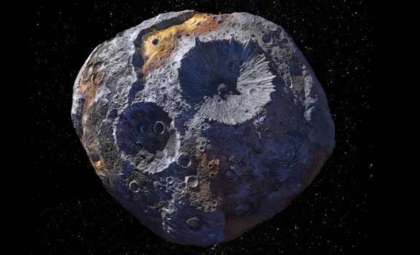
Asteroid 16 Psyche, a massive and intriguing body in the asteroid belt, will be the target of NASA’s Psyche mission set for 2029. Ahead of the spacecraft’s arrival, fresh research sheds light on the asteroid’s makeup, challenging previously held ideas about its beginnings. Appearing in the Journal of Geophysical Research, the study utilizes advanced simulations of significant craters on Psyche’s surface to predict its internal structure, aiding the forthcoming mission’s analysis.
A team from the University of Arizona’s Lunar and Planetary Laboratory (LPL) conducted the first comprehensive simulation of large impact craters on Psyche. By modeling the creation of these craters, the researchers seek to determine if Psyche represents a planetary core fragment or a primordial metallic object originating early in the solar system.
Using Crater Formation Models to Probe Psyche’s Interior
Namya Baijal, a PhD candidate at LPL and lead author of the paper, states that studying how large craters develop on Psyche unlocks crucial information about what lies beneath its surface.

“Large impact basins or craters excavate deep into the asteroid, which gives clues about what its interior is made of,” said Baijal. “By simulating the formation of one of its largest craters, we were able to make testable predictions for Psyche’s overall composition when the spacecraft arrives.”
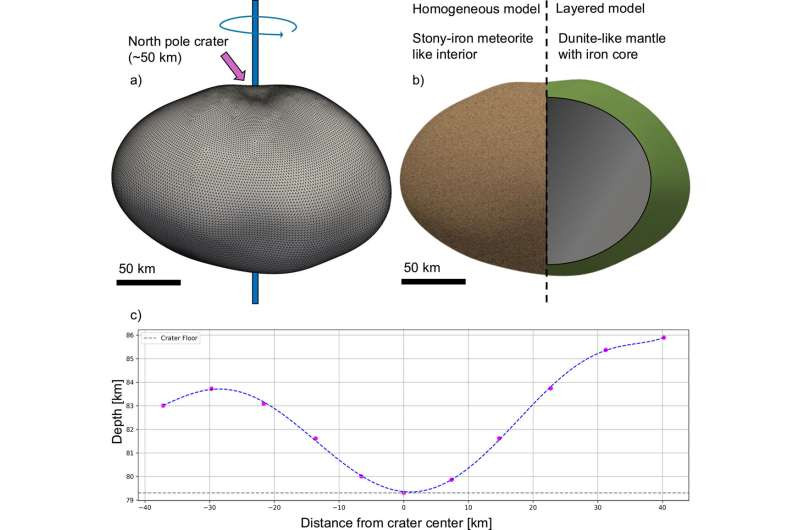
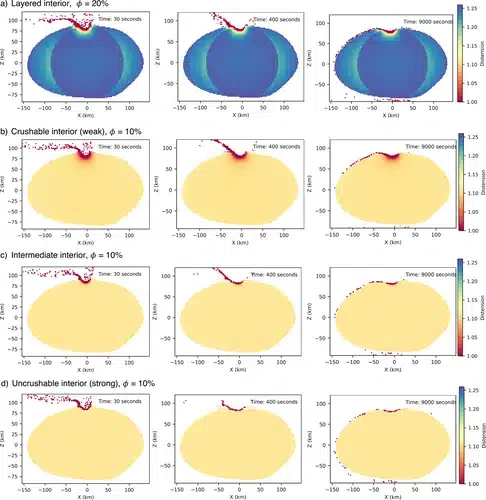
The investigation zoomed in on a significant crater near Psyche’s northern pole, testing two structural models: one describing a layered arrangement with a metallic core and rocky mantle, and the other depicting a homogeneous alloy of metal and silicate. Simulations involved virtual projectiles colliding with Psyche at average impact speeds, showing that an impactor roughly three miles wide could produce a crater matching observed dimensions for both interior hypotheses.
Baijal highlighted the crucial role of porosity—the asteroid’s internal voids—often neglected in prior research. “Porosity basically refers to how much empty space is inside Psyche, and it greatly influences crater formation,” she said.
“Porosity is often ignored because it’s difficult to include in models, but our simulations show it can strongly affect the impact process and shape of craters left behind.”
Unraveling Psyche’s Origins: Could It Be a Planetary Core?
The research also revisits the bigger mystery of Psyche’s past. For years, scientists have proposed that Psyche might be the exposed metallic core of a parent body destroyed by early solar system collisions, providing a rare window into planetary core formation.
Erik Asphaug, LPL professor and co-author, offers an analogy:
“The cooks have long left, but you can look at what’s left behind—the ovens, scraps of dough, the toppings—and make inferences about how the pizzas were made. We can’t get to the cores of Earth or Mars or Venus, but maybe we can get to the core of an early asteroid.”
The dual models propose contrasting possibilities: either a layered configuration with a dense metallic nucleus surrounded by a rocky shell after losing outer layers through collisions, or a more jumbled mixture of metal and rock forged by repeated disruptive impacts. The simulations indicate both could produce the observed crater features, posing new questions while laying groundwork for subsequent exploration.
Preparing for NASA’s Psyche Spacecraft Arrival
These crater formation insights are critical for interpreting surface observations once NASA’s Psyche spacecraft reaches the asteroid.
“By rigorously treating Psyche’s shape, porosity and composition, this work represents a true watershed moment for our capacity to realistically simulate impacts into unique types of asteroids,” said Adeene Denton, a postdoctoral fellow and co-author.
The findings will serve as a valuable resource for the interdisciplinary team of geochemists, geologists, and modelers analyzing Psyche’s surface after the 2029 arrival.
As Asphaug remarks on the study’s impact:
“When the spacecraft arrives at Psyche in a few years, the geochemists, geologists and modelers on the team will all be looking at the same object and trying to interpret what we see. This work gives us a head start.”
- Categories:
- Astronomy






0 comments
Sign in to Comment