
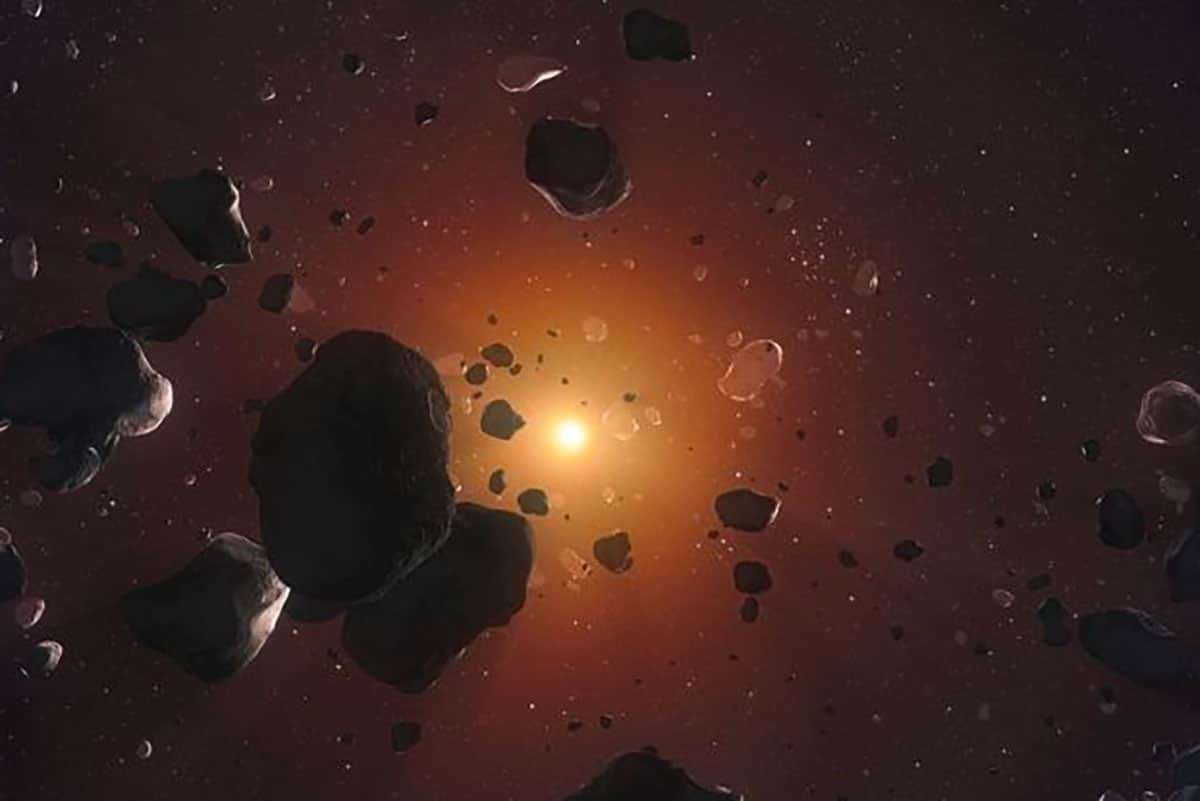
Encircling the Sun beyond Neptune’s orbit lies the Kuiper Belt, a vast torus packed with icy bodies such as Pluto and Arrokoth. Traditionally seen as the farthest frontier of our Solar System, this region has recently surprised scientists with fresh insights.
Astronomers employing Hawaii’s Subaru Telescope have observed an unexpected increase in the concentration of Kuiper Belt Objects (KBOs) located between 70 and 90 astronomical units from the Sun. This pattern hints at the presence of two separate Kuiper Belt populations, divided by a significant, largely empty zone.
Fumi Yoshida, a planetary expert affiliated with Japan's University of Occupational and Environmental Health Sciences and Chiba Institute of Technology, highlights the importance of this find: “If validated, this discovery could reshape our understanding of the primordial solar nebula’s size and offer new perspectives on how planets formed in our Solar System.”

Frozen archives: the Kuiper Belt’s role in unveiling solar history
The Kuiper Belt acts as a time capsule preserving the early Solar System’s composition. Situated 30 to 50 astronomical units from the Sun, it is protected from intense solar radiation, allowing its icy inhabitants to remain virtually unchanged for over 4.6 billion years.
These ancient objects allow scientists to study the original solar nebula — the cloud of gas and dust that eventually birthed our Sun and planets. The newly detected distant grouping of KBOs expands this preserved record, possibly revealing details about the initial phases of planetary development.
Key facts about the Kuiper Belt include:
- Position: Beyond Neptune’s orbit
- Composition: Mainly icy bodies and dwarf planets
- Age: Approximately 4.6 billion years
- Importance: Safeguards primordial Solar System debris
A puzzling gap: exploring the dual structure of the Kuiper Belt
The idea of a bifurcated Kuiper Belt offers fresh clues regarding how our Solar System formed and changed over time. An international collaboration led by Wesley Fraser from Canada’s National Research Council identified 11 remote objects beyond 70 astronomical units, provoking a rethink about the belt’s composition.
What stands out is the notable absence of objects between 55 and 70 astronomical units. This gap separating the inner and outer Kuiper Belt populations resembles features found in other planetary nurseries, suggesting our Solar System might follow patterns common in the galaxy.
Wesley Fraser comments on this breakthrough: “What we once thought was a relatively small Kuiper Belt may have been an observational artifact. Our findings imply that, assuming further confirmation, our Solar System’s outer region may not be so unusual when compared with extrasolar planetary systems.”
This new architectural perspective could influence models of planet formation. Recent discoveries of planets near our Solar System continue to expand our grasp of cosmic structure.
Reevaluating habitability prospects in the Solar System
Our Solar System’s unique features have often been linked to its ability to foster life, but current technological limits might have biased these assumptions.
If the expanded Kuiper Belt structure is confirmed, it could challenge the view of a small solar nebula, aligning our star system more closely with typical planetary systems and potentially offering important clues about habitability conditions.
Here is a comparison between previous beliefs and this new outlook:
Characteristic Old View Updated View Kuiper Belt Size Relatively small Comparable to other stellar systems Extent of Solar Nebula Limited Considerably larger Overall System Layout Unique More consistent with galactic patterns
Tracking the orbits of these remote KBOs will be vital to confirm this scientific breakthrough. Alan Stern, the Principal Investigator for the New Horizons mission at the Southwest Research Institute, expresses enthusiasm: “This discovery is groundbreaking, unveiling unexpected and fascinating features in the Solar System’s farthest realms.”
As we continue to explore our cosmic neighborhood, new findings will keep reshaping our understanding of the universe and the possibilities for life beyond Earth.
- Categories:
- Astronomy









0 comments
Sign in to Comment