
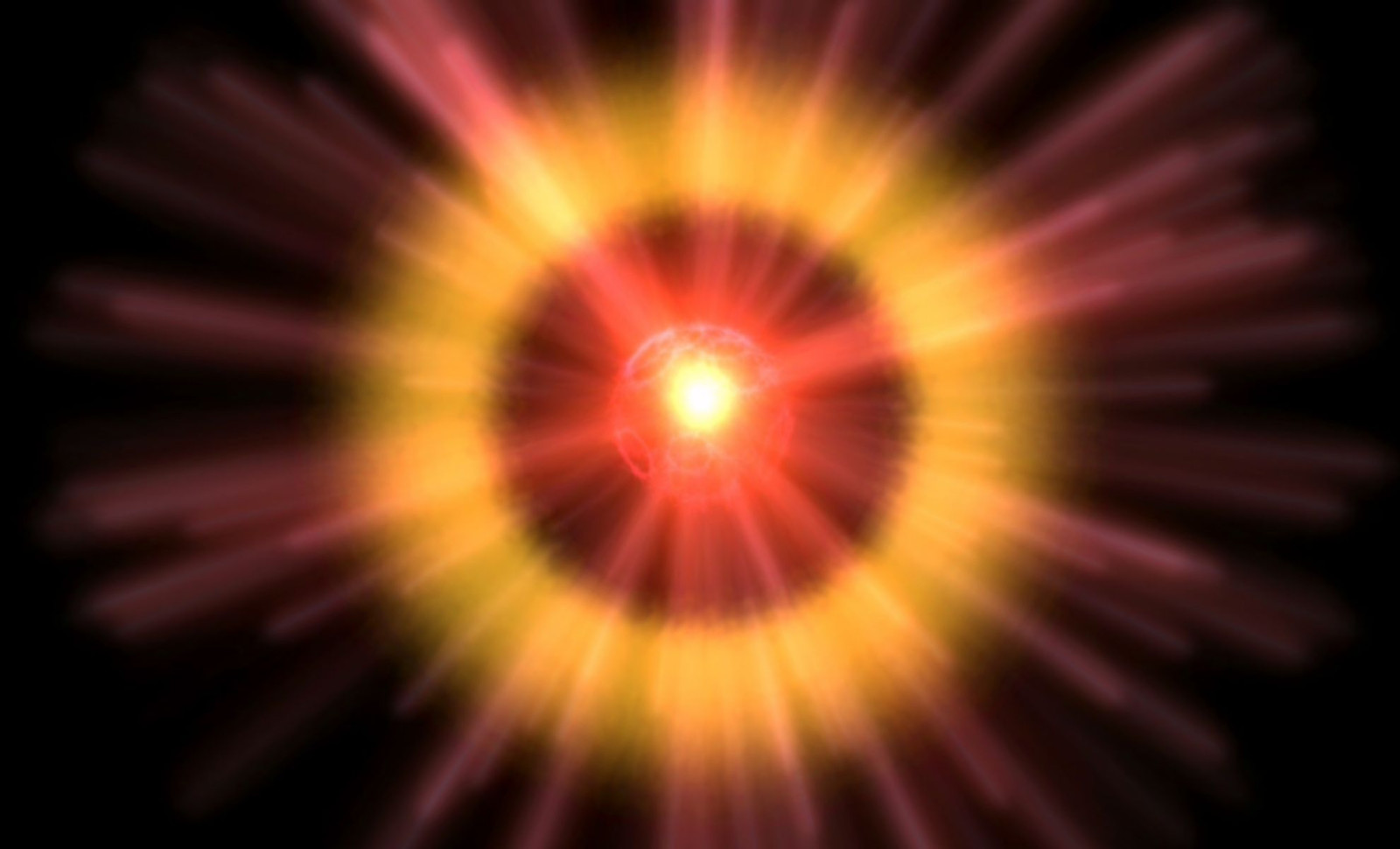
Researchers have successfully recreated a nuclear reaction never previously observed in laboratory conditions. Their focus was on p-nuclei, rare proton-heavy isotopes that challenge the traditional narratives of element formation. By capturing data on one key reaction responsible for their synthesis, the team is bridging a longstanding gap in nuclear astrophysics knowledge.
While decades of research have clarified how most elements heavier than iron arise via neutron capture—where atomic nuclei absorb neutrons and gradually transform—this mechanism does not explain the existence of certain unique isotopes.
These exceptional isotopes, known as p-nuclei, cannot be created through neutron capture. A new paper published in Physical Review Letters highlights that scientists have been puzzled by the origin of these isotopes for over 60 years, largely due to the formidable challenges of observing their formation reactions directly in the lab.

Direct Observation of a First-Time Reaction
The research, led by Artemis Tsantiri, achieved the first direct measurement of how arsenic-73 absorbs a proton to become selenium-74. This is the inaugural observation of this specific proton-capture reaction using a rare isotope beam.
The experiment was conducted at the Facility for Rare Isotope Beams (FRIB), where radioactive arsenic-73 nuclei were accelerated into a chamber containing hydrogen gas, which provided the protons needed for the nuclear process.
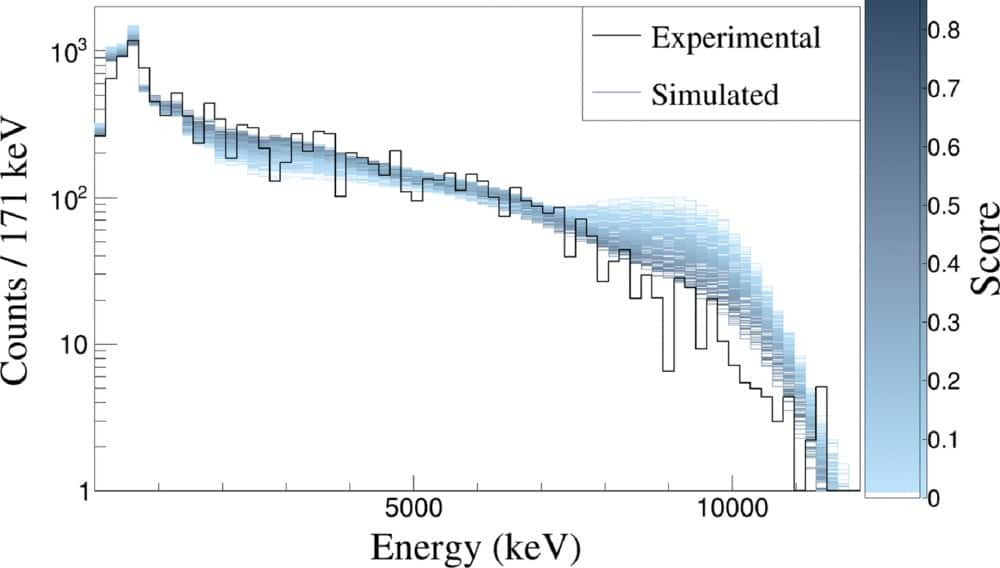
During the reaction, selenium-74 was produced in an excited state, emitting gamma rays as it returned to stability. According to the published findings, capturing these gamma emissions gave researchers direct empirical evidence rather than relying solely on theoretical predictions. As Tsantiri noted:
“Even though the origin of the p-nuclei has been a topic of study for over 60 years, measurements of important reactions on short-lived isotopes are almost non-existent.”
Simulating Nuclear Processes in Stellar Explosions
This particular reaction forms part of the gamma process, which occurs during intense supernova outbursts. In these violent environments, gamma photons knock particles off atomic nuclei, leaving behind proton-enhanced isotopes like the p-nuclei.
The study reveals that to fully understand selenium-74, it is necessary to examine both its synthesis and decay mechanisms. Until now, these properties had to be approximated through computational models because the involved isotopes are highly unstable. The new experimental data enables refinement of these theoretical frameworks.
Advancing Knowledge While Challenges Remain
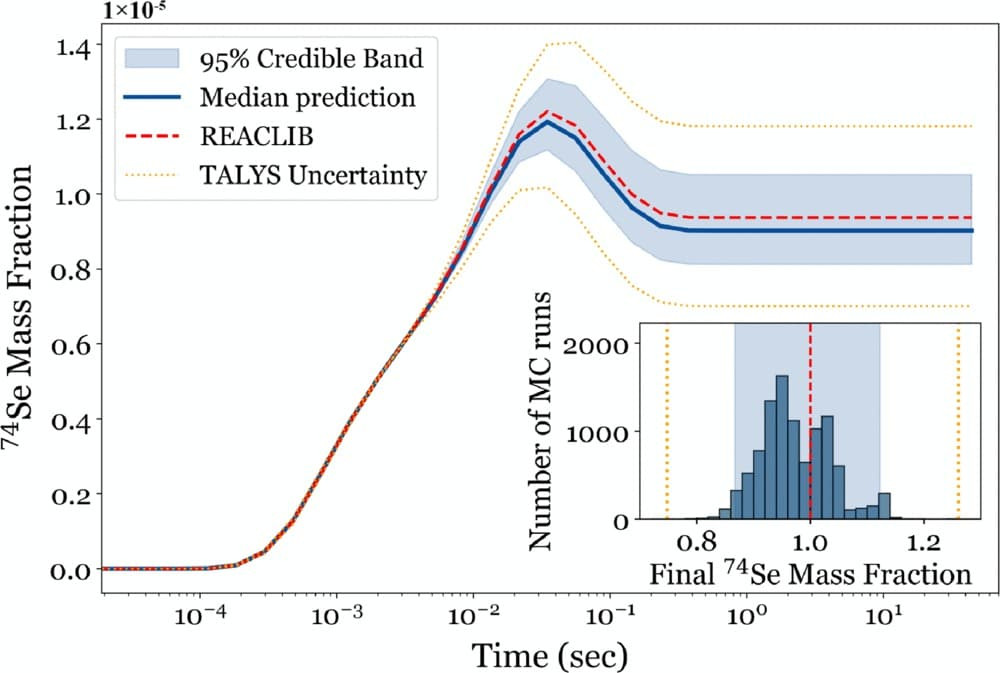
Incorporating the experiment’s results into astrophysical models cut the uncertainty in selenium-74 abundance by roughly 50%, which represents a substantial enhancement.
However, discrepancies between simulation outputs and astronomical observations persist. These gaps imply that further elements—such as detailed supernova conditions or still unknown nuclear processes—may play a role. As Artemis Spyrou from FRIB expressed:
“These results bring us a step closer to understanding the origins of some of the rarest isotopes in the universe,” she added that: “Tsantiri’s work is a nice example of the multidisciplinary collaborations needed for advancing the field, and of the kind of professional development opportunities for early career researchers at FRIB.”
- Categories:
- Astronomy



0 comments
Sign in to Comment