
Neanderthals might have shared more human-like qualities than previously assumed. A fresh examination of genetic, archeological, and fossil records points to the possibility that spoken language existed among both Neanderthals and modern humans, with roots extending hundreds of thousands of years before Homo sapiens emerged.
Historically, Neanderthals were often depicted as primitive and lacking the intellectual traits commonly linked to modern humans. This perspective has shifted considerably in recent decades as new findings depict them as cognitively and culturally sophisticated. Among these evolving views, a key question is whether Neanderthals had the capacity for complex speech and language comparable to our own.
Language Origins May Date Back Much Further
The commonly held belief that language suddenly arose around 50,000 years ago due to a limited number of genetic mutations has faced increasing scrutiny. Researchers Dan Dediu and Stephen C. Levinson argue in their review that this timeline is inconsistent with the broader evidence. Their assessment suggests that speech and language could be a significantly older evolutionary trait within the human lineage.

Published in Frontiers in Language Sciences, their study proposes that the capacity for language may have originated with the last common ancestor of modern humans, Neanderthals, and Denisovans approximately 500,000 years ago.
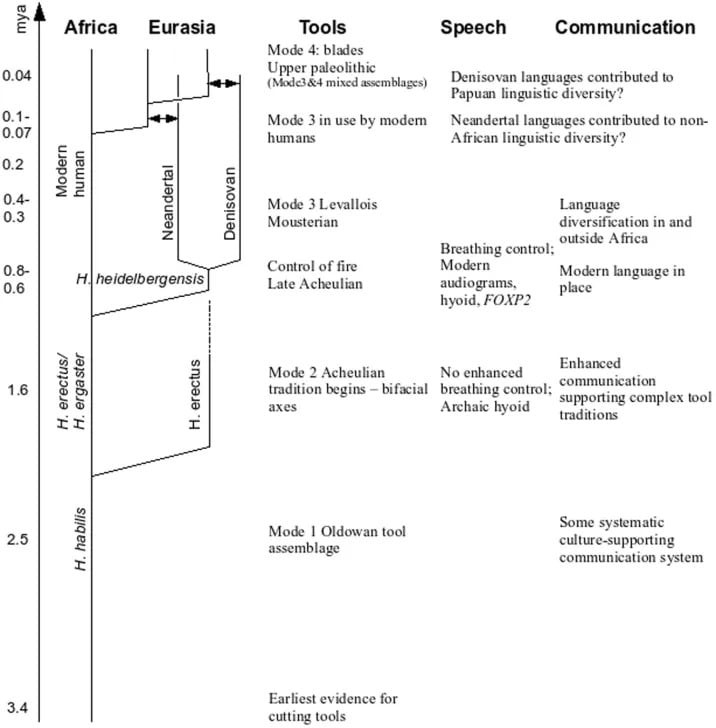
They even hypothesize that the roots of language extend back as far as one million years, challenging traditional estimates. This suggests language could have arisen gradually through numerous biological and cultural developments rather than appearing suddenly.
A Revised Understanding of Neanderthals
Since their discovery nearly two centuries ago, Neanderthals have captivated researchers. Early interpretations often underestimated their capabilities, portraying them as intellectually limited beings capable of only rudimentary communication.
However, ongoing research has profoundly altered this viewpoint. Insights from newly uncovered artifacts, reevaluation of older findings, and breakthroughs in ancient DNA studies now show that Neanderthals possessed intellectual and cultural complexity rivaling that of early modern humans.
Occupying vast regions of western Eurasia for hundreds of thousands of years, Neanderthals endured both frigid ice ages and milder periods. Their extensive tenure and ability to adapt to varying climates demonstrate resilience and versatility that were once overlooked. This expanded evidence base has prompted scientists to reconsider Neanderthals’ role in the overarching narrative of human evolution.
Do Elements of Neanderthal Language Persist Today?
The study raises captivating possibilities about the nature of interaction between ancient human groups. Genetic evidence confirms that modern humans migrating out of Africa interbred with Neanderthals and Denisovans, resulting in genetic legacies that remain in non-African populations.
According to the researchers, these encounters may have involved more than just genetic exchange—they may have also included cultural and linguistic sharing. If early humans exchanged knowledge, cues, and customs, then traces of Neanderthal languages might still influence the diversity of languages today. This hypothesis can be explored by analyzing linguistic patterns in African versus non-African languages and running computer models simulating the diffusion of language across populations.
Although no direct recordings or artifacts of Neanderthal speech exist, the review highlights that evidence supporting their use of language has grown significantly in recent years. As new discoveries emerge, the perceived divide between Neanderthals and modern humans continues to shrink, revealing a more interconnected and nuanced past.
- Categories:
- Science












0 comments
Sign in to Comment