
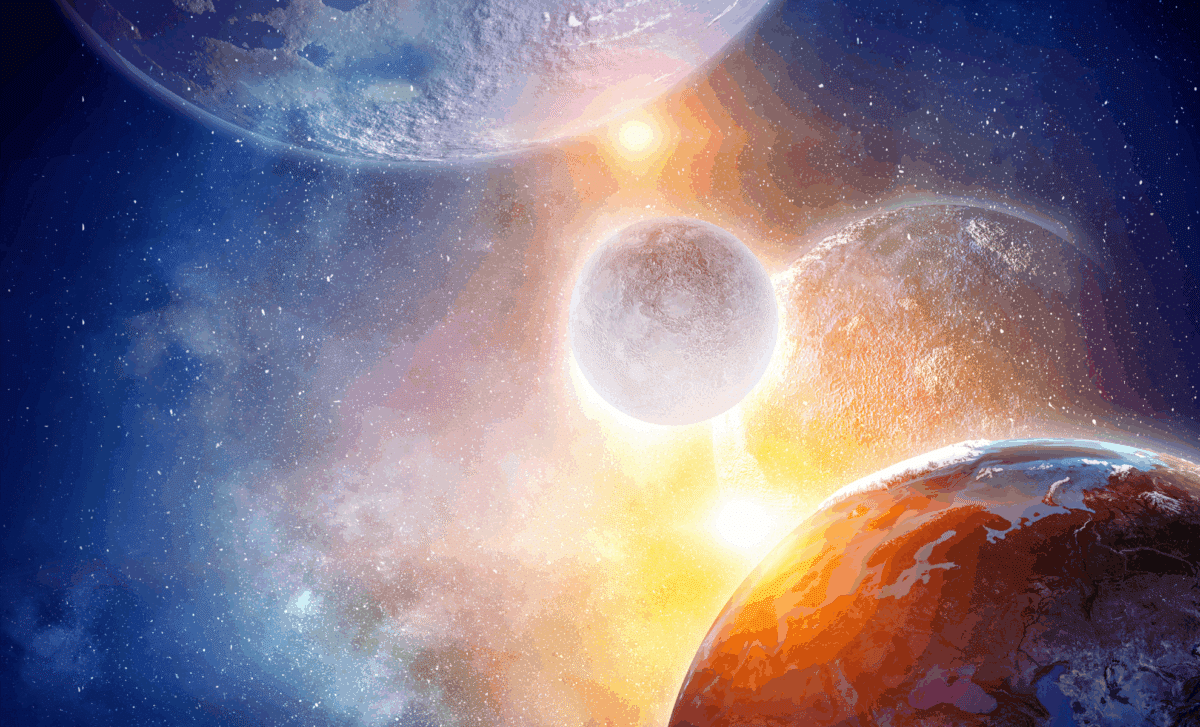
For generations, scientists and thinkers alike have debated the universe's ultimate destiny. While many theories have ranged from endless expansion to a catastrophic “big crunch,” recent research offers fresh perspectives that challenge long-standing assumptions. A newly released study on the arXiv journal casts doubt on the idea that the cosmos will perpetually expand.
Understanding the Cosmological Constant’s Influence on Cosmic Fate
For more than twenty years, the dominant concept in cosmology held that the universe’s growth would persist without limit. This was grounded in the belief that the cosmological constant—the parameter in Einstein’s field equations reflecting the energy contained in empty space—has a positive value. Such a positive constant was thought to fuel the accelerating expansion of the cosmos. As physicist Henry Tye elaborates,
“For the last 20 years, people believed that the cosmological constant is positive, and the universe will expand forever.”
Add Cosmo Herald as a Preferred Source

Nevertheless, emerging evidence challenges this traditional outlook. New measurements indicate the cosmological constant might instead be negative. This would mean the expansion of the universe could decelerate and eventually reverse, resulting in a dramatic contraction rather than endless growth. Tye notes,
“The new data seem to indicate that the cosmological constant is negative, and that the universe will end in a big crunch.”
Exploring Dark Energy and Axions in Cosmic Dynamics
Dark energy remains one of the most enigmatic forces influencing the cosmos. It is widely seen as the driver behind the universe’s accelerating expansion, yet its fundamental nature is still not fully known. Traditionally, cosmological models, including those centering on a constant cosmological constant, assumed dark energy’s strength stays unchanged over time. However, recent findings from the Dark Energy Survey (DES) and the Dark Energy Spectroscopic Instrument (DESI) propose that dark energy could evolve, challenging the simplistic notion of it as a fixed force.
Incorporating the idea of axions—hypothetical particles thought to influence dark energy—Tye’s research provides fresh insights. Axions might explain the universe’s initial accelerated expansion, but their impact could wane over time. As Tye explains,
“People have said before that if the cosmological constant is negative, then the universe will collapse eventually. That’s not new. However, here the model tells you when the universe collapses and how it collapses.”
Tye and his team’s model predicts that as axions lose their influence, the negative cosmological constant would dominate, halting expansion and triggering cosmic contraction.
What a Big Crunch Would Mean for Our Universe
The big crunch hypothesis—suggesting the universe might one day shrink back into a singularity—has existed for decades. Yet earlier predictions lacked precise timing. Tye’s approach, which factors in the changing role of dark energy and axions, offers clearer forecasts. Their results imply the universe could end roughly 33 billion years from now, with contraction starting in about 20 billion years. Once expansion stops, a rapid shrinkage would follow, much faster than the gentle growth observed today.
Although these timelines are speculative, the implications are staggering. If dark energy continues to evolve as proposed, the cosmos could ultimately reverse course, collapsing in a big crunch. This swift contraction contrasts sharply with the slow expansion we currently witness, signaling a transformative shift in cosmic evolution.
The Consequences of a Universe with a Limit
The possibility of a universe with a finite lifespan represents a fundamental change in cosmological thinking. While accelerating expansion driven by dark energy suggested a cosmos stretching into infinity, Tye’s findings imply the universe’s entire life cycle might span about 33 billion years, with contraction commencing around 20 billion years from now.
Such a revelation compels us to reconsider our cosmic perspective. Though civilizations arise and fade, and stars ignite and extinguish, the universe itself may face an eventual conclusion, long after humanity has passed. These vast timeframes challenge comprehension but also underscore the fragility and transient nature of all existence, including our universe.
- Categories:
- News






0 comments
Sign in to Comment