
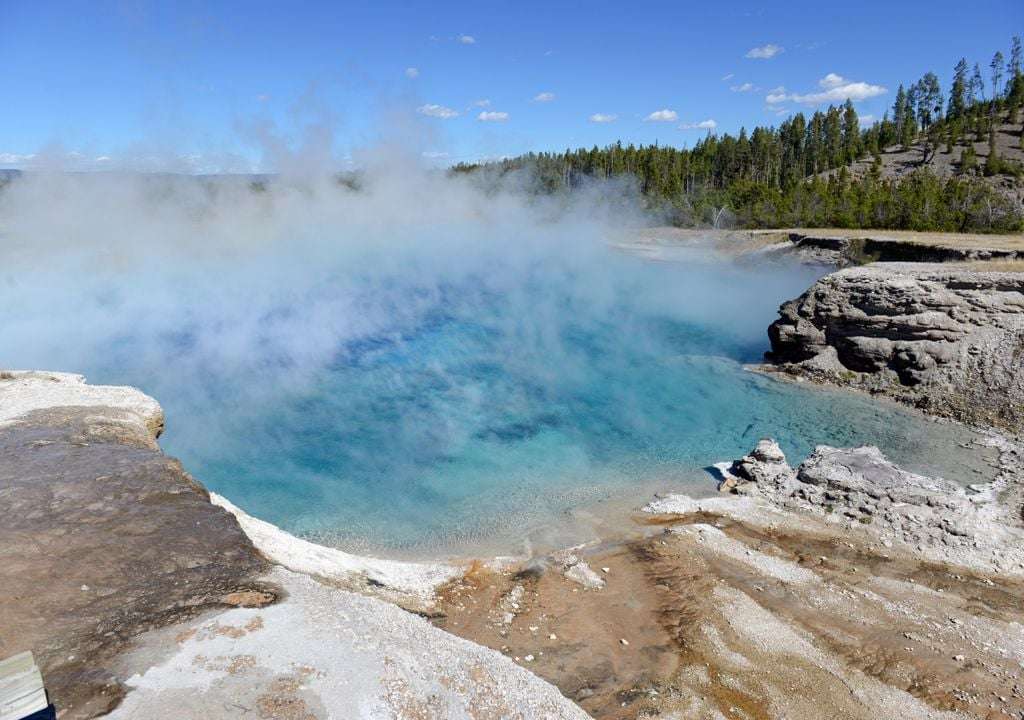
Scientists have long been intrigued by hot springs due to their distinctive geochemical environments. These natural features, formed from subterranean volcanic activity, produce settings rich in minerals and organic molecules. Recent investigations have found that terrestrial hot springs exhibit notable resemblances to deep-sea hydrothermal vents, which have traditionally been viewed as possible origins of life.
A central factor in this link is the presence of iron sulfide minerals. Present in both hot springs and underwater vents, these minerals are thought to have catalyzed vital chemical reactions essential to life's early development. Research shows that iron sulfides can promote carbon fixation, a critical biochemical process underlying life.
Carbon fixation refers to the transformation of carbon dioxide into organic compounds—an indispensable function for life, carried out by various organisms such as:

- Plants
- Bacteria
- Archaea
The role of iron sulfides in enhancing carbon fixation across different environments hints that life might have originated in diverse locations, potentially uniting different hypotheses about our world's beginnings.
Recreating Early Earth Conditions
To explore their theories, scientists developed a cutting-edge experimental setup mimicking the conditions of ancient hot springs. This method enabled real-time monitoring of chemical reactions possibly similar to those that occurred billions of years ago.
These experiments produced compelling outcomes. Every tested iron sulfide sample showed the capacity to generate methanol, a molecule formed through carbon fixation, with production levels rising depending on:
- Elevated temperatures
- Exposure to visible light
- Variable water vapor concentrations
This evidence supports the hypothesis that iron sulfides could have driven carbon fixation in early terrestrial hot springs, providing a plausible route for life’s initial emergence.
Connecting Ancient Reactions to Present-day Life
The research revealed striking parallels between primordial chemistry and the metabolic strategies of modern microbes. The observed mechanism, known as the reverse water-gas shift reaction, closely mirrors the acetyl-CoA pathway found in certain bacteria and archaea.
Also referred to as the Wood-Ljungdahl pathway, this process is among the oldest forms of carbon fixation. The resemblance suggests a chemical continuum bridging early Earth’s hot springs and cellular environments.
To underscore this connection, consider the following comparison:
These findings imply that chemical pathways in primordial hot springs may have facilitated the evolution of increasingly complex biological systems. This research contributes to mounting evidence that iron-sulfur clusters and the acetyl-CoA pathway were pivotal in life's origin, irrespective of whether it began on land or beneath the sea.
Broadening Perspectives on Life’s Origins
The relevance of this study transcends Earth. As the quest for extraterrestrial life intensifies, understanding Earth's life-forming environments gains greater importance. The research broadens the range of possible habitats where life might arise, both on our planet and beyond.
The idea that hot springs could have ignited life on Earth also prompts deeper inquiry into human evolution and our species' extraordinary adaptability. Unlocking Earth's early secrets enriches our knowledge of life's journey here and hints at life's potential throughout the cosmos.
This pioneering study opens fresh pathways for future investigation, encouraging a reconsideration of long-held beliefs about life's inception. By continuing to explore the dynamic interrelations among geology, chemistry, and biology, scientists are gradually unveiling the intricate story of life's beginnings, bringing humanity closer to understanding its cosmic origins.
- Categories:
- Evolution








0 comments
Sign in to Comment