
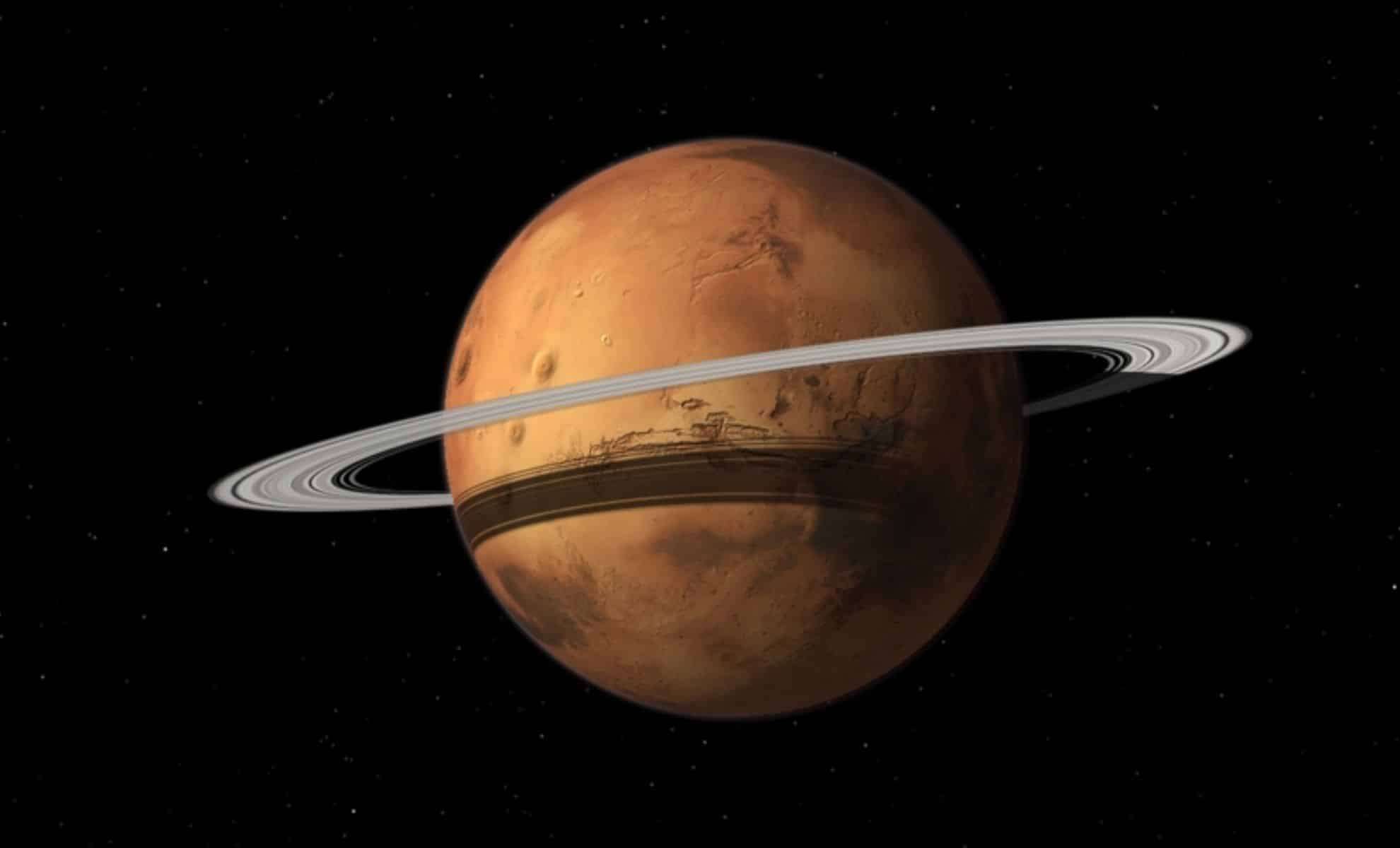
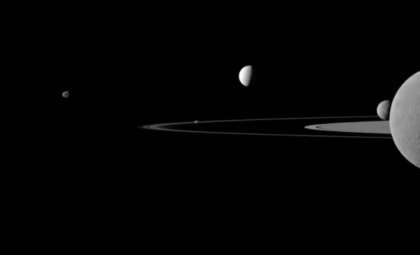
A recent investigation challenges established ideas about the origin of Mars’s satellites by suggesting that the Red Planet might have been encircled by rings in the past. Conducted by Matija Ćuk, Kaustub P. Anand, and David A. Minton, this study, released on arXiv in March 2025, proposes that Phobos, the innermost and larger moon of Mars, could be much younger than previously believed. According to the authors, Phobos might represent the latest phase in a dynamic pattern of moon formation and destruction governed by tidal forces and ring debris around the planet.
Phobos Could Be a Recently Formed Moon Within a Cycle of Breakdown and Creation
Previously, the prevailing view suggested that Mars’s moons—Phobos and Deimos—were asteroids captured by Mars’s gravitational pull. However, this notion has lost favor because their nearly circular trajectories near the planet’s equator deviate from typical capture behavior. The new hypothesis considers that Phobos originated from a debris ring created by a colossal impact on Mars, which resulted in a disk of dust and rock orbiting the planet.
In this framework, the debris ring gradually merged into a moon. Importantly, this might not have been a singular event. The research team suggests that over Mars’s history, this process of moon creation, inward orbital spiral, and subsequent fragmentation could have repeated up to six times. Each moon drawn inward would break apart near Mars’s Roche limit, forming a new debris ring from which a smaller moon arose. The current Phobos may be the tiniest in this sequence, possibly only around 100 million years old.

Impact of Tidal Forces and Orbital Mechanics on Mars’s Moons
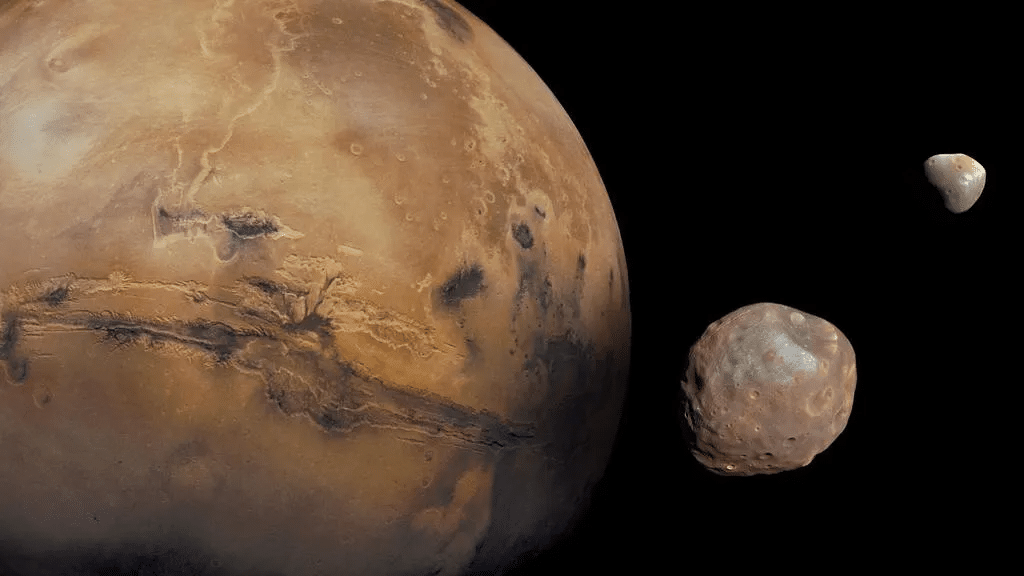
A compelling aspect of this theory is how it explains the unique orbital patterns of Phobos and Deimos. Presently, Phobos orbits Mars at approximately 2.7 times the planet’s radius and is gradually moving closer due to tidal friction. If this trend continues, the moon could disintegrate and form a new ring within several tens of millions of years, perpetuating the cycle.
The authors point out that Phobos’s shape provides important clues. Its warped structure aligns with what would be expected under strong tidal forces at around 3.3 Mars radii—the region where a ring system would have existed. This observation bolsters the ring-origin proposition. At the same time, Deimos exhibits an inclined orbit, which might stem from gravitational interactions with a former inner ring.
Orbital Modelling Supports Multiple Evolution Scenarios
The researchers conducted extensive orbital simulations using realistic galactic and tidal parameters to assess both the traditional asteroid capture explanation and their newer ring-based theory. Their results indicate that both could potentially recreate the current orbits of Mars’s moons. Nonetheless, the ring-origin approach better accounts for certain mysteries such as Phobos’s mass, orbital radius, and peculiar shape.
At present, observational evidence alone cannot decisively distinguish between these two possibilities. The simulations, while informative, do not clarify where Phobos originally formed or its precise age. Future missions could provide critical insights. Notably, the Martian Moons eXploration (MMX) mission, spearheaded by JAXA, plans to gather and return surface samples from Phobos by 2029. Analyzing their composition may validate or challenge the idea that Phobos emerged from a debris ring.
Implications for Understanding Mars and Beyond
If substantiated, the ring-driven moon cycle would dramatically transform our comprehension of Mars’s geological development and orbital history. Mars would be seen not as a planet with two static, ancient moons but as an active site of ongoing tidal forces, collisions, and gravitational reshaping. Rather than stable relics, Mars’s moons might be fleeting features that cyclically vanish and reappear across hundreds of millions of years.
This concept also invites reevaluation of other planetary systems. If such moon-to-ring formation occurred around Mars, similar processes might have influenced other small moons within our solar system. It may further illuminate the dynamics of exoplanetary systems, where transient rings and satellites could affect planetary evolution and stability.
- Categories:
- News





0 comments
Sign in to Comment