

A recent theoretical analysis suggests that the light emitted from faraway galaxies might experience a subtle color change due to interactions with dark matter. This alteration, shifting wavelengths either toward red or blue, depends on the fundamental characteristics of this mysterious material. The study introduces a fresh perspective for detecting dark matter by examining its indirect influence on the light that fills the universe. Although the effect is extremely faint, upcoming advanced astronomical measurements may soon be capable of detecting it.
Can Light Reveal the Secrets of Dark Matter?
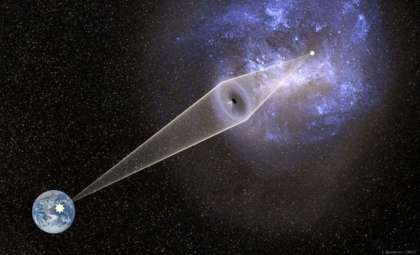
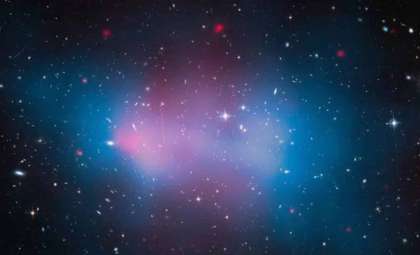
Dark matter first became apparent through observations like galaxy rotation speeds and gravitational lensing, yet its exact composition remains unknown. It impacts gravity but does not significantly emit or absorb electromagnetic radiation. Generally, dark matter is classified as either cold or hot. Cold dark matter moves slowly and shapes the universe’s large-scale framework, while hot dark matter—including particles like neutrinos—travels at near-light speeds and cannot fully explain observed dark matter effects.
But could dark matter affect light in more nuanced ways than previously thought? A recent theoretical paper published by Physics Letters B investigates this idea. Instead of looking for light directly emitted from dark matter decay, the researchers focused on how the particles produced during decay might influence the cosmic photons traveling through space. Their calculations reveal a possible process where dark matter could incrementally adjust the photon energies, tinting the universe’s light by shifting colors slightly toward blue or red, depending on those interactions.

Two Possibilities: Blue Shift or Red Shift?
The research team examined two primary scenarios: one where dark matter interacts only through gravitational forces, and another where particle collisions generate secondary particles. In the gravitational case, photons with low energy tend to scatter forward, gaining mild energy increases and causing a slight blue shift. Conversely, when backscattering is prevalent, photons lose some energy, leading to a gentle red shift.
These color shifts are exceedingly small, posing no threat to widely accepted cosmological theories like the expanding universe or inflation. Nevertheless, based on the authors’ models, upcoming sensitive gamma-ray surveys may be able to detect these subtle effects. Observations from the Fermi Large Area Telescope (Fermi-LAT) looking at the Milky Way’s center already show data that fit within the uncertainty range of both dark matter interaction models. As a result, neither scenario can be excluded at this stage, but future technologies could provide clearer answers.
A Novel Approach to Dark Matter Detection
This study stands out by shifting focus from the classic hunt for dark matter particles themselves to examining how dark matter influences background light indirectly. Conventional searches target WIMPs (weakly interacting massive particles) hoping for signals from their decays or interactions, yet no conclusive evidence has been found. This new approach proposes monitoring the secondary effects caused by dark matter’s interactions with photons.
Published in Physics Letters B, the paper delves into the details of scattering cross-sections where photons meet particles produced by dark matter decay. Though a complex technical concept, this process explains how energy is exchanged during these interactions. By characterizing how photons' energies are redistributed, the researchers offer a framework that could test dark matter’s non-gravitational effects. It highlights that detecting something invisible might best be achieved by tracking its subtle influences on the environment.
The Smallest Cosmic Hue Shift
Even though the predicted red or blue tints are minimal, their cumulative effect over vast cosmological distances could influence measurements of galaxy light spectra, cosmic microwave background radiation, or large-scale cosmic surveys. Such shifts might introduce small biases or even explain certain unexplained phenomena observed in cosmic data related to early universe conditions or the rate of cosmic expansion.
This fresh perspective may not yield instant discoveries but contributes a valuable method for indirect dark matter detection. Should observations confirm it, this mechanism could shed light on how dark matter subtly leaves its mark— not through energetic bursts or direct radiation, but through gentle alterations in the cosmic light streaming into our instruments.
- Categories:
- Space







0 comments
Sign in to Comment