
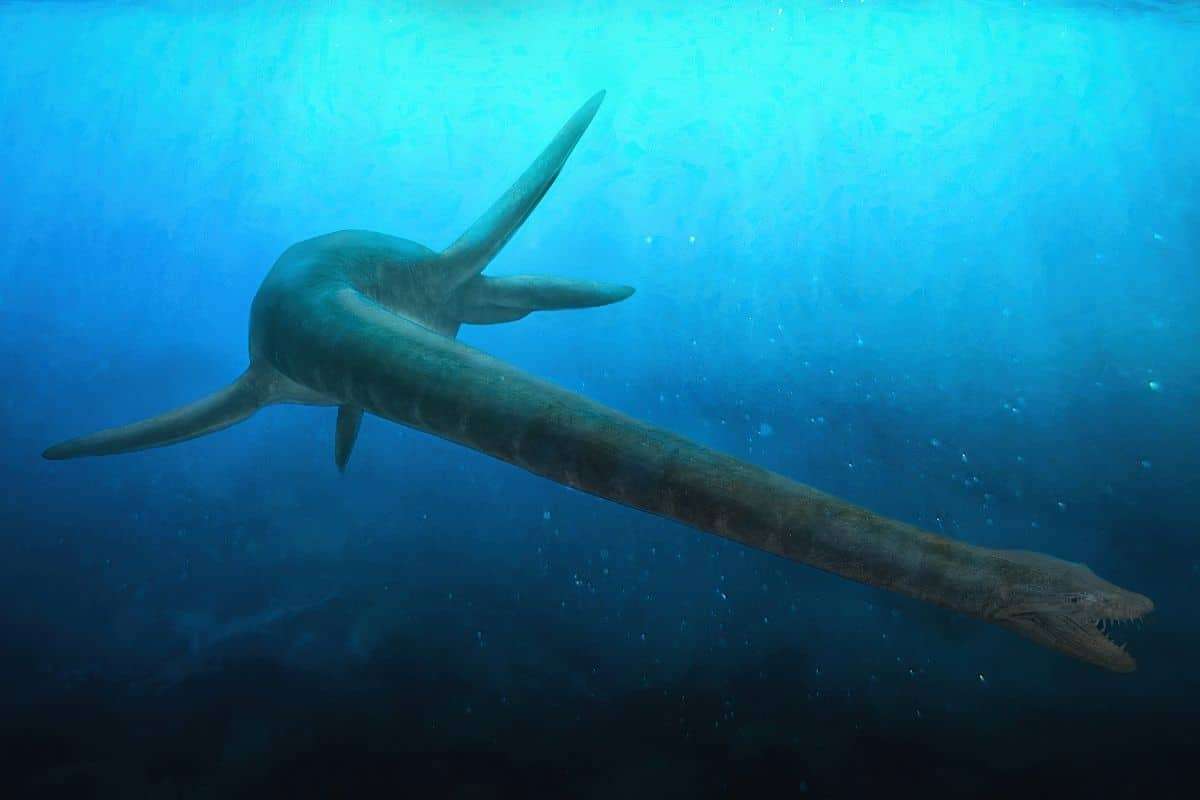
An exceptionally preserved Plesiopterys wildi fossil discovered in southern Germany provides fresh perspectives on the initial evolution of these long-necked aquatic reptiles. Featured in a March 31, 2025 publication in PeerJ Life and Environment, this find suggests plesiosaurs began diversifying into distinct regional groups much earlier than previously documented.
A Glimpse Into Jurassic Marine Predators
The specimen, known as MH 7, was uncovered in the renowned Posidonienschiefer Formation near Holzmaden—a site famous for abundant ichthyosaur and marine crocodile fossils. While plesiosaur fossils are scarce in this area, this nearly complete fossil offers invaluable insights.
Dating back approximately 180 million years, this Plesiopterys wildi individual, thought to be a subadult, allows researchers to perform thorough anatomical studies thanks to its remarkable condition.

“The Holzmaden specimen gives us an unprecedented look at Plesiopterys wildi in a more mature stage of development, allowing us to refine our understanding of this species and its place in plesiosaur evolution,” said Miguel Marx of Lund University, the study’s lead author.
Tracing the Roots of Early Plesiosaur Diversity
Phylogenetic studies position Plesiopterys wildi as a crucial early-branching member of the plesiosaur lineage. Closely related to Franconiasaurus brevispinus, this species exemplifies the gradual evolution toward the more specialized cryptoclidid plesiosaurs seen in the Late Jurassic.
By providing evidence that plesiosaurs began developing specialized traits and diversifying far earlier than once thought, this fossil reshapes previous evolutionary timelines.
“Our research reinforces that plesiosaurs were already evolving specialized adaptations and distinct regional lineages much earlier than we used to believe,” said Sven Sachs, co-author and researcher at Naturkunde-Museum Bielefeld.
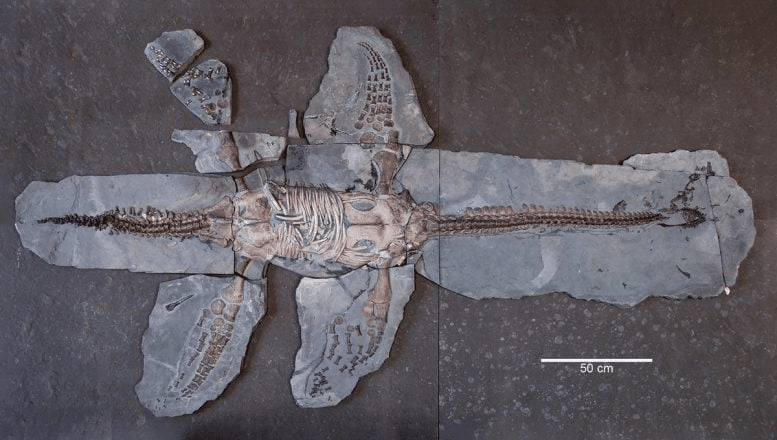
(A) Ventral view of the mandible and associated skull elements. (B) Mandible and skull elements are labeled. (C) Left lateral view of the mandible. Credit: PeerJ Life and Environment.
Early Signs of Regional Evolution
A key discovery from this fossil is evidence pointing to early regional specialization. Instead of existing as widespread species, plesiosaurs likely evolved into geographically distinct forms adapted to specific shallow marine environments across Europe.
This challenges previous notions suggesting geographic specialization occurred later, indicating that local factors were already shaping evolutionary paths in the Early Jurassic.
“It also suggests that distinct plesiosaur communities may have evolved in different regions of the European seas during the Early Jurassic.” Marx explained.
Revising the Marine Reptile Evolutionary Timeline
The MH 7 fossil revises the view of the Early Jurassic as a time of evolutionary dormancy, revealing instead a period with dynamic diversification. Nearly complete, it bridges the evolutionary gap between primitive Triassic marine reptiles and the highly specialized plesiosaurs that appeared later.
Researchers from Lund University, Uppsala University, Urwelt-Museum Hauff, and Naturkunde-Museum Bielefeld emphasize that this discovery enhances our knowledge of Plesiopterys wildi and sheds light on broader patterns of biogeographic differentiation and early specialization within marine reptiles.
Impact on Future Paleontological Studies
Looking forward, fossils like MH 7 promise to considerably deepen our understanding of Early Jurassic marine ecosystems. They demonstrate that plesiosaurs had already developed regional and ecological diversity much earlier than previously acknowledged.
- Categories:
- Science




0 comments
Sign in to Comment