
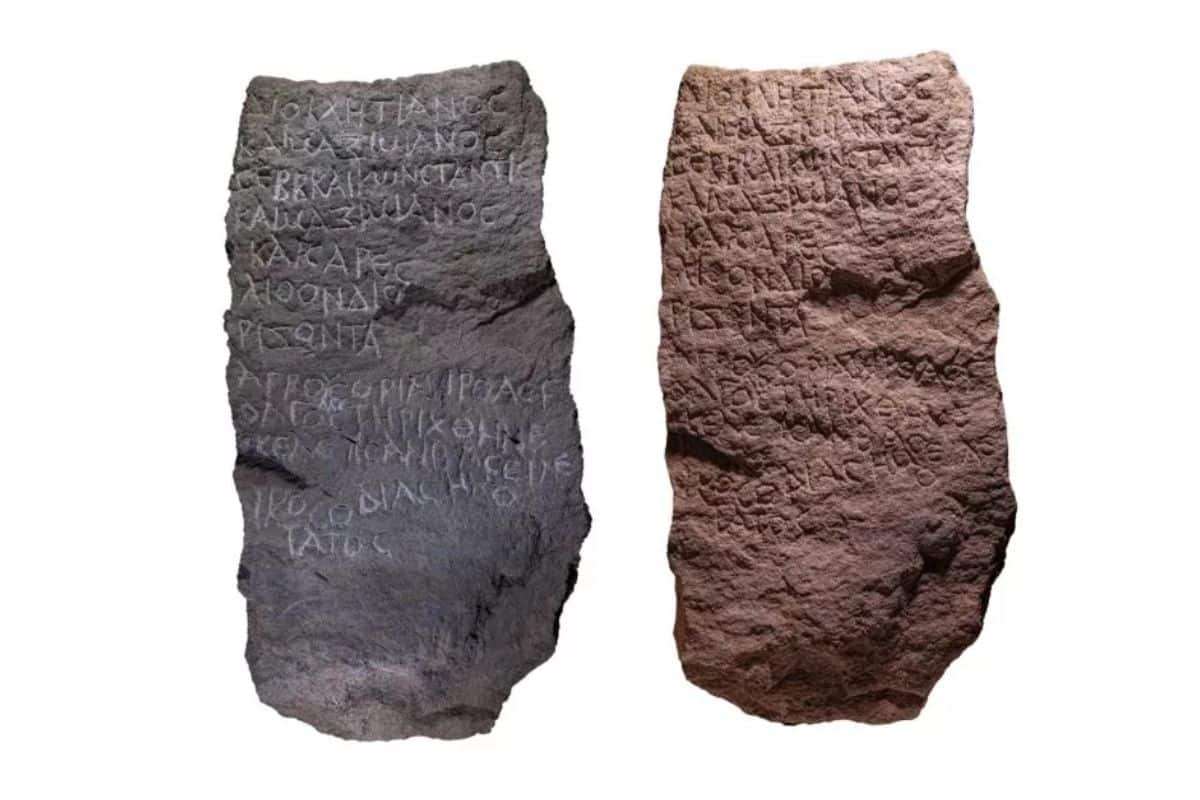
A team of archaeologists has recently revealed a unique Roman boundary stone at the historic location of Abel Beth Maacah in northern Israel. This Greek-inscribed artifact dates to the Tetrarchy era (A.D. 293-305) and was discovered beneath a basalt slab sealing an ancient tomb, offering new insight into vanished communities and the Roman Empire’s precise land governance.
Rediscovering an Ancient Roman Artifact
In 2022 excavations at Abel Beth Maacah—a biblical mound close to today’s Metula—archaeologists found what appeared to be a modest basalt burial cover. Flipping the slab revealed an extensive Greek inscription, which was soon identified as a Tetrarch-period boundary marker. This rare piece, used to delineate village boundaries during the late Roman Empire, had been concealed beneath layers of habitation for nearly 1,700 years.
The Message Carved in Stone
The inscribed Greek text refers to Emperor Diocletian’s reign and the implementation of the Tetrarchy, a governance system of four rulers aimed to improve imperial control. Intriguingly, the inscription cites two previously unknown villages, Tirthas and Golgol, absent from any other historical records.

It also records the name of an imperial land surveyor, or “censitor,” a bureaucratic official entrusted with mapping property and enforcing taxation, whose identity was previously unrecognized.
Insights Into Roman Provincial Administration
This boundary stone illuminates the extensive reach of Roman administration even in distant provinces. Under the Tetrarchy, emperors like Diocletian and Maximian sought to stabilize the empire by implementing detailed legal and fiscal frameworks.
The presence of this stone at Abel Beth Maacah indicates close Roman oversight in the area, demonstrating that northern Israel was more tightly integrated into imperial agriculture and governance than scholars had assumed.
The Historical Weight of Abel Beth Maacah
Abel Beth Maacah is historically and biblically prominent. Situated near ancient trade corridors, it is mentioned in the Old Testament as a refuge city and strategic stronghold. Its history includes occupations by Canaanites, Israelites, and Arameans, before it came under Assyrian and later Roman control.
This recent find reinforces the city's longstanding significance, confirming that Roman administrative influence persisted in this region well into the empire's later period.
How This Discovery Reshapes Historical Understanding
Small artifacts like this boundary stone drastically refine the historical narrative. Dr. Uzi Leibner of Hebrew University states the find “illuminates ancient property rights and taxation systems, while offering a direct link to the individuals involved in these complex bureaucracies nearly two thousand years ago.”
Archaeologist Dr. Avner Ecker emphasizes its importance: “The discovery of two previously unknown settlements and the name of a new imperial surveyor highlights how minor findings can significantly broaden our knowledge of the region’s socio-economic and geographical past.”
Future Directions in Excavation
Excavations at Abel Beth Maacah will continue with goals to unearth additional inscriptions shedding light on Roman-era villages in northern Israel. Using advanced techniques such as GIS mapping and imaging, researchers aim to locate the lost settlements of Tirthas and Golgol, potentially uncovering further remnants from this forgotten chapter of history.
This discovery demonstrates how the ancient world’s complexities remain to be fully revealed, even in its furthest reaches.
- Categories:
- Science








0 comments
Sign in to Comment