

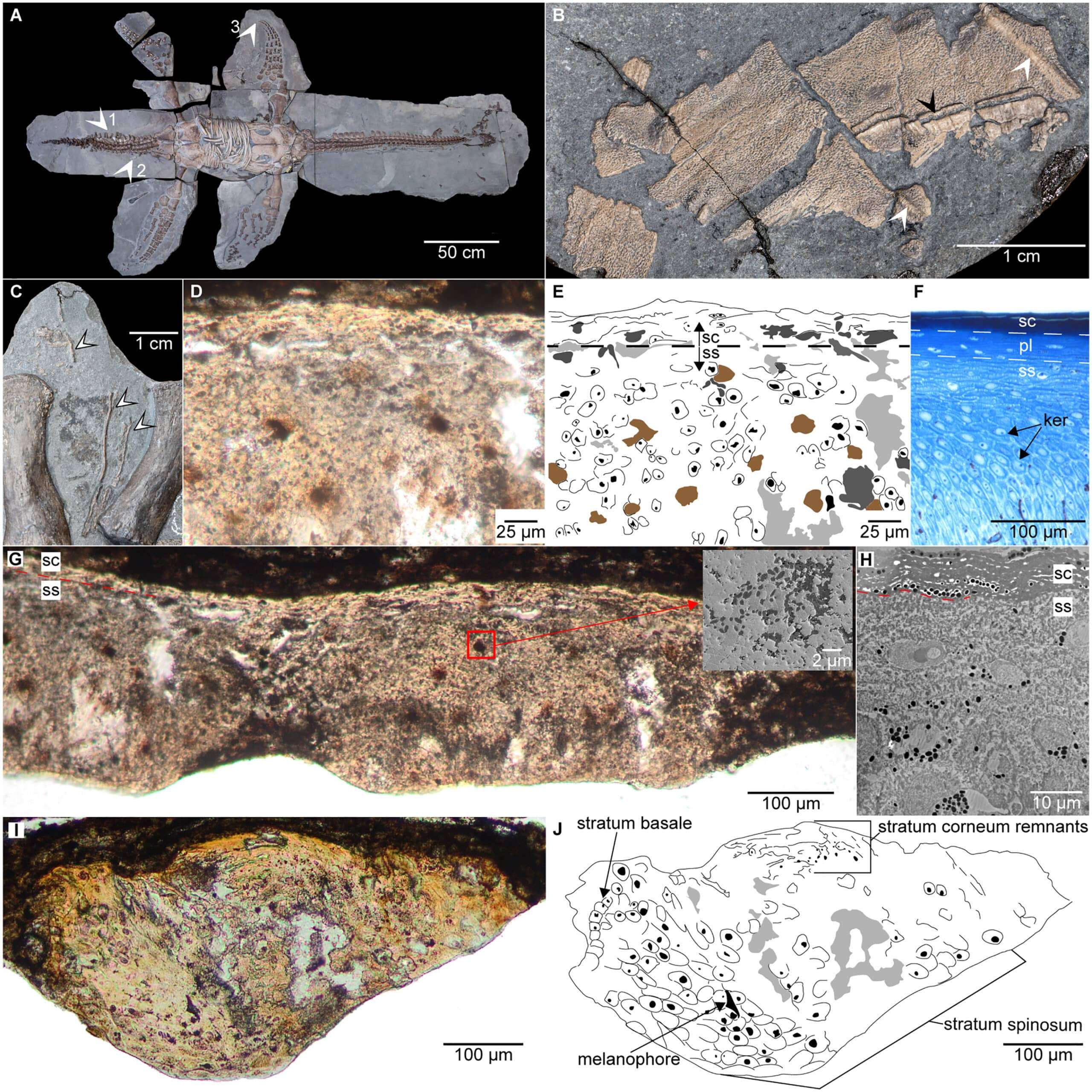
A remarkable plesiosaur fossil dating back 183 million years has been uncovered in Germany, offering scientists groundbreaking knowledge about the skin structure of this renowned Jurassic marine reptile. A team at Lund University in Sweden discovered fossilized soft tissues that reveal an unexpected blend of scaly and smooth skin, a feature previously unknown in plesiosaurs.
Exceptional Preservation of Soft Tissue
Fossils retaining soft tissue are incredibly uncommon, especially for marine reptiles. While bones often fossilize, skin and other soft parts typically decompose before preservation is possible.
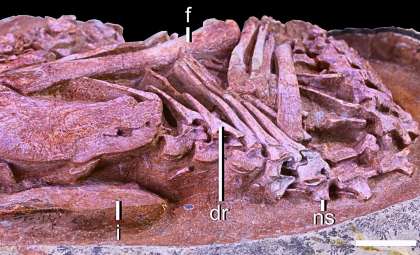
The recently found plesiosaur fossil, excavated near Holzmaden, Germany, maintained evidence of skin and flipper textures, allowing researchers to study characteristics never before observed in these ancient creatures.
“Seeing skin cells preserved for 183 million years was astonishing,” shared Miguel Marx, a geology Ph.D. student at Lund University and the study’s first author. “It closely resembled looking at contemporary skin.”

Revealing an Unexpected Pattern of Scales
For many years, scientists assumed plesiosaurs had uniformly smooth, scale-free skin similar to modern marine mammals like whales. However, this latest research uncovered a complex patchwork of smooth and scaly skin textures, indicating a more intricate skin composition than expected.
“Discovering this combination of scales and smooth skin is unprecedented in plesiosaurs,” said Johan Lindgren, associate professor at Lund University’s geology department. “This extraordinary fossil lets us better visualize how these creatures might have appeared while alive.”
Dominant Predators in Ancient Seas
Plesiosaurs ranked among the Jurassic period’s apex marine hunters. With their extended necks, robust flippers, and hydrodynamic bodies, some species reached lengths of up to 40 feet. They propelled themselves through water using four powerful paddle-like limbs, reminiscent of today’s sea turtles.
Despite over two centuries of study, details about their external anatomy remained scarce—until now. This finding transforms the understanding of their adaptations to marine life.
“The discovery of scales was surprising and changes our perceptions of how these animals would have adapted to their pelagic environment,” Marx said.
Implications for Evolutionary Biology
In addition to revealing new anatomical details, this fossil offers vital clues for evolutionary studies. The combination of smooth and scaly skin implies plesiosaurs evolved specialized surface structures to improve hunting agility and movement efficiency in diverse aquatic habitats.
“We applied multiple analytical methods to detect smooth skin on the tail and scales along the back edges of the flippers,” explained Marx. “This gave us unparalleled insights into the visual and biological traits of these ancient reptiles.”
Had the soft tissue not been preserved, scientists would have likely assumed plesiosaurs were completely scaleless, much like other marine reptiles from the same period.
- Categories:
- Science









0 comments
Sign in to Comment