
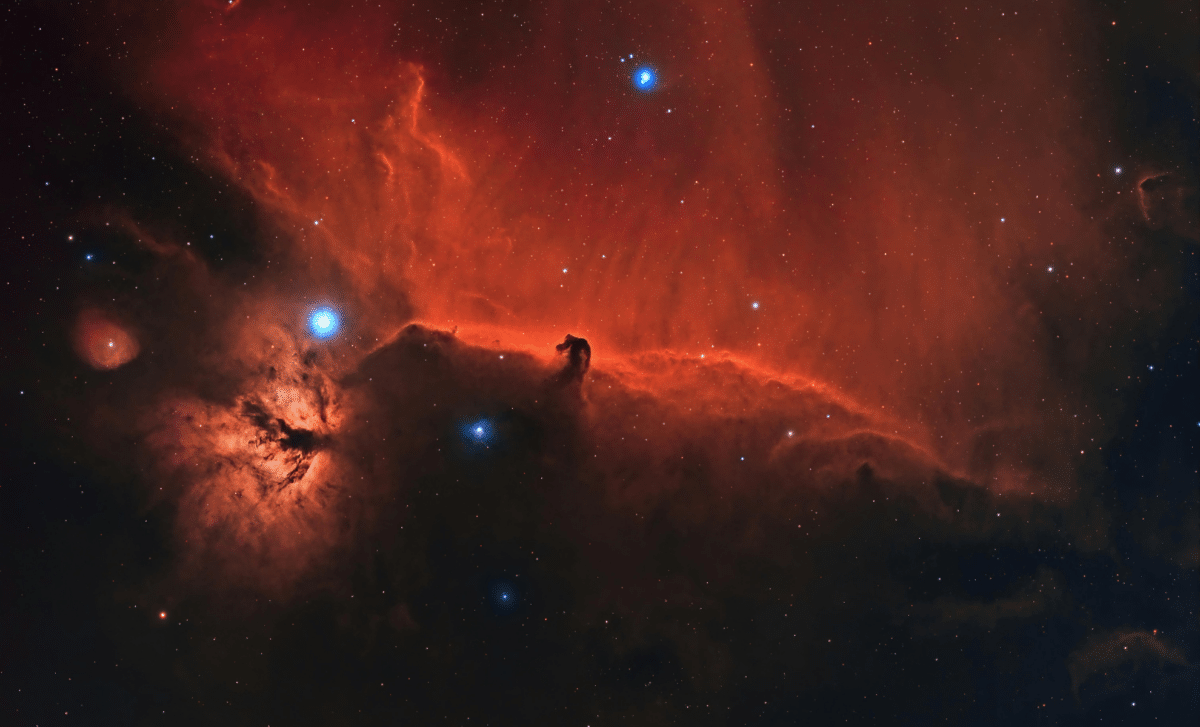
As winter advances throughout the Northern Hemisphere, the constellation Orion emerges prominently in the evening sky. On the night of January 26, 2025, skywatchers will be treated to a dazzling spectacle featuring stars glowing in vibrant shades of red, white, and blue. This striking display showcases some of the night sky’s most famous luminaries: Betelgeuse, Rigel, Bellatrix, and Saiph. Their unique colors not only captivate viewers but also reveal important details about stellar lifetimes.
Orion’s Palette: Stellar Colors Reveal Cosmic Stories
The Orion constellation is among the most easily recognized groupings in the heavens, highlighting differences in star temperatures through vivid hues. Positioned prominently in the southern sky once darkness falls, Orion features the famous trio known as Orion’s Belt, framed by a diamond-shaped configuration of four prominent stars. Each star shines with a particular color reflecting its surface temperature, allowing observers to discern these variations with the naked eye.
At the upper left corner, the aging red supergiant star Betelgeuse emits a warm orange-red light, indicating its cooler surface. In contrast, the youthful, hot star Rigel at the lower right radiates a brilliant blue-white glow. Nestled between these extremes are Bellatrix and Saiph, both shining with a clean white hue. This colorful arc acts as a natural gauge of stellar conditions, reminding us that the night sky is an ever-changing narrative of cosmic evolution.

The Moon Enhances the Celestial Display in Taurus
On this evening, Orion’s Belt directs the eye to a 58% illuminated waxing gibbous moon resting within the Taurus constellation. The moon’s gentle glow pairs beautifully with Orion’s vivid stars, adding depth to the visual canvas for anyone gazing upwards.
The brightness of the gibbous moon provides ample light to softly illuminate the surroundings while ensuring the stars remain visible. This balance is ideal for both casual sky observers and astrophotographers. Binoculars or smaller telescopes can reveal more of the moon’s surface details, enhancing the entire astronomical experience and illustrating the harmonious interaction between lunar and stellar spectacles.
What Star Colors Tell Us About Their Nature
The distinct coloration of Orion’s stars stems from variations in surface temperature and the stage of stellar development. Cooler stars like the red Betelgeuse are typically larger and nearing the end of their lifespans as supergiants. Conversely, the hot, blue stars such as Rigel are young and consume their energy rapidly. Stars with white hues, including Bellatrix, have intermediate temperatures and lifetimes. These color cues offer much more than visual interest; they serve as tools for astronomers to approximate a star’s mass, temperature, age, and distance. With its diverse stellar types, Orion acts as an open astronomical textbook, providing a perfect subject for learners, educators, and enthusiasts. As noted by Space.com, this observation moment is a rare chance to see different phases of stellar life all at once.
Tips for Spotting Orion: Why This Period is Ideal
To catch Orion at its peak visibility, look toward the southern horizon shortly after sundown. The constellation climbs high throughout the chilly winter evenings, offering exceptionally clear viewing conditions far from summer’s haze. Even in cities with light pollution, Orion remains visible, while darker areas reveal even more neighboring stars.
Follow Orion’s Belt upward to locate the moon and the Taurus constellation, or trace downward to find Sirius, the brightest star in the night sky. By late January and early February, Orion reaches its highest position around 9 to 10 p.m., allowing ample viewing time. These crisp nights are perfect for extended stargazing with minimal atmospheric interference, making this season an excellent opportunity to observe the wonders of the winter sky.
- Categories:
- News









0 comments
Sign in to Comment