
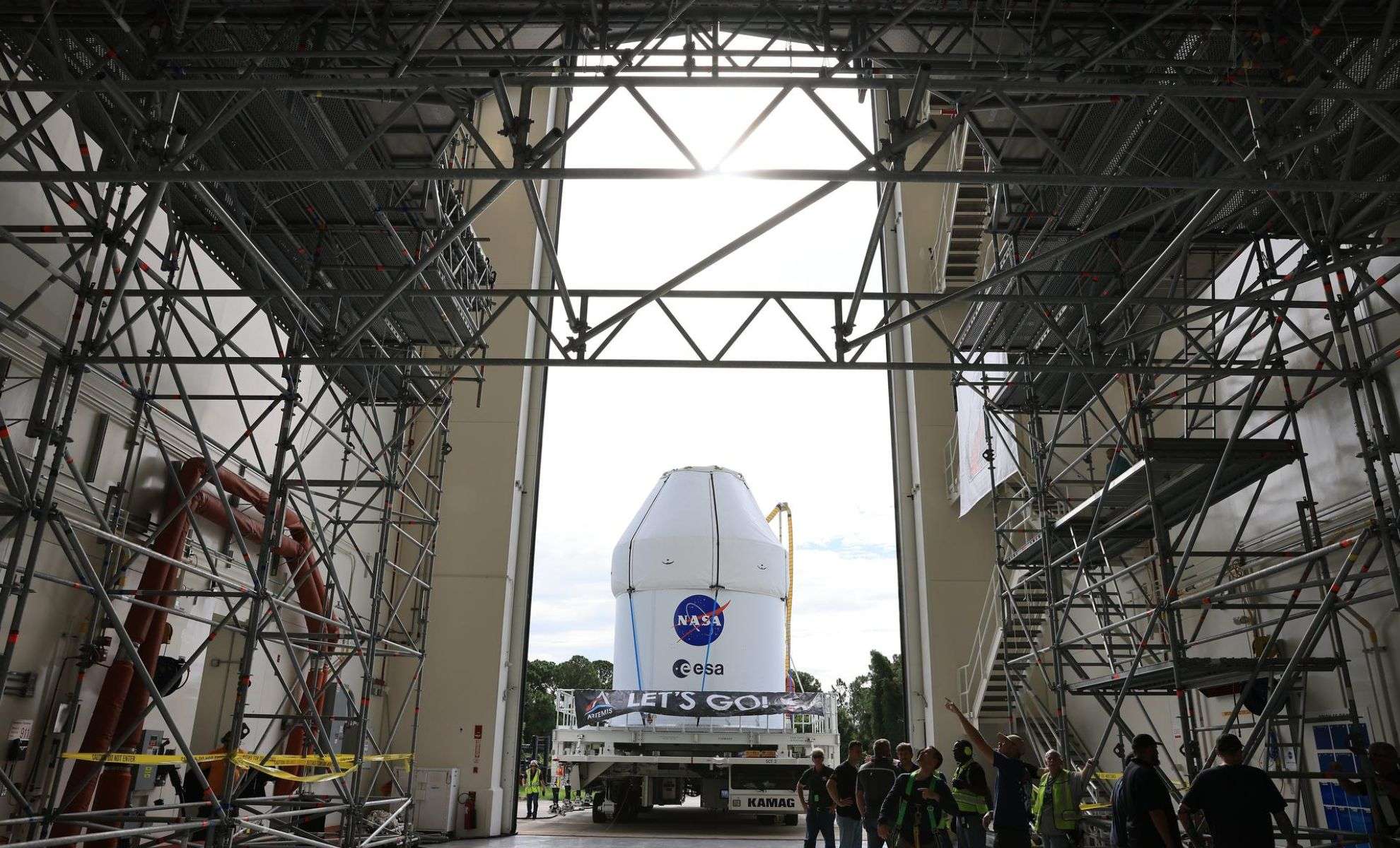
NASA’s Artemis 2 mission is making significant progress toward its goal of orbiting astronauts around the Moon. Recent updates from NASA reveal that the Orion spacecraft has completed its propellant loading and is moving forward through essential phases of readiness. The vehicle was recently transferred from the Multi-Payload Processing Facility (MPPF) to the Launch Abort System Facility (LASF) at Kennedy Space Center (KSC), where it will be outfitted with its critical emergency escape system. This achievement represents a major advance toward the first crewed Artemis mission, targeted for no sooner than February 2026.
The Artemis initiative is integral to NASA’s vision of establishing a sustained human foothold on the Moon, and Artemis 2 marks a crucial leap toward that goal. With the mission’s astronaut crew now deep in preparation for their lunar journey, the global community eagerly anticipates this new chapter in space exploration. As highlighted in previous updates from the original NASA blog and Space.com article, these developments underscore Artemis 2’s role both as a spacecraft evaluation and a milestone toward broader objectives including human missions to Mars.
Orion Spacecraft’s Recent Milestones: Steps Toward Artemis 2 Launch
The Orion spacecraft, engineered to safely transport astronauts through deep space, is undergoing critical prelaunch processing for Artemis 2. Having recently received essential propellants and high-pressure gases, Orion was transferred to the LASF at Kennedy Space Center to receive the Launch Abort System (LAS), a 44-foot (13.4-meter) mechanism designed to swiftly separate the crew module from the SLS rocket in case of emergency during liftoff.

The LAS is a vital safety feature, capable of rapidly pulling the crew capsule to safety if anomalies occur during the initial launch sequence. This system also incorporates thrusters to jettison components and maintain vehicle orientation under emergency conditions. Following successful LAS installation, the fully assembled Orion stack will be moved to the Vehicle Assembly Building (VAB) for final integration atop the Space Launch System (SLS) booster, in preparation for liftoff.
This organized sequence reflects years of meticulous engineering and rigorous testing in the Artemis program. Each successful step, from fueling to abort system assembly, brings the Orion spacecraft closer to its historic mission.
The Artemis 2 Crew: Astronauts Preparing for a Landmark Expedition
Artemis 2 will feature a four-person crew, marking NASA’s first personnel flight beyond lunar orbit since 1972’s Apollo 17 mission. The team consists of NASA astronauts Reid Wiseman, Victor Glover, Christina Koch, and Canadian Space Agency astronaut Jeremy Hansen. Their mission involves a 10-day flight circling the Moon before returning to Earth.
Intensive training has been central to their preparations, including simulations of spaceflight and practicing with the Orion Crew Survival System spacesuits intended for launch and re-entry. They have tested the connection to life support and communication systems inside Orion to confirm operational readiness. These rehearsals are essential since Artemis 2 represents the first crewed exploration beyond Earth’s orbit in decades.
As launch approaches, the astronauts continue refining their knowledge of Orion’s systems. Their experiences and feedback will be crucial to enhancing the safety and success of future Artemis missions.
Launch Outlook: Tentative Windows and Readiness Considerations
NASA’s current timeline schedules Artemis 2’s launch window between February and April 2026, though program officials remain cautious about achieving an early 2026 liftoff. Crew members, including Christina Koch and Victor Glover, express eagerness to proceed yet remain mindful of possible schedule adjustments. As Glover noted, the team's desire to expedite launch is balanced by the need to address potential delays.
The ambitious timeline requires coordinating many complex elements, such as integrating Orion with the SLS rocket, conducting further spacecraft systems validation, and ensuring proper installation of safety devices like the abort system. Given the intricacy of this orchestration, adjustments remain possible. Nonetheless, NASA prioritizes rigorous safety protocols and comprehensive testing before clearances for launch.
Preparing for Launch: Inside Artemis 2’s Final Preparations
Behind the scenes, extensive work is underway to ready the Orion spacecraft for Artemis 2. From thorough testing to fitting critical components, NASA engineers and astronauts collaborate closely to guarantee mission readiness. Propellant loading included the infusion of necessary gases and coolants to equip the spacecraft for the harsh conditions of spaceflight.
These procedures verify Orion’s capacity to endure extreme temperature fluctuations, radiation exposure, and other environmental hazards. After the Launch Abort System installation, the spacecraft will be transported to the Vehicle Assembly Building, where it will be mounted on the Space Launch System rocket. This integration finalizes the preparation for the mission’s primary goal: safely taking astronauts on a lunar orbit journey and bringing them back to Earth.
- Categories:
- News




0 comments
Sign in to Comment