
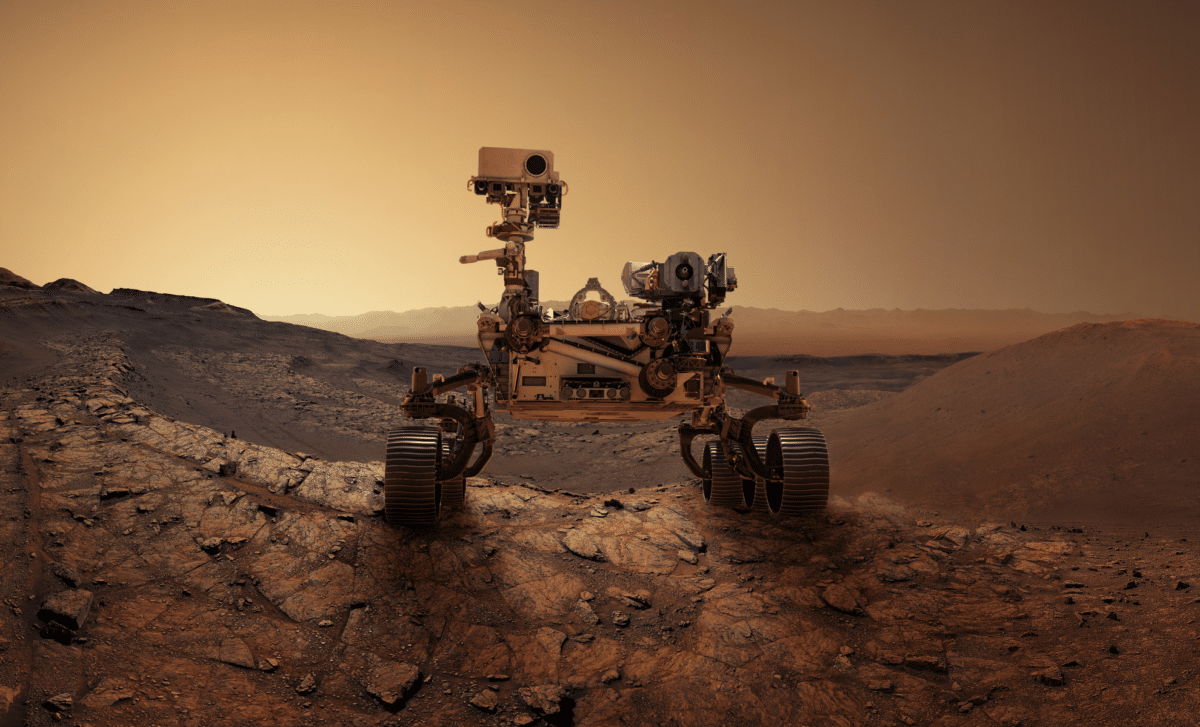
NASA’s Perseverance rover has arrived in one of the most geologically significant areas ever probed on Mars, capturing a captivating new selfie while investigating timeworn rocks beyond Jezero Crater’s edge. The latest photos and geological findings shared by NASA highlight a landscape believed to hold some of Mars’ oldest exposed rock formations, providing scientists a unique chance to explore the Red Planet’s deep crust and its earliest volcanic chapters.
Perseverance Explores Untamed Territory West of Jezero Crater
Departing from the flat expanses where it initially landed in 2021, Perseverance is currently maneuvering through a rugged region named Lac de Charmes, situated beyond the western boundary of Jezero Crater. The rover’s recently unveiled selfie, constructed from 61 individual photos taken on March 11 during Sol 1797, shows it dust-covered beside the freshly scraped Arethusa rock formation, with dramatic ancient landscape stretching to the horizon behind it.
This milestone marks the farthest west the rover has traveled since its arrival over five years ago. The mission team believes this region could preserve geological evidence from a Martian era preceding the formation of Jezero Crater, potentially dating back nearly four billion years to a time when Mars was geologically active and may have supported habitable conditions.

“We took this image when the rover was in the ‘Wild West’ beyond the Jezero Crater rim — the farthest west we have been since we landed at Jezero a little over five years ago,” said Katie Stack Morgan, Perseverance’s project scientist at NASA’s Jet Propulsion Laboratory in Southern California. “We had just abraded and analyzed the ‘Arethusa’ outcrop, and the rover was sitting in a spot that provided a great view of both the Jezero Rim and the local terrain outside of the crater.”
Creating this selfie took remarkable finesse, with the rover’s WATSON camera at the end of its robotic arm performing 62 precisely coordinated moves over about an hour. This composite not only reveals the Martian environment but also documents the rover’s active scientific efforts in fine detail.
Timeless Rocks Offer Glimpse into Mars’ Geological Origins
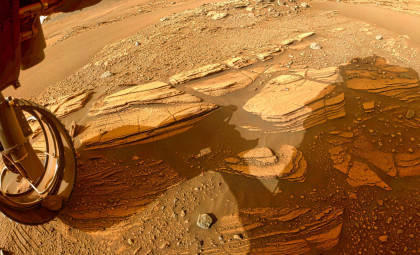
Alongside the selfie, Perseverance captured an extensive panoramic mosaic of the nearby Arbot site using its Mastcam-Z system. This 46-image montage showcases a windswept scene featuring fractured ridges, rounded stones, and exposed ancient rock layers. Researchers believe this area contains megabreccia — massive rock fragments propelled by a colossal meteorite impact in Isidis Planitia about 3.9 billion years ago.
The scene’s geological variety has excited scientists, as it contrasts sharply with previously surveyed sediment-rich delta deposits within Jezero Crater. Instead of sedimentary rocks formed by water, many here exhibit igneous traits, having solidified from molten magma underground or lava flows. These formations are critical to decoding the earliest phases of Mars’ development.
“What I see in this image is excellent exposure of likely the oldest rocks we are going to investigate during this mission,” said Ken Farley, Perseverance’s deputy project scientist at Caltech in Pasadena. “There is a sharp ridgeline visible in the mosaic whose jagged, angular texture contrasts starkly with the rounded boulders in the foreground. We also see a feature that may be a volcanic dike, a vertical intrusion of magma that hardened in place and was left standing as the softer surrounding material eroded away over billions of years.”
Scientists are particularly intrigued by the chance that these rocks formed deep within Mars’ crust and were later exposed by erosion and impact events over billions of years. Validating this could provide unparalleled insights into the Red Planet’s early interior evolution, including planetary cooling and the possible existence of an ancient magma ocean.
NASA Researchers See Critical Shift in Perseverance’s Mission Focus
NASA scientists emphasize that this new terrain marks a pivotal change in the rover’s scientific goals. While earlier efforts concentrated on clues of ancient water and sedimentary environments that may have hosted microbial life, the current exploration targets Mars’ deep geological framework and the forces that molded it before surface waters existed.
“The rover’s study of these really ancient rocks is a whole new ballgame,” said Stack Morgan. “These rocks — especially if they’re from deep in the crust — could give us insights applicable to the entire planet, like whether there was a magma ocean on Mars and what initial conditions eventually made it a habitable planet.”
Unraveling Mars’ formation and geological past could revolutionize our understanding of terrestrial planets, allowing comparisons with early Earth and other rocky bodies. Perseverance’s collected samples might one day return to Earth, where sophisticated labs could uncover mineralogical and chemical details beyond the reach of remote instruments.
The rover has secured 27 rock samples during its mission, with 25 stored for possible return missions. These precious samples could be part of one of the most complex extraterrestrial sample-return efforts ever undertaken.
Perseverance Approaches Marathon Milestone After Over Five Years on Mars
Despite harsh Martian conditions, Perseverance has surpassed engineering expectations throughout its five-year mission. It has nearly traversed 26 miles across Mars’ surface — just shy of a full marathon distance. Along the way, the rover has drilled, scraped, imaged, and chemically examined many rock targets while enduring dust accumulation, extreme temperatures, and rugged landscapes.
Looking ahead, mission planners aim to guide Perseverance from the Arbot area toward Gardevarri, known for olivine-rich volcanic rocks. Following that, the rover may continue southeast to Singing Canyon, where scientists hope to uncover further evidence about Mars’ primordial crust.
“Thanks to the lessons learned from four previous rovers, our team has always viewed this mission as a marathon, not a sprint,” said acting project manager Steve Lee at JPL. “Although the selfie shows the rover covered in dust, its true strength lies beneath. Perseverance remains in excellent shape as it moves onward, venturing into ultramarathon distances.”
With each new photo and rock sample collected, Perseverance continues to piece together Mars’ story — revealing how the planet evolved from an active volcanic world to the cold desert we see today.
- Categories:
- Nasa




0 comments
Sign in to Comment