
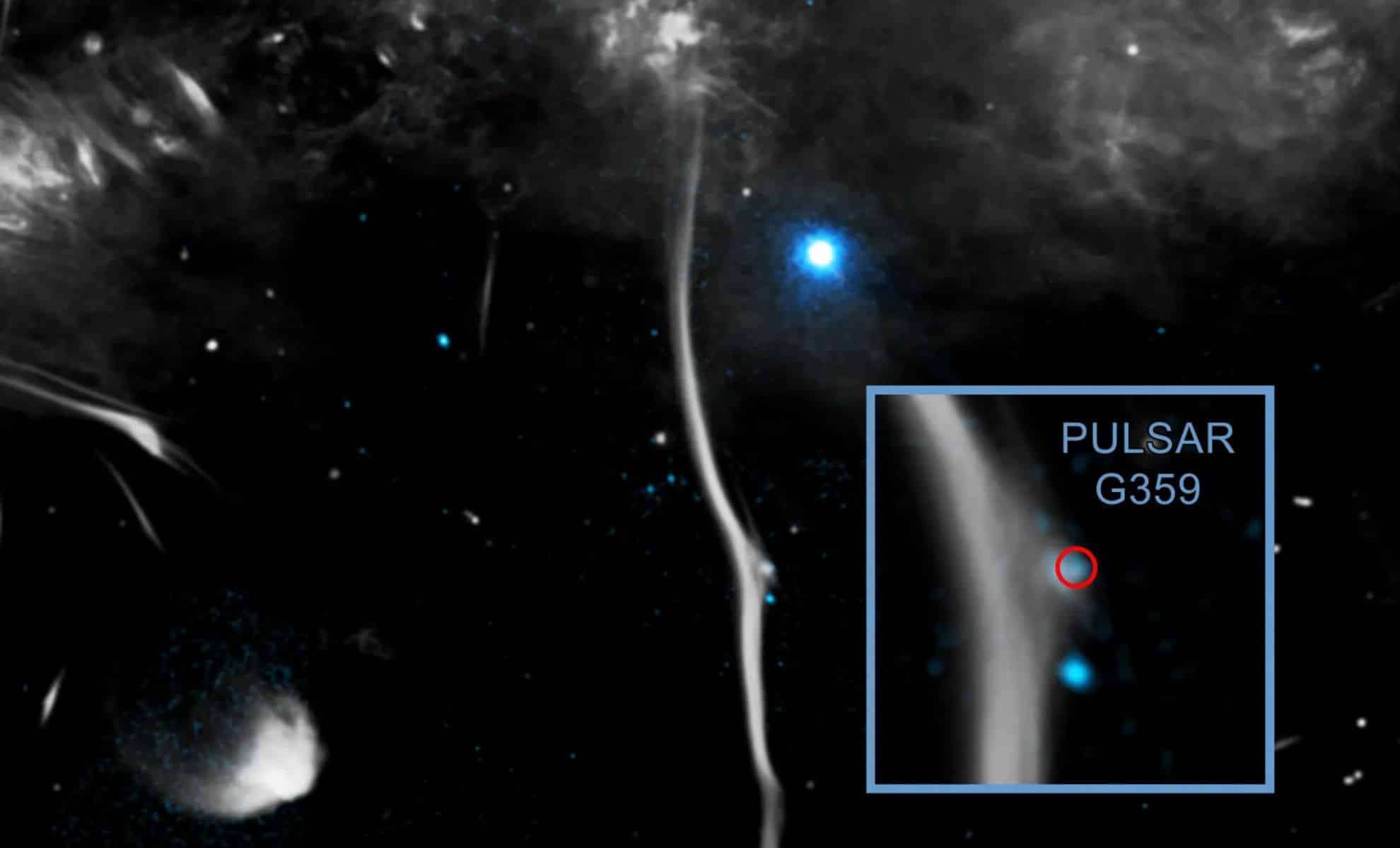
Traveling at nearly 2 million miles per hour, a pulsar has dramatically impacted one of the Milky Way’s largest enigmatic formations, known as the Snake filament.
Positioned near the center of our galaxy, this remarkable filament stretches an impressive 230 light-years and has recently been pierced by a high-velocity pulsar. The study, published in May 2024 by the Monthly Notices of the Royal Astronomical Society, sheds light on the powerful ways pulsars can interact with their cosmic environment.
Introducing the Galactic 'Snake' Filament
The Snake filament is an extraordinary magnetic structure, spanning an astonishing 230 light-years across the Milky Way’s central region. This vast thread consists of energized particles spiraling along magnetic lines, producing a distinctive glow. Its uniformity has puzzled scientists, particularly because of two strange breaks within it that had no clear explanation until now.

Thanks to observations via the Chandra X-ray Observatory and the MeerKAT radio telescope, researchers have identified the cause of one fracture.
Pulsar’s Role in the Galactic Collision
A rapidly spinning radio pulsar has been pinpointed as the culprit behind the crack. Pulsars are neutron stars born from supernova explosions, incredibly dense and rapidly rotating, emitting beams of radiation. This particular pulsar likely received a powerful "natal kick" from its parent supernova, propelling it across the galaxy at extraordinary velocity.
Its path intersected the Snake filament, causing a forceful impact that disrupted its magnetic field. This disturbance altered typical radio emissions and enhanced X-ray signals in the region, indicating accelerated electrons and positrons generated by the collision.
What This Means for Pulsar Dynamics and Galactic Structures
This discovery challenges the usual understanding that pulsars generally have minimal influence on large cosmic structures. Instead, it demonstrates how pulsars can induce significant changes far beyond their immediate areas.
The Snake’s magnetic field particle acceleration is a direct result of this high-speed pulsar collision, emphasizing how rapidly moving celestial bodies can create pronounced disruptions in space.
Scientists continue to study whether this pulsar might eventually exit the Milky Way. While its current velocity and trajectory make this conceivable, its position, roughly 26,000 light-years from Earth, means it remains well embedded within the galaxy for the time being.
- Categories:
- Science










0 comments
Sign in to Comment