
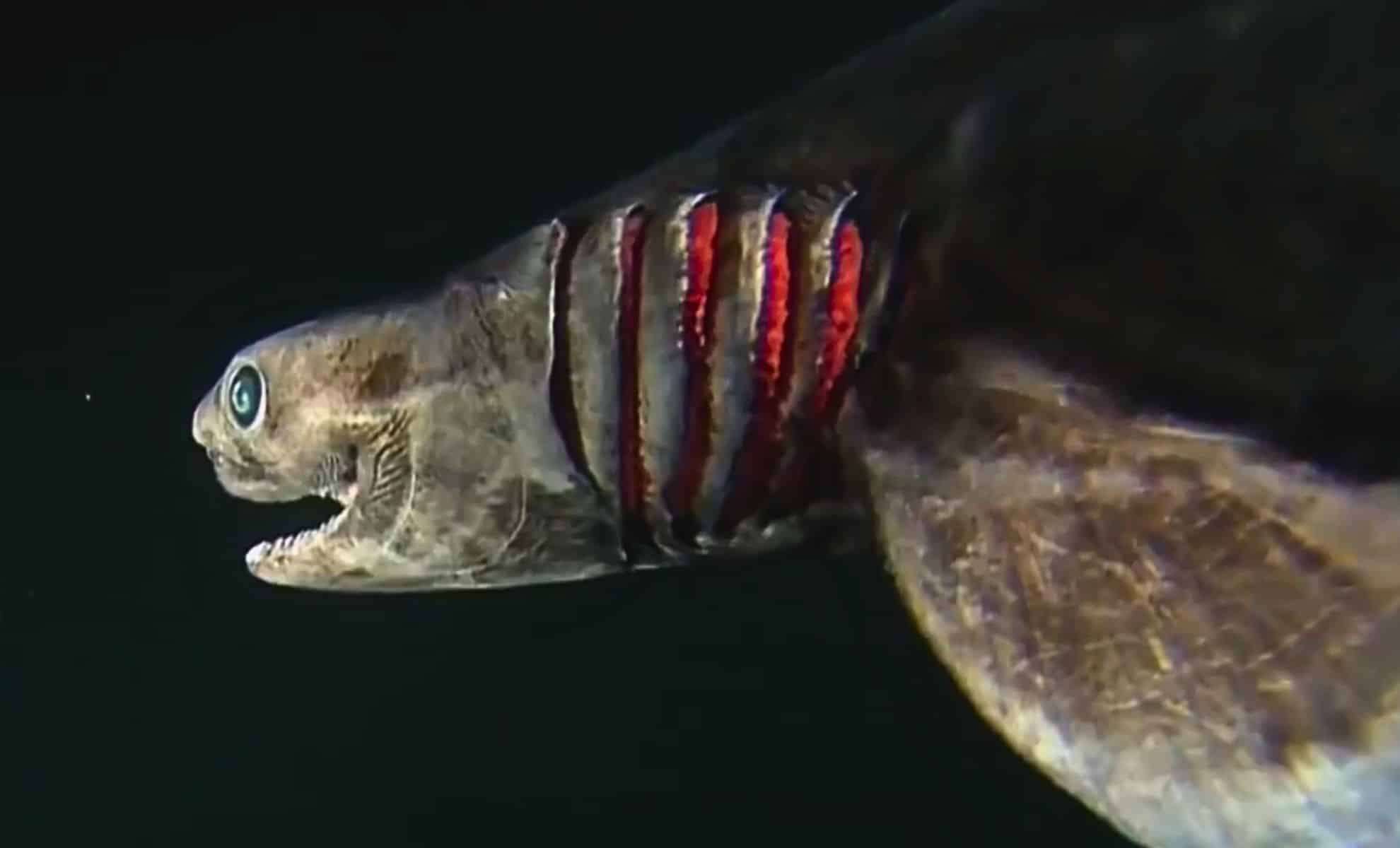
Off the coast of Portugal, researchers encountered a remarkable specimen during a routine commercial fishing haul—a frilled shark, a species virtually unchanged for some 80 million years. This elusive deep-sea hunter, known for its serpentine form, exceptionally flexible jaw, and nearly 300 needle-sharp teeth, provides a rare window into the mysterious creatures of the ocean's depths.
An ancient creature thriving in the deep ocean
The frilled shark was retrieved from waters nearly 700 meters deep during a European Union-supported initiative focused on reducing unintended bycatch. This 1.5-meter-long predator is often called a “living fossil” because its anatomy has scarcely changed since the era of the dinosaurs.
Characterized by its frilly gill arches encircling its throat, the shark’s sinuous, eel-like body aids its stealthy movement through the ocean’s twilight zones. Its diet consists mainly of fish and squid, captured by sharp rows of rear-pointing teeth that make escape nearly impossible.

A rarely witnessed denizen of the deep
Although found in many ocean regions around the world, the frilled shark is seldom seen alive because it dwells at depths ranging from 500 to 1,000 meters. There remain significant gaps in scientists’ understanding of its population dynamics, behavior, and survival outlook.
One notable live capture occurred in Australia in 2007, though the shark did not survive long once brought to the surface. It’s believed that most of these deep-sea sharks only surface due to injuries, sickness, or environmental disruptions, making sightings extraordinarily unusual.
Specialized features for life in the deep sea
Unlike many modern sharks that rely on swift, forceful attacks, the frilled shark seems to favor an ambush approach, striking prey unexpectedly in the ocean’s dark recesses. Its highly flexible jaw allows it to engulf large fish whole, and its slim, eel-like body lets it access narrow hiding places where prey might seek refuge.
An unusual reproductive trait is its lengthy gestation period, estimated at up to 3.5 years, which is among the longest known for any vertebrate. Females give birth to between 2 and 15 pups, but this slow reproductive rate could increase vulnerability to environmental threats.
Could expanding deep-sea fishing threaten survival?
The frilled shark is not yet listed as endangered by the International Union for Conservation of Nature (IUCN). However, growing deep-sea fishing operations raise concerns regarding unintended catches. Given their slow reproduction and habitat in largely unexplored ocean zones, scientists caution that the species’ resilience may be overestimated.
The recent encounter with this extraordinary shark highlights the urgent need for further exploration of the deep sea. As vast regions of the oceans remain uncharted, creatures like the frilled shark serve as reminders of Earth’s ancient marine life. Yet, with increasing human activity at great depths, the future of these primordial hunters is uncertain.
This article appeared on Nationalgeographic.
- Categories:
- Science







0 comments
Sign in to Comment