
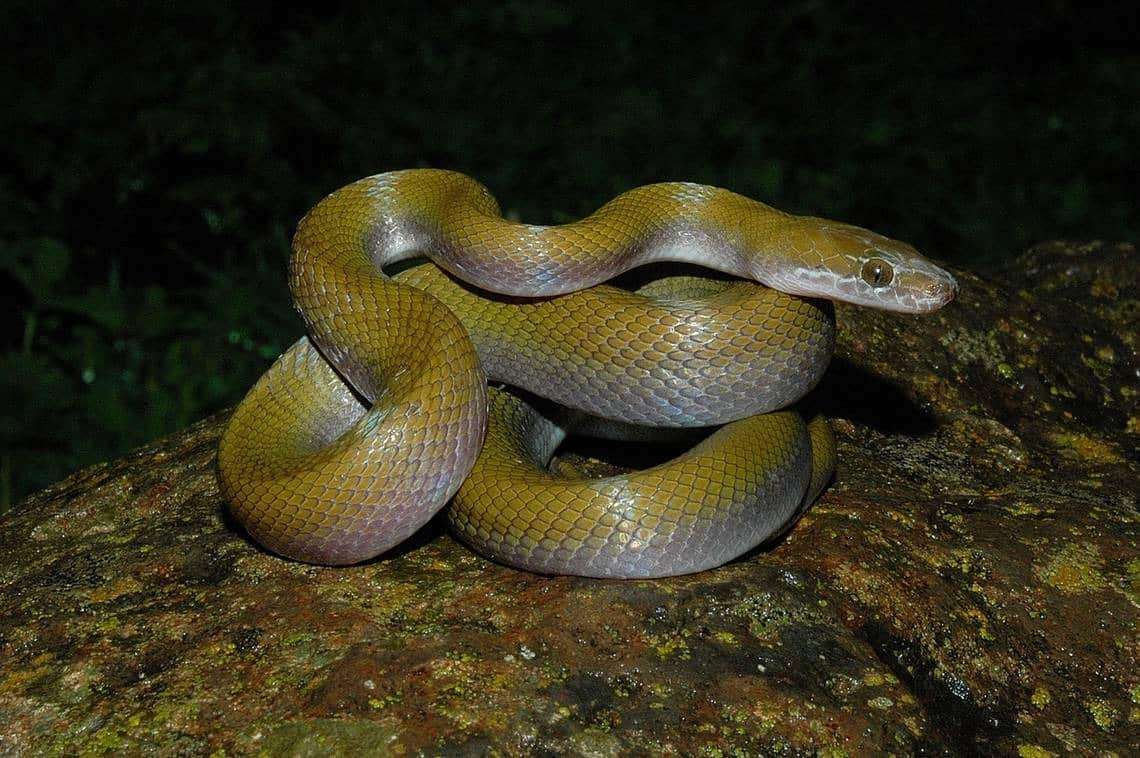
After nearly two decades held in captivity, an enigmatic olive-hued snake has been unveiled as a previously unknown species native to Ethiopia. Researchers Jakob Hallermann and Oliver Hawlitschek recently published their findings in Zootaxa, introducing the species named Boaedon broadleyi, commonly called Broadley’s African house snake, in tribute to the noted herpetologist Donald George Broadley.
Uncovering a Neglected Group of African Snakes
The investigation focused on a collection of African house snakes that have long been confused due to their similar appearances. Through intensive genetic analysis of museum specimens and freshly collected samples from multiple countries, researchers uncovered distinct DNA profiles, confirming the existence of a novel species within Ethiopian populations.
Distinctive Features and Environment
Broadley’s African house snake is notable for its olive-green scales, pale underbelly, and subtle white streaks positioned along the sides of its head. These snakes reach lengths surpassing 4 feet (1.22 m) and thrive in diverse landscapes, including forests, savannas, and agricultural zones near human settlements. They inhabit altitudes between 2,400 and 9,800 feet (approx. 2.99 km).

A photo of an individual highlights its natural camouflaging ability, blending with rocky terrain. Like other members of its genus, Boaedon broadleyi primarily preys on rodents but will opportunistically take other small animals available in its environment.
Discovery and Classification History
The snake now known as Broadley’s African house snake was initially collected in the late 1980s and held in captivity until 2006, after which it was donated to a museum in Germany. This rediscovery, coupled with modern classification techniques, underscores the crucial role museums play in safeguarding data about species yet to be formally recognized.
Named in honor of British herpetologist Donald George Broadley, whose extensive research significantly advanced knowledge of African reptiles, especially house snakes, this species stands as a testament to his lasting impact on herpetological science.
Significance for Regional Biodiversity
This finding enhances our appreciation of the diverse ecosystems in the region. Besides Boaedon broadleyi, scientists have recently described another new house snake species from nearby Somaliland, suggesting that East Africa harbors more undiscovered reptilian diversity.
Currently, Broadley’s African house snake is documented throughout Ethiopia, with potential range extensions into adjacent territories like Somaliland. The combined use of DNA sequencing and morphological studies illustrates the value of integrative methods in revealing Earth’s concealed biological richness.
- Categories:
- Science








0 comments
Sign in to Comment