

Could the secret to pinpointing when humans first started donning clothes lie not in ancient relics but in the study of lice? This intriguing possibility comes from research led by David Reed, associate curator at the Florida Museum of Natural History, who explored the evolutionary history of lice to estimate the dawn of clothing use in humans.
Tracing the Birth of Clothing: Insights from Lice
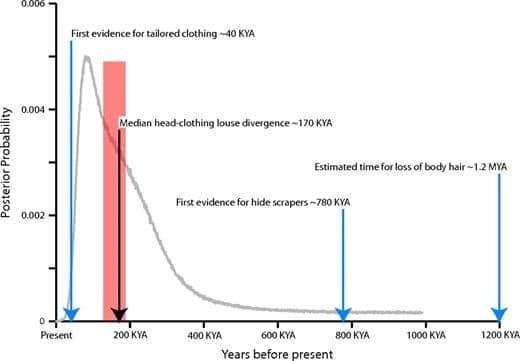
Early humans spent much of their existence without clothing, relying instead on their natural body hair and exposed skin for survival. However, evolutionary changes point to a critical moment when clothing emerged. Reed and his colleagues analyzed DNA from present-day lice genetics to date the origin of clothing roughly 170,000 years ago. According to Reed, this development marked a transformative stage in human evolution.
While conventional wisdom associates the advent of clothing with protection against harsh cold environments, Reed’s findings suggest the origins were more complex. He explained:

“We wanted to find another method for pinpointing when humans might have first started wearing clothing,” he said. “Because they are so well adapted to clothing, we know that body lice or clothing lice almost certainly didn’t exist until clothing came about in humans.”
Reed’s data indicates that clothing use predates human migration out of Africa, which began around 100,000 years ago. This suggests that clothing’s origins may have been influenced by social interactions, practical needs, or health advantages, rather than solely by climate challenges.
The Role of Clothing in Human Adaptation and Survival
Though early humans adapted successfully to African climates with thick body hair, the need for clothing became critical as populations began moving into cooler regions. Reed described this innovation as a major milestone in technological progress that allowed humans to endure novel environmental pressures:
“It’s just interesting to think that humans were able to survive in Africa for hundreds of thousands of years without clothing and without body hair,” Reed noted. “And that it wasn’t until they had clothing that modern humans were then moving out of Africa into other parts of the world.”
Therefore, clothing was not merely protection against cold; it was fundamental to human dispersal and adaptation.
Lice: Biological Timekeepers of Human Evolution
Though often seen as mere pests, lice have offered a novel evolutionary lens for Reed’s team. Because lice inhabit their hosts intimately, their genetic divergence sheds light on human behavior and evolution. Reed elaborates on this unique relationship:
“We use these lice as a marker, if you will, as a marker of their host’s evolutionary history,” he said.
Body lice, which live on clothing, emerged only after garments became commonplace, enabling researchers to calculate that clothing usage began near 170,000 years ago—much earlier than previously believed.
This revelation extends the timeline of clothing origins far beyond earlier estimates, indicating that early human attire was not just a response to Ice Age climates but a crucial evolutionary innovation.
What This Reveals About Our Ancestors' Lives
The timing for the advent of clothing coincides with the challenging environmental conditions of the Ice Ages, approximately 180,000 years ago, when human populations required adaptive technologies to thrive.
Ian Gilligan, a lecturer at The Australian National University, weighed in on the implications:
“The new result from this lice study is an unexpectedly early date for clothing, much older than the earliest solid archaeological evidence, but it makes sense,” noted Ian Gilligan.
This study suggests early humans were bundling up well before the Last Ice Age, about 120,000 years ago, using clothing to adjust to shifting climates.
Additional Innovations That Shaped Human Success
Beyond clothing, Reed points out that other breakthroughs like the controlled use of fire, novel hunting methods, and refined stone tool technology were equally vital in enabling early humans to flourish:
“The things that may have made us much more successful in that endeavor hundreds of thousands of years later were technologies like the controlled use of fire, the ability to use clothing, new hunting strategies, and new stone tools,” Reed pointed out.
Collectively, these innovations allowed humans to endure diverse and demanding environments.
Lice as Evolutionary Archives
Interestingly, lice act as living records of human evolutionary patterns. Reed’s research involved collecting lice from varied settings such as health clinics and homeless shelters, enhancing the understanding of lice-host dynamics and human evolutionary history.
“It gives the opportunity to study host-switching and invading new hosts, which has everything to do with diseases that do the same thing, like emerging infectious diseases that affect humans,” Reed explained.
Clothing’s Crucial Influence on Human Evolution
Ultimately, this research underscores that clothing was not simply a fashion choice or climate response but a transformative technological advancement vital for human survival. Without the innovation of clothing, humans might never have expanded across the globe.
As Reed and his team conclude:
“This was a pivotal moment in Earth history that allowed humans to migrate around the globe and adapt to new environments and extreme weather.”
This pioneering study shows how even the tiniest creatures like lice can provide critical clues about our past, highlighting that early clothing was far more than mere decoration—it was key to human endurance.
- Categories:
- Science ,
- Evolution ,
- Nature










0 comments
Sign in to Comment