
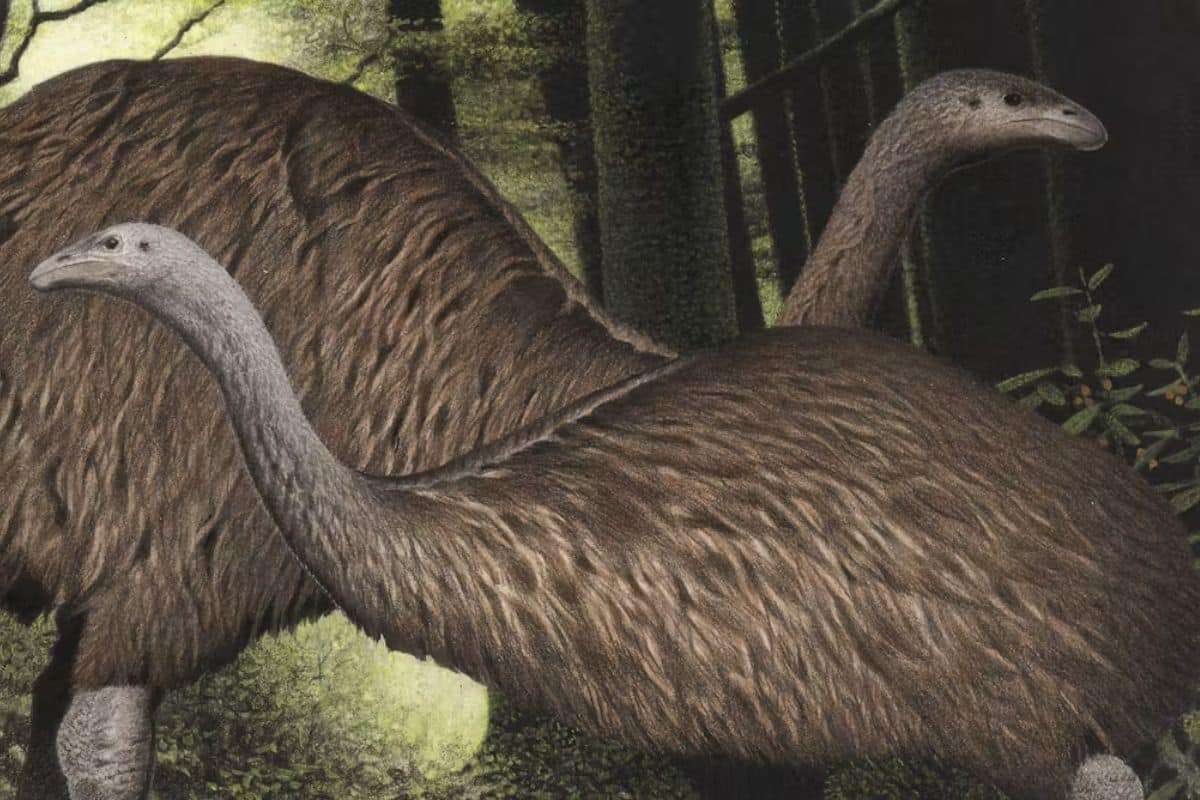
Recent findings confirm that New Zealand’s colossal, flightless moa vanished within just 300 years following human settlement. A paper published in Science of the Total Environment attributes this swift extinction to continuous hunting and the harvesting of moa eggs.
Researchers assert that preserving the moa would have demanded no-harvest zones encompassing over half of New Zealand’s landmass—an impractical solution for the Polynesian communities relying heavily on available resources.
When a Prehistoric Giant Confronted Humans
For millions of years, moa species prospered in New Zealand’s predator-free woodlands. Some individual birds grew taller than 12 feet, dominating their environment. These enormous birds developed without the need to fly—until humans arrived.
Circa 1300 AD, Polynesian explorers reached New Zealand, armed with advanced hunting techniques and hungry for food. The sizeable, slow-moving moa quickly became prime prey. Every part of the bird was utilized: meat provided nourishment, bones served as tools, and feathers were used for ornamental purposes. However, the moas’ vulnerability was sharply intensified by egg collection—their low egg production and fragile shells made population recovery nearly impossible.

Was There Any Chance to Save the Moa?
Dr. Sean Tomlinson, the study’s principal investigator, explains that moa extinction was nearly inevitable once humans started exerting pressure. His group analyzed fossil records along with computer simulations to explore survival possibilities.
Findings indicated that for moa populations to endure, vast regions of New Zealand—roughly more than half its land—would have had to remain strictly protected from hunting.
Such extensive restrictions were not feasible for the early Māori, whose livelihood depended on gathering wild food. Consequently, moa numbers plummeted swiftly under incessant hunting, disappearing within just several generations.
Lessons for Modern Conservation Efforts
Although moa restoration remains impossible, their extinction story delivers vital insights for saving present-day endangered creatures. Dr. Damien Fordham, co-author of the research, points out that other large, flightless birds like the kiwi and cassowary face comparable dangers today. Ongoing habitat loss, poaching, and climate shifts threaten these species’ survival.
The study indicates that existing protected areas might be too limited in size to effectively safeguard such sensitive birds. Achieving their endurance may require establishing extensive, uninhabited sanctuaries—feasible in modern times, unlike during the moa era.
The moa’s extinction serves as a powerful illustration of the devastating impact human presence can have on species diversity. Within a mere few hundred years, these remarkable birds vanished, leaving behind only fossils and cultural memories.
- Categories:
- Nature







0 comments
Sign in to Comment