
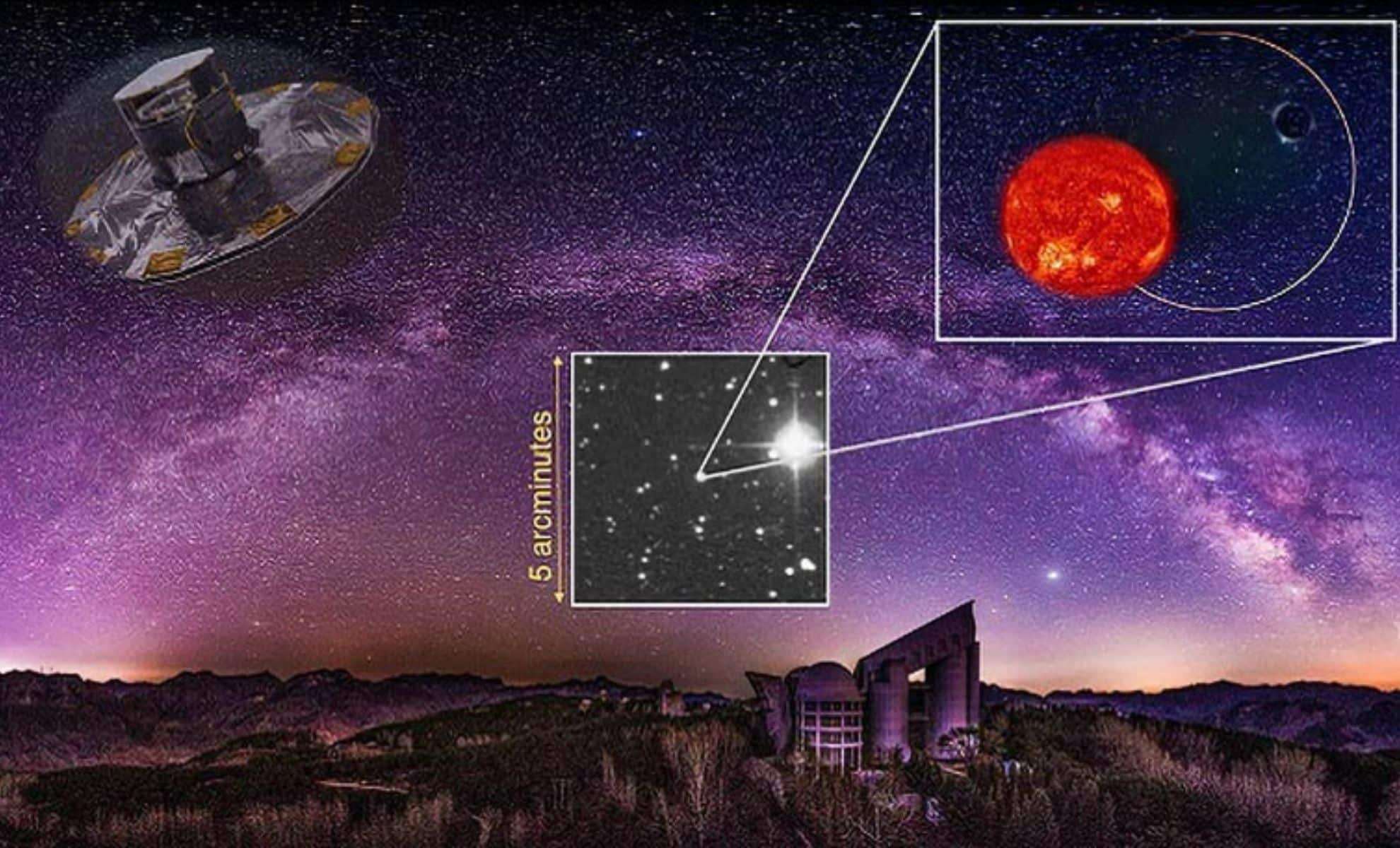
A team of Chinese astronomers has identified a low-mass black hole that defies established astrophysical theories. This compact object, belonging to a binary system named G3425, weighs in at roughly 3.6 times the mass of our Sun. It resides in the so-called mass-gap, a range where black holes were traditionally thought to be missing. Utilizing a combination of radial velocity techniques and astrometric observations, this finding sheds new light on black hole birth and binary star development.
Uncovering a Black Hole Within the Mass-Gap in the G3425 System
The black hole is part of the G3425 binary system, partnered with a visible companion star, a red giant about 2.7 solar masses. Notably, this black hole shows no signs of X-ray emissions, a standard way to detect these objects. This hints that the black hole is dormant, not currently drawing material from its stellar companion. Instead, astronomers relied on spectroscopic data from the Large Sky Area Multi-Object Fiber Spectroscopic Telescope (LAMOST) together with data from the Gaia satellite to detect the black hole through its gravitational impact on the red giant’s orbit.
The detection method represents a significant step forward in finding black holes that evade traditional X-ray detection. Leading author Dr. Song Wang from the Chinese Academy of Sciences highlighted its importance: “Previously, these black holes were suspected but remained undiscovered due to their lack of X-ray signals. Combining radial velocity and astrometry opens a new window to locate these elusive objects.”

This black hole’s estimated mass at 3.6 solar masses places it firmly within the mass-gap, verifying the presence of black holes in this previously unconfirmed mass range and challenging the idea that unknown processes inhibit their formation.
Anomalous Orbital Features of the G3425 Binary System
Beyond the black hole's mass, the orbital dynamics of the G3425 system further contradict current stellar evolution models. The black hole and red giant orbit one another in a nearly circular path lasting about 880 days. This relatively broad and circular orbit puzzles scientists, as standard theories on supernova events and binary evolution suggest such systems should exhibit highly elliptical orbits, especially post-supernova.
Typically, the supernova explosion that forms a black hole imparts considerable energy, disrupting the binary system and causing an eccentric orbit. However, the enduring, smooth orbit observed here hints at additional, poorly understood mechanisms influencing the system’s stability. As Dr. Wang remarked, “The wide, nearly circular orbit challenges existing theories about binary and supernova evolution, indicating gaps in our understanding of these processes.”
This finding prompts a reevaluation of assumptions about black hole and binary system dynamics, suggesting some models may need profound revisions, particularly in explaining how stable orbits persist after supernova explosions.
Broad Impacts on Future Astrophysics Investigations
Implications of this discovery stretch well beyond G3425. Identifying a mass-gap black hole offers fresh perspectives on black hole formation and stellar life cycles. The previous lack of black holes within the 3-5 solar mass bracket led researchers to suspect unknown mechanics preventing their emergence. Finding one now compels scientists to rethink how supernova mechanisms and stellar mass shedding influence black hole birth.
This breakthrough also underscores the potential of leveraging radial velocity combined with astrometry to reveal quiescent black holes—those that emit no significant radiation. With ongoing and future data from instruments like Gaia and LAMOST, astronomers anticipate discovering more hidden black holes in binary pairs, possibly uncovering new population trends and behaviors.
Furthermore, the unusual orbital setup of G3425 generates new puzzles regarding supernova physics and binary star evolution. How can such a system sustain a wide, circular orbit following a supernova? What forces contribute to this orbital stability? These questions will drive forthcoming research inspired by this remarkable finding.
- Categories:
- Astronomy ,
- News ,
- Science





0 comments
Sign in to Comment