
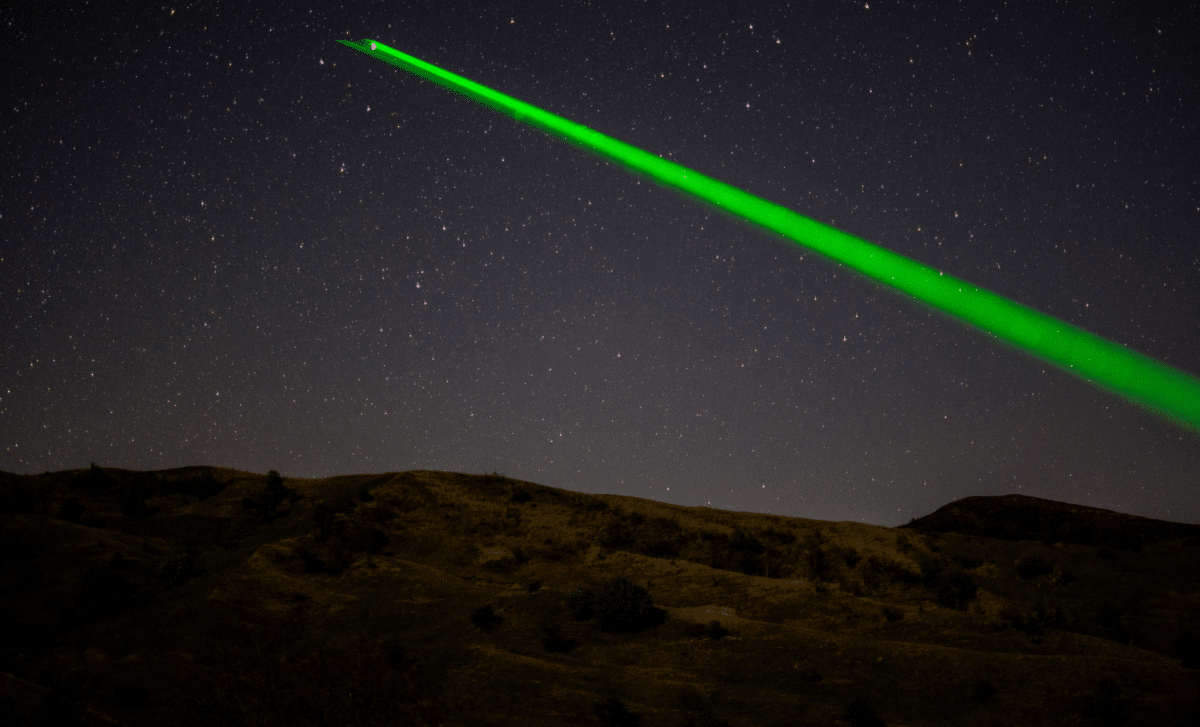
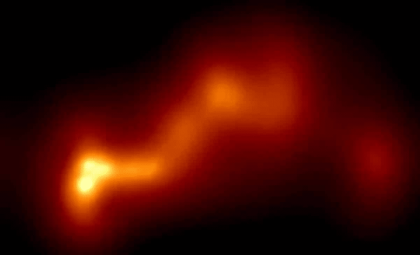
Scientists employing the MeerKAT radio telescope in South Africa have identified the farthest hydroxyl megamaser on record—a luminous cosmic "laser" originating from a galaxy over 8 billion light-years distant. This groundbreaking detection is documented in a study accepted for publication in Monthly Notices of the Royal Astronomical Society Letters, with a pre-print accessible on arXiv. The finding advances our understanding of the cosmos and underscores the critical role of cutting-edge computational methods in exploring space.
A Laser-Like Signal from the Distant Universe
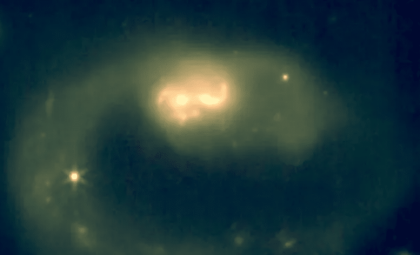
Hydroxyl megamasers are intense emitters of radio waves generated when hydroxyl molecules in dense, gas-rich environments—typically in colliding galaxies—are compressed and stimulated to produce amplified radio signals. The newly discovered megamaser, situated in a galaxy 8 billion light-years away, stands as the most remote ever observed, with such power that it qualifies as a "gigamaser," denoting the most luminous class of these space-based radio lasers.
“This system is truly extraordinary,” said Dr. Thato Manamela, the lead author of the study and a postdoctoral researcher at the University of Pretoria.
Add Cosmo Herald as a Preferred Source

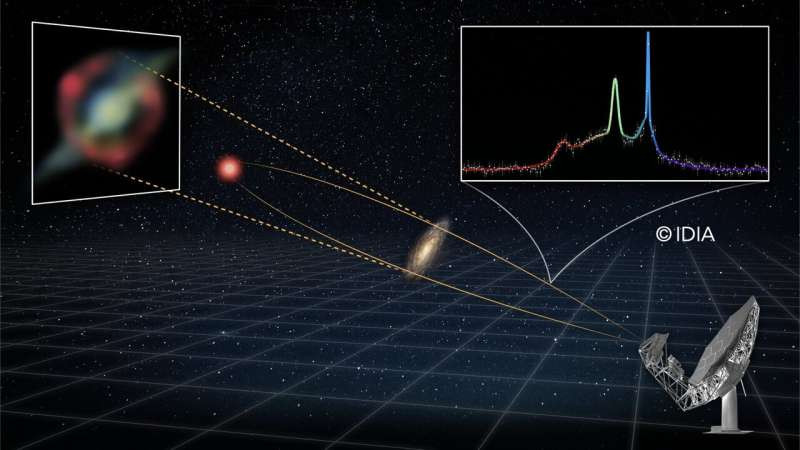
“We are seeing the radio equivalent of a laser halfway across the universe. Not only that, during its journey to Earth, the radio waves are further amplified by a perfectly aligned, yet unrelated foreground galaxy. This galaxy acts as a lens, the way a water droplet on a windowpane would, because its mass curves the local space-time. So we have a radio laser passing through a cosmic telescope before being detected by the powerful MeerKAT radio telescope, all together enabling a wonderfully serendipitous discovery.”
Gravitational lensing, a phenomenon initially predicted by Einstein where light is magnified by the gravity of a galaxy, is well-known in optical astronomy. However, this marks the first instance where such lensing has been crucial in intensifying a radio signal from such a remote distance, providing an extraordinary glimpse into cosmic events.
The Advanced Technology Powering MeerKAT
Situated in South Africa’s Karoo region, the MeerKAT radio telescope excels at detecting faint radio signals from the cosmos. Its design is optimized to capture centimeter-wavelength emissions vital for probing distant astronomical phenomena. Yet, gathering this data is only half the challenge. Processing the massive volumes of information requires intense computational resources and sophisticated software, supported by expert technical teams.
“This achievement highlights the immense capabilities of MeerKAT when combined with dedicated computational infrastructure, specialized data pipelines, and skilled software support teams,” explained Prof. Roger Deane, co-author of the paper and Director of the Inter-University Institute for Data Intensive Astronomy (IDIA). Holding professorships at both the Universities of Cape Town and Pretoria, Prof. Deane noted that these resources empower emerging South African researchers such as Dr. Manamela to make significant contributions on the global science stage.
MeerKAT’s state-of-the-art instrumentation has already revolutionized radio astronomy by enabling unprecedented studies of previously elusive cosmic sources. The prominent role of young scientists in these discoveries highlights South Africa’s growing impact in the forefront of astronomical research.
Looking Ahead to New Universal Insights
The identification of this hydroxyl gigamaser is just the start. Dr. Manamela expressed enthusiasm about uncovering many more such systems in upcoming surveys.
“This is just the beginning,” he said. “We don’t want to find just one system—we want to find hundreds to thousands. Here at the University of Pretoria, we are carrying out systematic surveys of the universe, building the required computational pipelines and algorithms to open this observational frontier ahead of, and ultimately with, the Square Kilometer Array.”
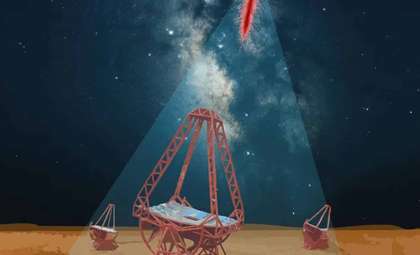
The Square Kilometer Array (SKA), a forthcoming radio telescope array, promises to transform our cosmic knowledge. As MeerKAT lays the groundwork, it will complement the SKA’s capabilities and further enhance investigations of distant galaxies and the universe’s hidden phenomena.
This discovery is detailed on arXiv and highlights remarkable progress in radio astronomy. With continued use of innovative surveys and data analysis, astronomers are poised to push space exploration and deepen understanding of the universe’s past and evolution.
- Categories:
- Astronomy




0 comments
Sign in to Comment