

Tibor Gánti’s contributions to understanding the beginnings of life on Earth have long been overshadowed. His innovative chemoton concept, introduced over half a century ago, offers a bold and comprehensive framework that could have transformed biology had it not been largely ignored.
An Unsung Innovator from Behind the Iron Curtain
Few beyond Hungary recognized Tibor Gánti when he died in 2009 at age 75. Nevertheless, his pioneering chemoton model, created during the Soviet-era 1970s, stands as one of the most thorough explanations for how life emerged on our planet.
Living in the isolation of the Eastern Bloc, Gánti’s research was inaccessible for decades. His key publication, Az Élet Princípiuma (The Principles of Life), was originally released only in Hungarian and wasn’t translated until many years later. Meanwhile, competing theories, especially the RNA World Hypothesis, gained prominence in the scientific community.

Today, there is renewed interest in Gánti’s groundbreaking ideas, which remain strikingly relevant.
The Chemoton Model: Defining Life Through Systems
Central to the origin-of-life debate is a crucial question:
What exactly constitutes life?
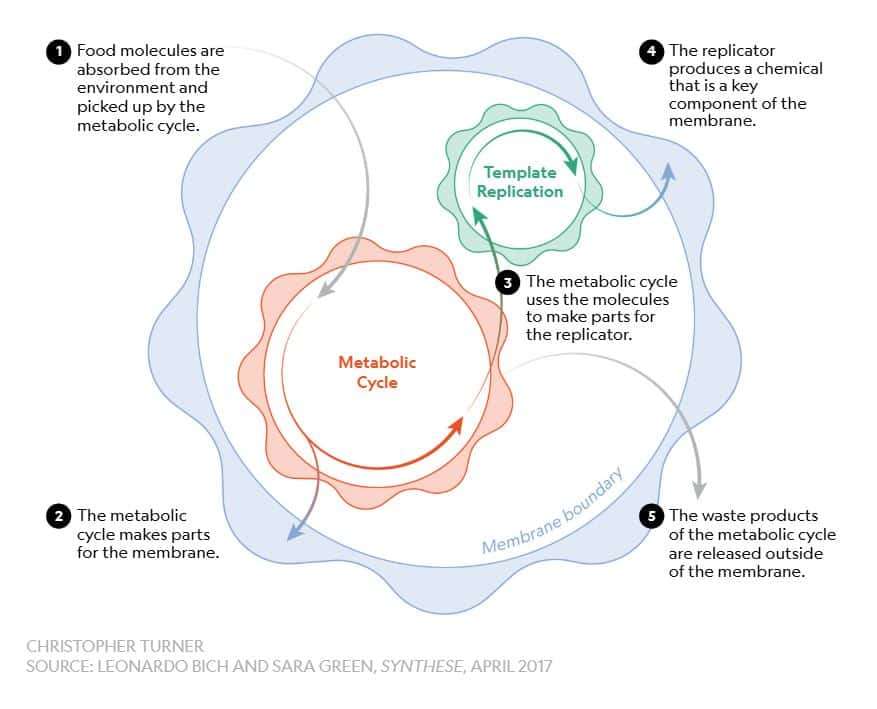
According to Tibor Gánti, any living entity needs three fundamental features:
- Metabolic processes capable of producing energy and sustaining the structure.
- A system for storing and passing on information to subsequent generations.
- A membrane that encapsulates and protects the organism from its surroundings.
Gánti argued that life should be understood not just as molecules like DNA or proteins, but as an organized system in which these parts interact. He named this minimal living system the chemoton.
Beyond Earth, his framework is influential for astrobiologists seeking life in the cosmos, offering a universal life definition based on system organization rather than specific biochemical compounds such as DNA or RNA.
The Causes Behind Gánti’s Initial Obscurity
Despite its clarity and depth, the chemoton concept remained underappreciated for many years. What held it back?
Primarily, the scientific spotlight of the 1970s was fixed on genetics. The unveiling of DNA’s structure meant that researchers focused intensely on self-replicating molecules. Gánti’s holistic perspective emphasized the entire system rather than isolated molecules, a notion that diverged from mainstream research directions.
Additionally, Gánti’s personal reputation for being difficult and resolute on his ideas alienated some colleagues. As evolutionary biologist Eörs Szathmáry recalls, Gánti was considered “impossible to collaborate with.” This inflexibility likely contributed to the slow spread of his theory.
Lastly, geopolitical factors played a role. Operating within communist Hungary, Gánti’s work was confined by limited international exposure. During this period, Western scientists were largely unaware of his developments due to restricted scientific exchanges.
The Chemoton’s Revival in Contemporary Science
Now, after decades out of the spotlight, the chemoton model is attracting renewed attention as a vital insight into how life could have arisen.
Laboratory research has produced protocells resembling chemotons, with scientists like Jack Szostak from Harvard Medical School and Taro Toyota of the University of Tokyo successfully engineering simple cell-like assemblies capable of spontaneous growth and division—a major stride towards creating artificial living systems.
Moreover, a 2023 study led by Sara Szymkuć at the Polish Academy of Sciences demonstrated that just six fundamental chemicals can synthesize thousands of critical biomolecules, including essential protein and RNA precursors.
This finding challenges the idea that life needed a rare molecular cocktail to start, supporting instead Gánti’s vision of a more integrated biochemical origin.
Reevaluating the Essence of Life
The legacy of Tibor Gánti highlights how transformative scientific concepts often require time to gain traction. Presently, his theories are inspiring new lines of inquiry within synthetic biology and astrobiology.
If his perspective holds true, life is more than just self-replicating molecules; it is a complex and coordinated system where multiple parts operate together. This insight promises to reshape biological research, influencing experimental approaches to life’s beginnings and guiding the search for life forms beyond our planet.
As James Griesemer, a science philosopher at UC Davis, puts it:
“Life is not proteins, RNA, or lipid bilayers. But then what is it? Life is all of these things connected in the right kind of organization.”
Though Tibor Gánti’s work remained hidden for decades, it now stands poised to revolutionize our understanding and pursuit of life itself.
This piece has been adapted from these original materials. Please note some content has been modified for length and clarity. For more information, kindly consult the source.
- Categories:
- Science











0 comments
Sign in to Comment