
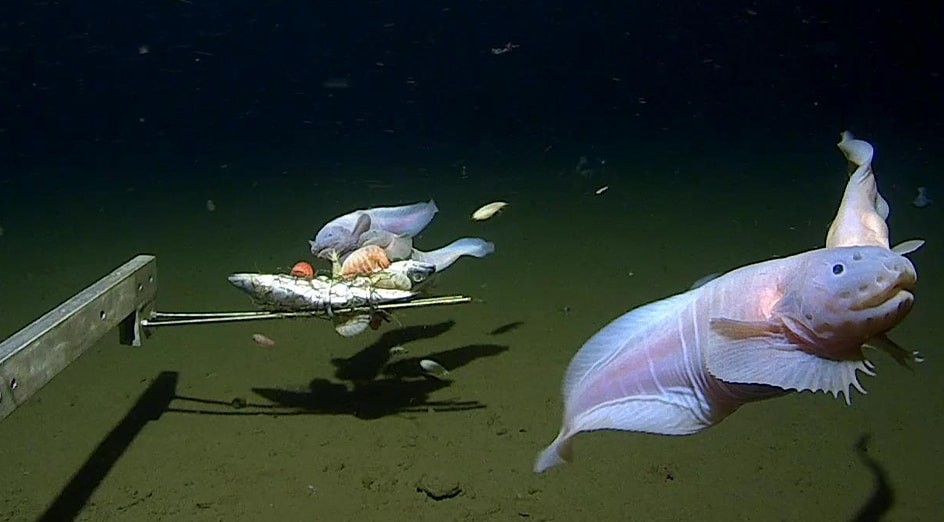
A recent expedition captured footage of a fish species living at an astonishing depth of 8,336 meters (27,350 feet) in the Pacific Ocean. This type of snailfish was found in the Izu-Ogasawara Trench, setting a new world record for the deepest observation of a fish. This remarkable discovery enhances our understanding of how organisms endure the extreme conditions of the ocean’s deepest realms.
The specimen, identified as belonging to the Pseudoliparis genus, was recorded during a 2023 mission led by Professor Alan Jamieson from the Minderoo-UWA Deep Sea Research Centre. The breakthrough surpassed the earlier maximum depth record of 8,178 meters, previously established in the Mariana Trench.
Exploring the Depths of the Izu-Ogasawara Trench
The Izu-Ogasawara Trench ranks among the planet’s deepest and least studied underwater locations. It descends to approximately 11,000 meters (36,000 feet). While the Mariana Trench has been the primary focus of deep-sea research, recent findings suggest the Izu-Ogasawara may conceal even more intriguing mysteries.

Unlike the frigid temperature of the Mariana Trench, the Izu-Ogasawara Trench maintains relatively warmer waters, which could be a key factor enabling life to persist at such crushing depths. As Alan Jamieson explained:
“Everyone thinks that depth is the most important thing in these trenches. Although depth, and the immense pressure it brings, does indeed shape life in these environments, it’s not the only factor. Temperature can also be important.”
Scientists at the University of Western Australia have long theorized the role of thermal conditions in supporting deep-sea ecosystems, and this finding corroborates that theory. Additionally, the trench benefits from greater biological productivity.
The mineral-rich waters surrounding the trench transport nutrients downwards, enriching the deep ecosystems and sustaining vibrant food chains under extreme conditions. This nutrient influx makes the Izu-Ogasawara Trench a more favorable habitat for marine life.
The Resilient Snailfish of the Abyss
The fish observed at 8,336 meters is a species within the Pseudoliparis genus— a group of snailfish commonly found in considerably shallower marine zones. Despite their modest size, between 20 and 25 centimeters (approximately 8 to 10 inches), these fish were seen feeding on tiny crustaceans that inhabit the deep ocean. These crustaceans subsist by scavenging organic debris that sinks from the ocean surface, a descending process that may take several weeks or even months to reach the depths such as the Mariana Trench.
This gradual descent of organic matter creates a critical energy source for the inhabitants of these profound depths.
“When you picture what the deepest fish in the world should look like, the chances are it’s gnarly, black, with big teeth and small eyes,” Jamieson told The Guardian. “Chances are it’s got nothing to do with deep sea – that has to do with being dark.”
These new findings indicate that the Izu-Ogasawara Trench may harbor more unknown species that challenge our perceptions of life’s limits. The trench’s warm, nutrient-abundant environment could support diverse organisms living at previously unimagined depths.
“There’s no doubt that the Japanese trenches are incredible places to explore; they are so rich in life, even all the way at the bottom,” he said in a statement, emphasizing the biological diversity found in these extreme environments.
- Categories:
- News




0 comments
Sign in to Comment