
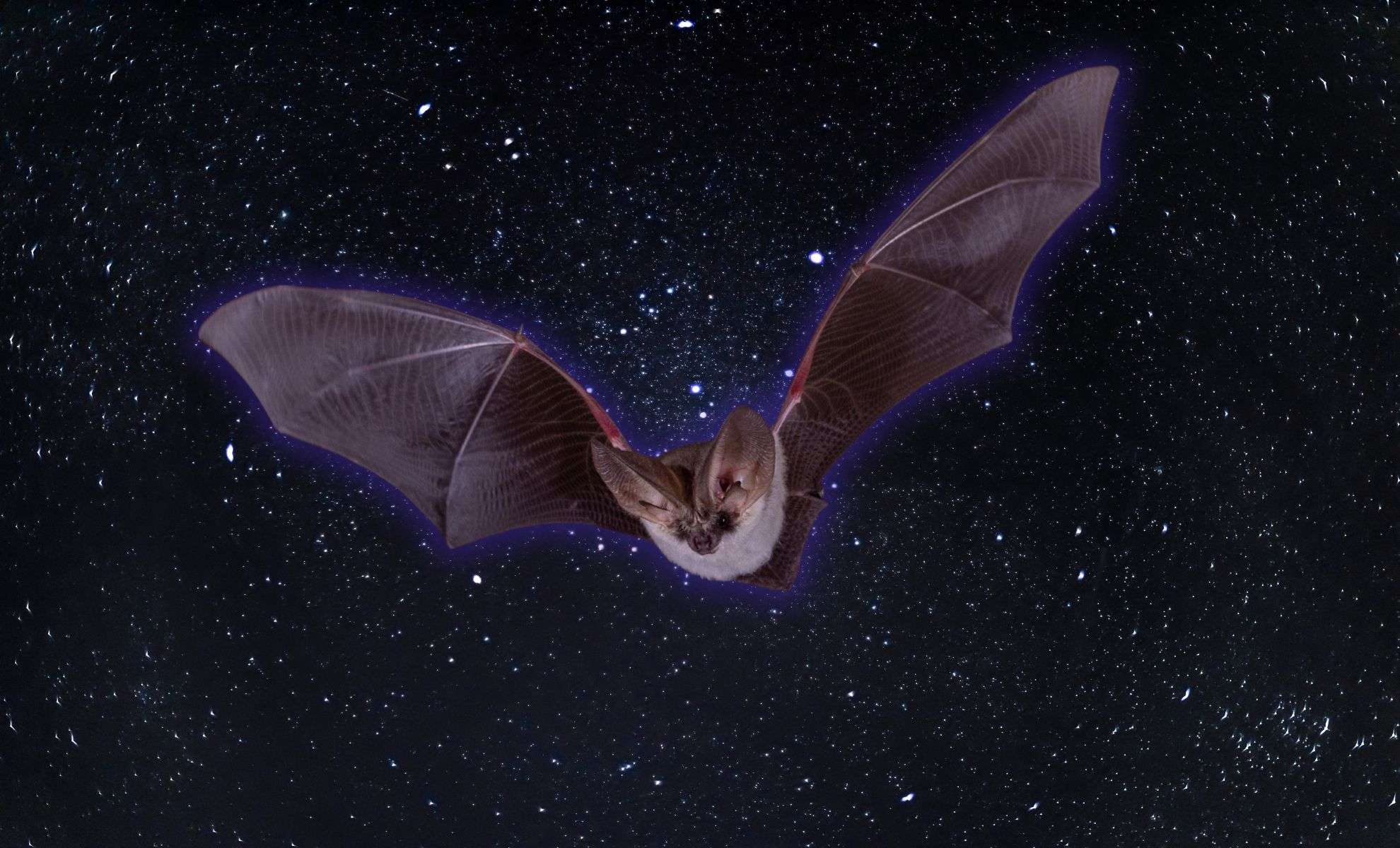
Scientists have recently uncovered that several North American bat species emit a striking greenish light when illuminated by ultraviolet rays, yet the reason behind this phenomenon remains elusive. This luminescence appears consistently in specific body parts across genders and ages alike.
Conducted by experts at the University of Georgia, this groundbreaking discovery calls into question prior beliefs concerning bat physiology and evolutionary history. The observed photoluminescent effect doesn’t display any apparent role in current bat behavior, but its steady presence implies it might have had significance in the past.
Unexpected Green Luminescence Captivates Scientists
Bats, known for their elusive nature and nocturnal habits, are notoriously difficult to observe, yet continue to surprise researchers with unique biological traits. The recent findings, featured in Ecology & Evolution, introduce a previously unreported widespread glow whose purpose remains unexplained.

Analyzing 60 preserved specimens, the team detected uniform photoluminescence across six different species, ranging from the big brown bat to the Brazilian free-tailed bat. This contributes to increasing documentation of natural fluorescence phenomena among mammals.

Consistent Glowing Patterns Across Species
Individuals from species such as Eptesicus fuscus, Lasiurus borealis, and Myotis grisescens all exhibited a distinct green UV-induced glow localized on their wings, hind legs, and the membrane connecting their legs.
The research team was particularly surprised by the remarkable uniformity of the glow, which appeared identical regardless of the bat’s gender, age, or species. According to ScienceAlert, this uniformity discounts common explanations like sexual display or species differentiation, which typically show variation.
“There was no variation at all,” said wildlife biologist Steven Castleberry from the University of Georgia. “That tells us it’s probably not being used to distinguish between species or for mating.”

Adding More Mammals to the List of Glowing Species
Fluorescence in mammals is not entirely new, with earlier research documenting this trait in flying squirrels, platypuses, and opossums. However, the bats’ consistent glow across species is an unusual phenomenon.
Experts believe this shared trait likely originates from a common ancestor, pointing to an ancient evolutionary link, although its original purpose remains unknown.
The study also notes that the wavelengths of this green light fall within the visual capabilities of bats, suggesting the possibility they might perceive each other's glow. Nevertheless, natural UV light is scarce in their environments, such as dark caves and nighttime skies, leaving uncertain how often the glow would be naturally visible.
What Lies Ahead in Bat Glow Research?
The glowing areas, predominantly on the bats’ wings and limbs, are highly visible during flight, but research has so far focused only on preserved specimens. There is no current evidence regarding whether live bats display the same glow or if it influences behaviors like communication or predator deterrence.
“It may be an artifact now,” Castleberry added, “since maybe glowing served a function somewhere in the evolutionary past, and it doesn’t anymore.”
Future research will need to explore live bat populations in their natural habitats to determine the functional relevance of this glow. Until such studies are conducted, the phenomenon remains an intriguing scientific enigma.
- Categories:
- Science













0 comments
Sign in to Comment