
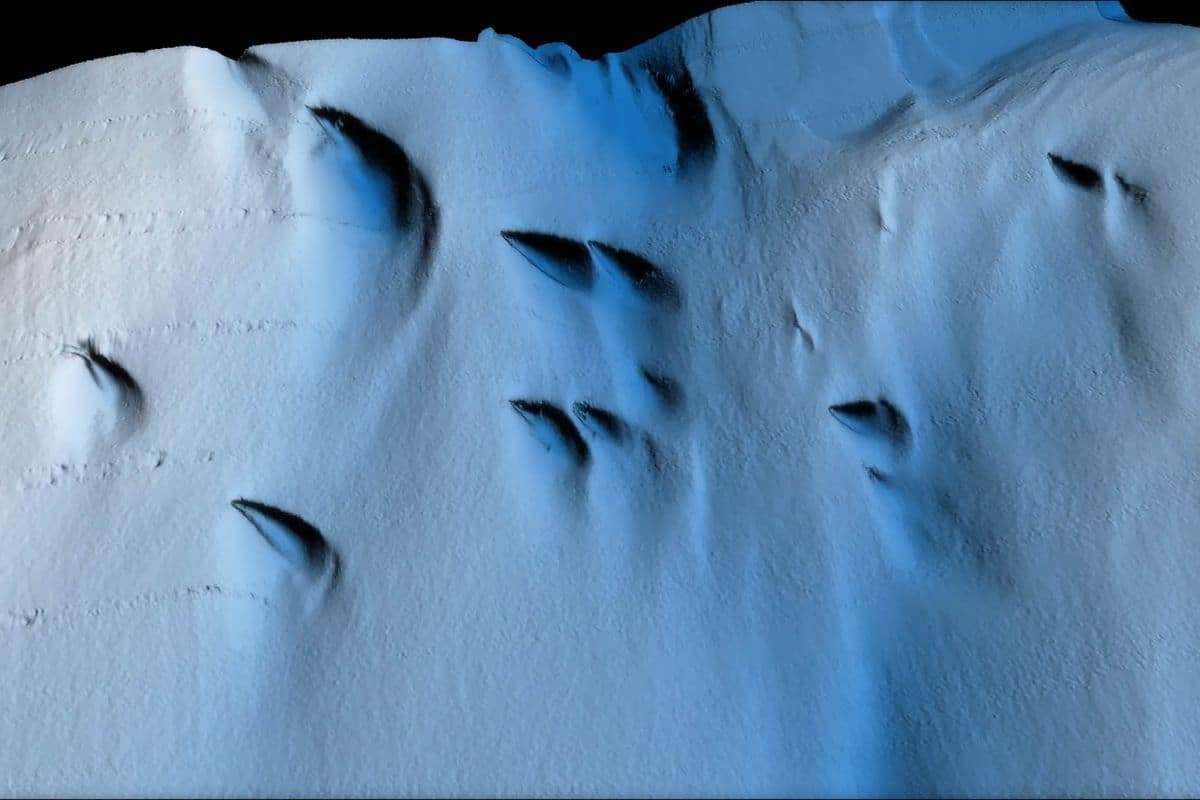
Using the autonomous underwater vehicle Ran, researchers have uncovered remarkable ice formations beneath Antarctica’s Dotson Ice Shelf. This pioneering expedition produced detailed sonar images that challenge earlier ideas about glacial melting dynamics and suggest a more intricate interaction of forces at play beneath the ice.
Diving Deep Into Hidden Territories
Published in Science Advances, the investigation saw Ran conduct a 27-day voyage underneath the Dotson Ice Shelf in West Antarctica, covering more than 1,000 kilometers and penetrating 17 kilometers into the ice cavity.
Equipped with sophisticated multibeam sonar technology, the robotic submersible captured unprecedented imagery of the glacier’s underside. These revealed intricate structures and textures, contradicting earlier expectations of a smooth and featureless ice base.
“Exploring inside the cavity with the submersible gave us detailed maps of the ice’s bottom surface. It feels like witnessing the 'dark side of the moon' for the first time,” remarked Professor Anna Wåhlin, lead scientist and oceanographer at the University of Gothenburg.

Unanticipated Ice Geometries
Contrary to a uniform ice bottom, the team found a complex landscape filled with ridges, plateaus, valleys, and dune-like patterns. Unique swirling and scooping features signaled the influence of sub-ice meltwater flows.
These formations likely arise from interactions between underwater currents and the ice, possibly shaped by the Coriolis effect, which causes moving water to curve due to Earth's rotation. Such observations question the accuracy of prior glacier melt models.
“This discovery is more than a revelation; it highlights how several previous views on glacier melting need re-evaluation,” emphasized Wåhlin.
Mission Halted Prematurely
The expedition was part of the TARSAN project, which investigates atmospheric and ocean influences on the Thwaites and Dotson glaciers. The plan included another mission in January 2024, but Ran was lost beneath the ice after just one more dive, ending the expedition unexpectedly.
“While the data we retrieved is invaluable, it is regrettable that we could not complete the full campaign,” Wåhlin noted. Nevertheless, the initial findings offer crucial insights and pose important questions for climate and glacial sciences.
Insights Into Past and Future Ice Dynamics
The peculiar structures detected underneath Dotson not only shed light on current ice melt mechanisms but might also reveal patterns linked to environmental changes over longer periods. Understanding how meltwater shapes these landscapes is key for refining predictive models.
Such knowledge is essential in reducing uncertainties related to global sea level rise forecasts, a critical component of climate adaptation strategies. The team advocates for ongoing exploration efforts.
As Antarctica remains a focal point for scientific inquiry, this study marks a milestone that underscores how much remains undiscovered beneath the ice.
Driven by advanced technology and international cooperation, future polar missions hold promise for unlocking further mysteries hidden in Earth's icy realms.
- Categories:
- Science








0 comments
Sign in to Comment