
A powerful magnitude 8.0 earthquake shaking a distant Pacific region sends initial tremors lasting mere seconds. However, the planet continues to resonate for hours with ultra-low frequency vibrations undetectable to human ears, causing Earth to oscillate like a massive bell. Thousands of seismometers deployed across oceans and continents capture these prolonged hums, gathering crucial data that moves both inward and outward through the planet.
For many years, seismologists observed unusual behaviors of seismic waves passing through the deep mantle beneath Africa and the central Pacific. These waves decelerate remarkably in these zones, indicating the presence of materials significantly different from the surrounding rock. Although these signals are faint and often drowned by Earth's persistent background vibrations, their consistent repetition across numerous earthquakes points to enormous hidden formations nearly 2,900 kilometers beneath the crust.
Researchers from Utrecht University invested years to compile faint signals from the planet’s strongest earthquakes. Instead of focusing solely on wave speed, their approach emphasized how much energy the waves lose while travelling, known as attenuation. By modeling Earth as one vibrating entity, they managed to unveil what exists at the crucial core-mantle interface.

Earth’s Biggest Internal Structures Revealed
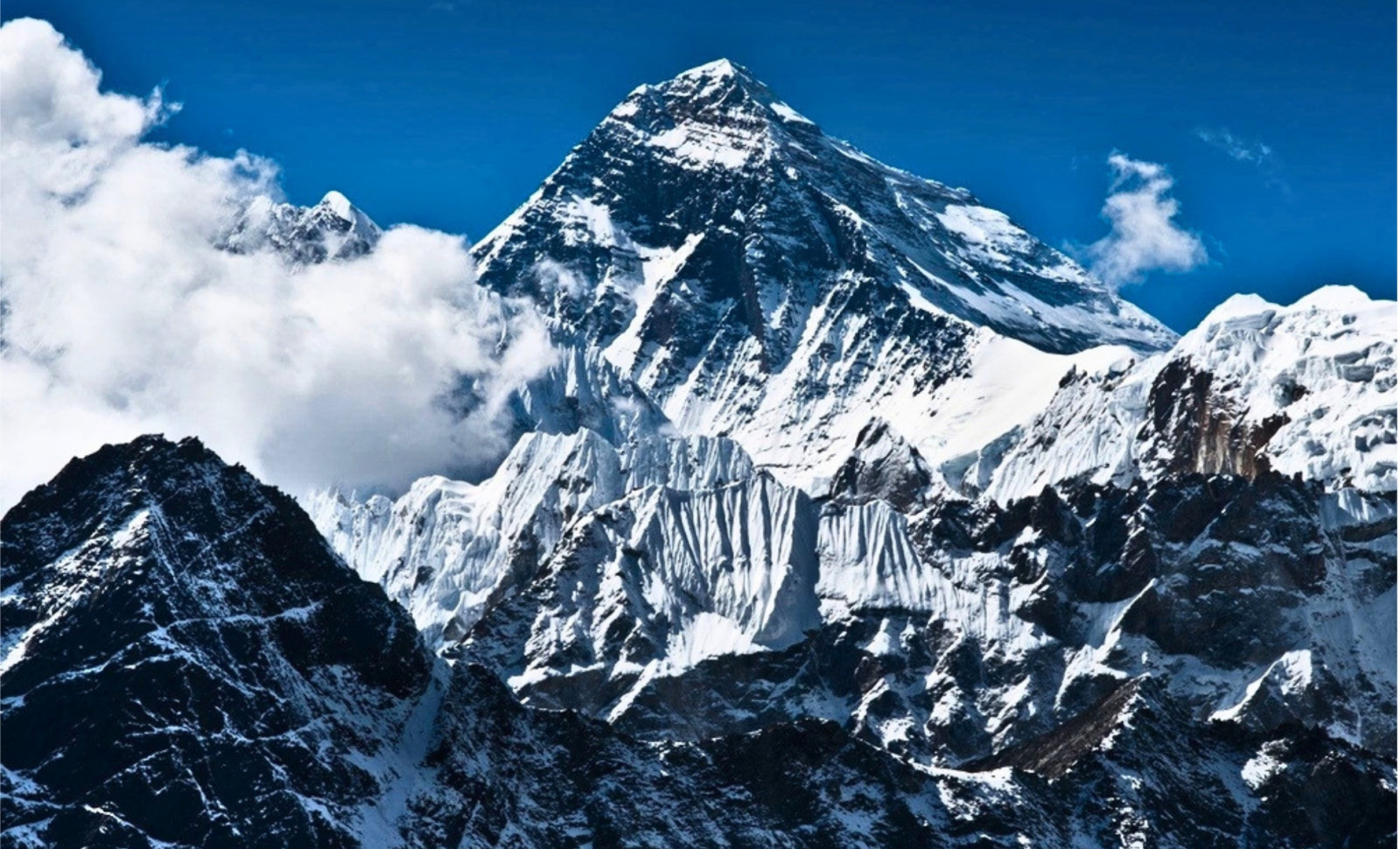
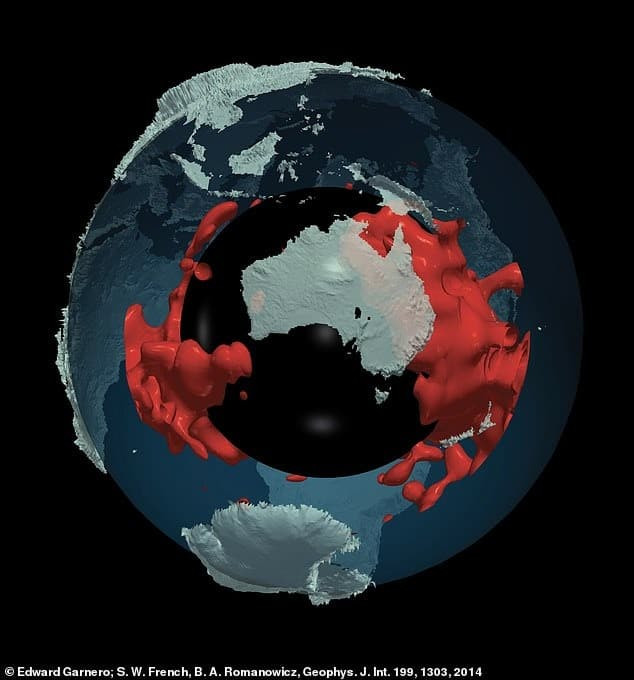
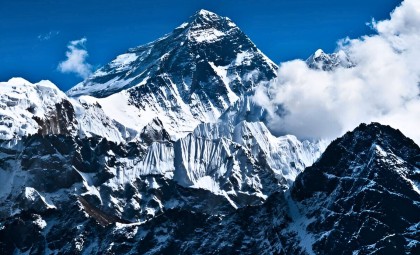
Their model uncovered two gigantic formations extending upwards from the core-mantle boundary, towering nearly 1,000 kilometers tall—almost 100 times Everest’s height, as reported by The New York Post. Known as Large Low Shear Velocity Provinces (LLSVPs), one lies beneath Africa and the other beneath the central Pacific Ocean. Each spans up to 5,000 kilometers across, ranking among the largest known internal Earth features.
This breakthrough, detailed in Nature, employed normal-mode seismology to analyze Earth’s free oscillations triggered by major seismic events. Unlike traditional seismic tomography that maps velocity differences, this method distinguishes both elastic and anelastic characteristics. The team developed a comprehensive 3D model called QS4L3, capturing spherical harmonics up to the fourth degree, representing Earth’s entire mantle in unprecedented detail.
Sujania Talavera-Soza, the principal investigator, along with her team analyzed data from quakes strong enough to excite Earth's normal modes. This technique enabled them to separate effects caused by temperature variations from those due to mantle composition—something previous models struggled to achieve reliably.
In their Nature publication, the authors clarify that these LLSVPs are "not mountains in the traditional sense," but rather large-scale thermochemical structures rising from the core-mantle boundary that influence mantle flow. Yet their vast sizes make them the tallest known features within Earth.
Ancient Subducted Crust Hidden Deep Beneath
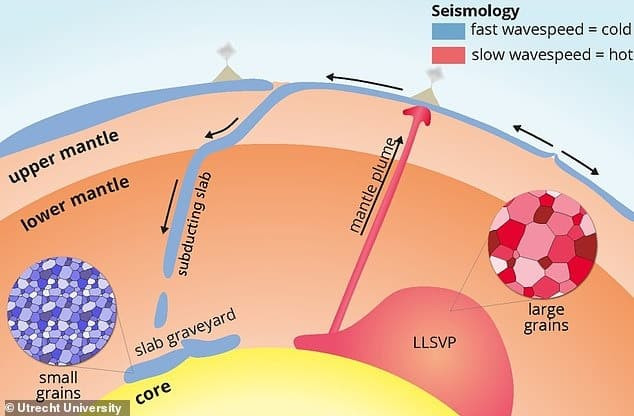
The findings highlighted a compelling pattern: while the upper mantle’s high attenuation aligns with low seismic velocity typical of hot rock, the lower mantle shows the opposite. The LLSVPs exhibit low attenuation, indicating that seismic waves travel more easily through them despite their lower velocity.
This suggests these bodies possess a unique chemical makeup rather than merely elevated temperatures. The team compared their model's wave speeds and attenuation with a viscoelastic laboratory model by Ulrich Faul (MIT) and Ian Jackson, concluding that the region surrounding the Pacific is cooler with smaller mineral grains, while the LLSVPs are warmer with coarser grains.
Prevailing theories suggest LLSVPs represent ancient slabs of oceanic crust subducted billions of years ago that have settled at the bottom of the mantle. Their distinct chemical properties prevent them from mixing fully with surrounding mantle via mantle convection. The authors note in Nature that these chemically unique regions have likely persisted since early Earth history.
Normal-Mode Seismology Unveils New Details
The major advance was the ability to measure seismic attenuation throughout the entire mantle, whereas previous global models covered only the upper mantle. The QS4L3 model significantly enhances resolution by resolving structures down to spherical harmonic degree four.
Team members including Laura Cobden from Utrecht University contributed expertise in mineral physics. They analyzed how Earth’s normal mode frequencies shift due to lateral structural variations using splitting function measurements. Their data detected the strongest attenuation in the lower mantle “ring around the Pacific,” a seismically fast zone, and the weakest attenuation inside the LLSVPs.
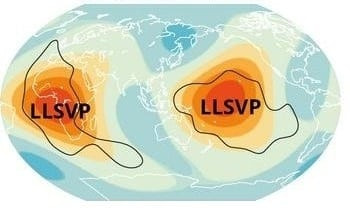
Calculations of viscosity based on grain size and temperature variations support the conclusion that LLSVPs are stable, long-lasting structures. This aligns with previous findings indicating these features have endured for hundreds of millions to billions of years.
Subterranean Giants Influencing Our Planet
These massive bodies are positioned just above the outer core, where temperatures rival those on the Sun’s surface. Their immense scale means that if placed on Earth's surface, their peaks would break through the upper atmosphere into space. Scientists now hypothesize these structures act as anchors for the slow movement of tectonic plates and may feed volcanic hotspots such as Hawaii and Iceland by channeling plumes of hot rock upwards.
While humans will never physically reach these subterranean summits or photograph their features, seismic waves generated by large earthquakes continue to reveal their outline. The tallest mountains on Earth are not found in the Himalayas or under oceanic depths, but hidden more than a thousand miles beneath us, where the mantle merges with the core — remnants from our planet’s earliest days.
- Categories:
- Science








0 comments
Sign in to Comment