
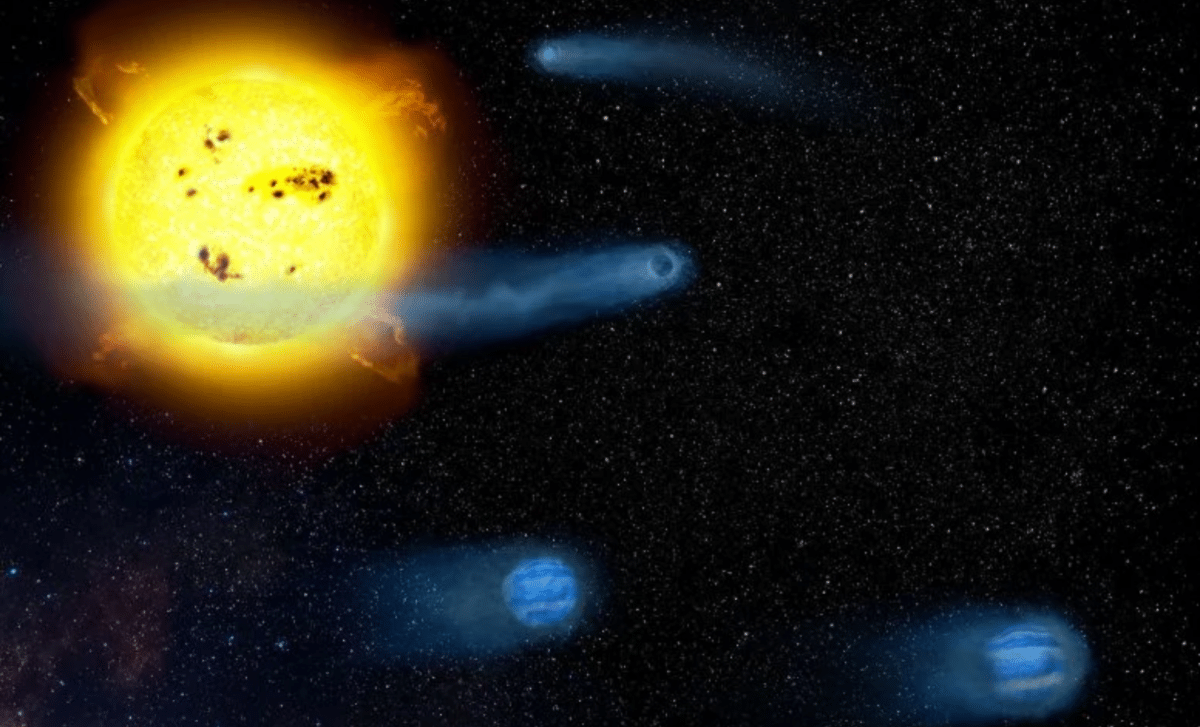
Researchers have unveiled remarkable insights into the infancy of four young exoplanets orbiting the star V1298 Tau, as detailed in a new Nature publication. These planets, with much lower masses than anticipated and expansive, tenuous atmospheres, are nicknamed “cotton candy” planets. Their unique characteristics offer fresh clues about the formation and development of the galaxy’s most abundant planet types. This milestone enhances our understanding of planetary origins and growth.
Capturing an Early Stage of Planet Formation
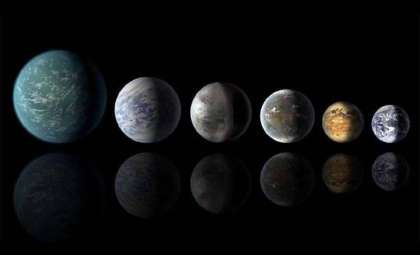
For years, astronomers have been intrigued by super-Earths and sub-Neptunes—planets larger than Earth but smaller than Neptune—that orbit closely around their host stars. Although absent from our solar system, these planets represent the dominant planetary category observed in the Milky Way. However, witnessing these bodies during their early development stages had remained elusive until the discovery of the V1298 Tau system, positioned approximately 350 light-years away.
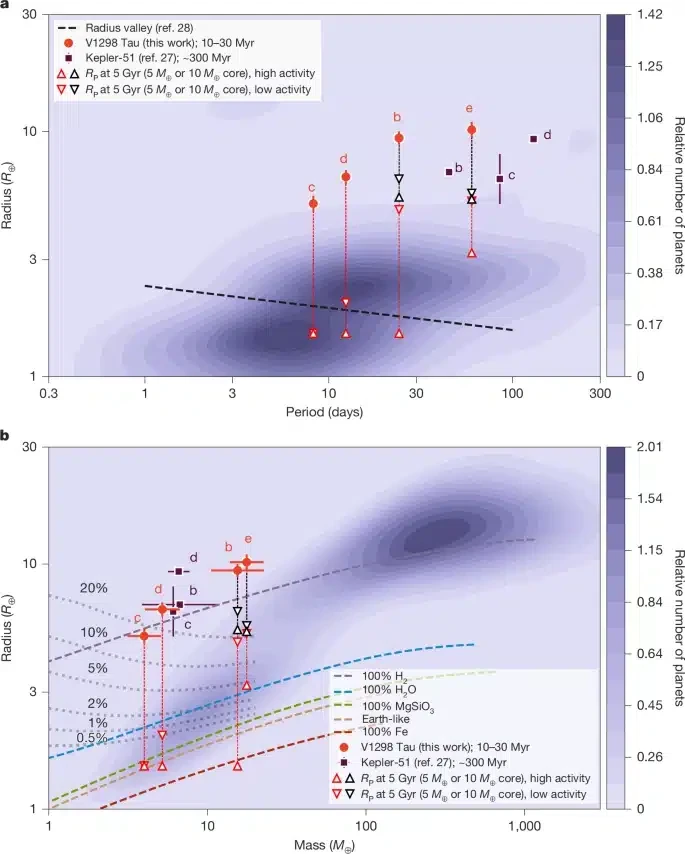
The star V1298 Tau is extremely young—just about 20 million years old, which is a mere instant in cosmic history. Its orbit hosts four large planets, ranging from Neptune-like to Jupiter-sized. The standout feature is their extraordinary low density. Despite their large sizes, these planets are surprisingly lightweight. According to John Livingston, lead author from the Astrobiology Center in Tokyo, “This system provides a sneak peek into what will eventually evolve into a typical planetary arrangement.”

“The four planets we studied will likely contract into ‘super-Earths’ and ‘sub-Neptunes’—the most common types of planets in our galaxy, but we’ve never had such a clear picture of them in their formative years.”
Published on January 7, 2026, in Nature, this research reshapes prevailing theories of planetary system formation. Findings from V1298 Tau suggest that these compact exoplanets begin their existence as giant, low-density planets and contract over billions of years.
Using Gravity’s Tug to Measure Planet Masses
Estimating planetary mass typically involves the Doppler method, which tracks a star’s wobble caused by orbiting planets. However, this technique falters with youthful, highly active stars like V1298 Tau, whose surfaces teem with starspots and magnetic disturbances, complicating precise velocity measurement.
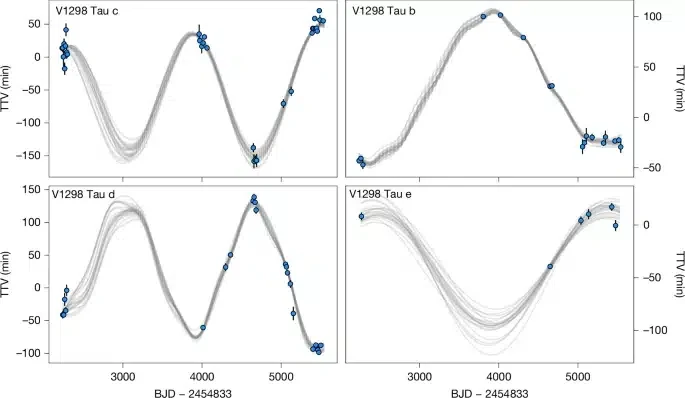
To overcome this, scientists employed an alternative called Transit Timing Variations (TTVs), which measures small shifts in the timing of a planet crossing in front of its star, caused by gravitational interactions with neighboring planets. Observations spanning a decade, combining space- and ground-based telescopes, tracked these subtle changes.
“The Doppler approach, our preferred method for weighing planets, isn’t feasible for young, volatile stars,” explains Erik Petigura from UCLA. “By analyzing how the planets’ gravity affects one another, we accurately gauged their masses despite the youthful star’s activity.”
This technique validated earlier expectations: the planets are swollen gas giants with extremely low densities, resembling fluffy cosmic marshmallows.
Conclusive Evidence of Puffy Young Planets
These planets possess unusual characteristics unseen in our solar neighborhood. While their diameters range from five to ten times Earth’s radius, their masses are merely five to fifteen times that of Earth, implying an atmosphere dominated by light gases and little dense core, much like cotton candy.
“While prior theories suggested these young planets might be incredibly low-density due to their size, this study delivers the first precise mass measurements,” states Trevor David from the Flatiron Institute, who initially discovered the system in 2019. “This confirmation provides a vital benchmark for planetary evolution models.”
Beyond curiosity, this insight delivers concrete data on early planetary development stages, reinforcing ideas that atmospheric loss plays a major part in shaping planetary systems.
Rapid Changes in Young Giant Planets
The investigation also reveals these planets are undergoing fast evolution. Their dense primordial atmospheres are evaporating due to intense radiation from their young host star. As this gas escapes, the planets contract and cool significantly. Such rapid changes challenge traditional models that envisioned a slower evolution process.
“These planets have already lost a considerable portion of their atmospheres and cooled more quickly than expected,” notes James Owen from Imperial College London. “Though still evolving, over billions of years, they will shrink and become the compact planets so common in the galaxy.”
Understanding this swift metamorphosis sheds light on why super-Earths and sub-Neptunes dominate the galaxy, and why such planets are missing in our solar system, possibly due to different formation histories or atmospheric dynamics.
- Categories:
- Space





0 comments
Sign in to Comment