

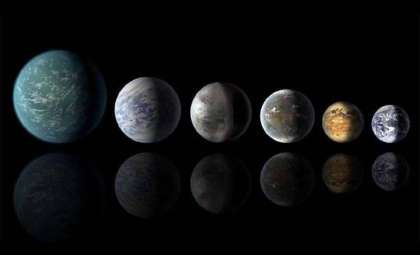
A groundbreaking investigation has revealed how certain exoplanets, which orbit extremely close to their stars and were thought unable to hold onto water, actually contain surprisingly large amounts of it. Scientists discovered that these planets, referred to as sub-Neptunes, might be producing water internally, challenging previous models of planetary formation and water retention.
Despite the intense heat near their host stars, which should prevent water from existing, data from NASA’s Kepler mission shows some of these planets are still abundant in water.
Unlocking the Mystery of Water on Close-In Planets
The recent study, published in Nature, conducted by a team from Arizona State University with collaborators at the Open University of Israel and the University of Chicago, proposes that sub-Neptunes generate water internally.

Prior explanations for planetary water centered on two processes: water arrival via comet or asteroid impacts, or planets initially forming at greater distances from their stars before migrating inward. These mechanisms do not fully explain the significant water reserves on planets situated so close to their stars.
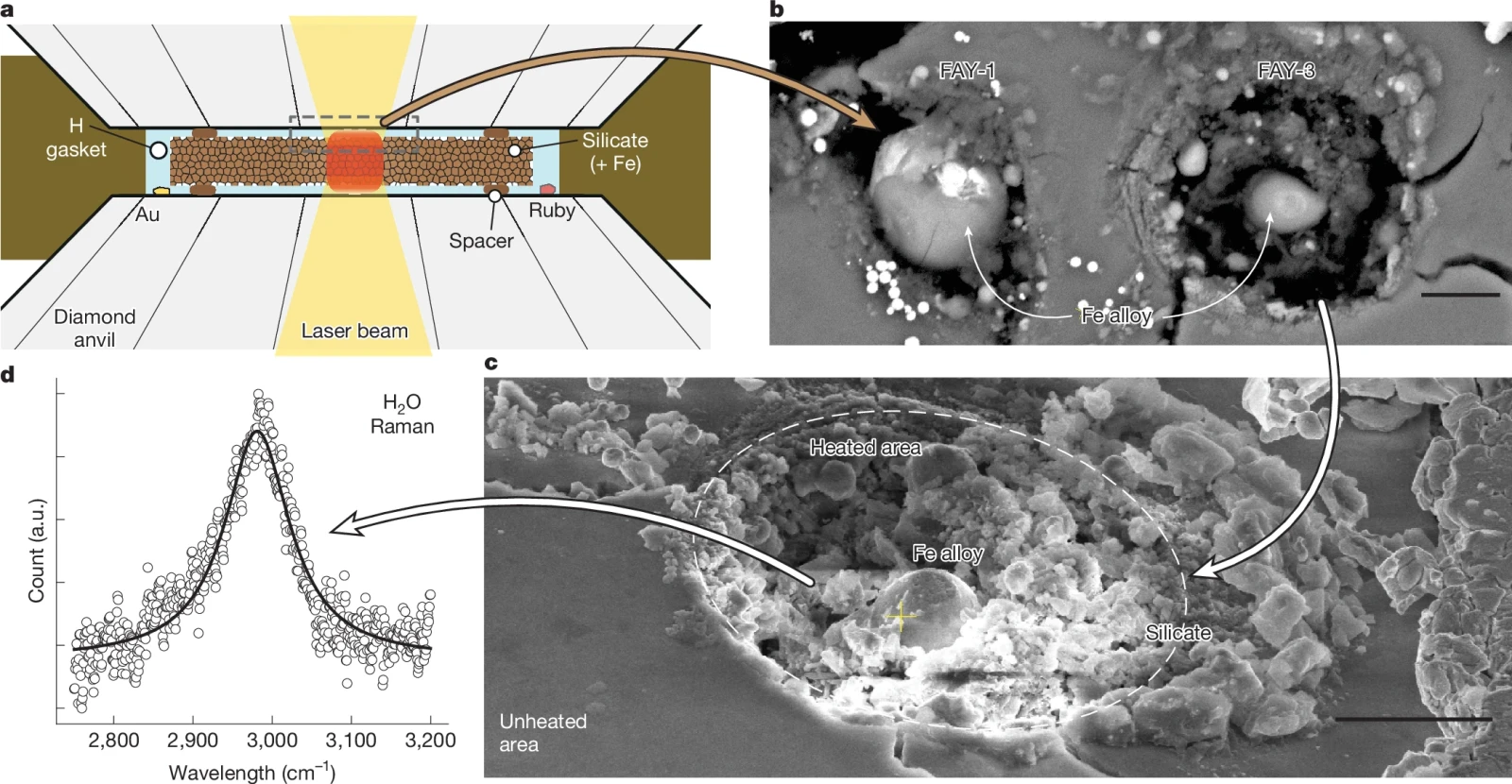
The researchers propose an alternative scenario. Instead of depending on external sources, sub-Neptunes could be synthesizing water through chemical reactions deep within their rocky interiors. When hydrogen from their thick atmospheres interacts with minerals at the boundary between the core and the atmosphere under extreme pressures and temperatures, water is formed.
Laboratory Advances Shed Light on Exoplanet Water Production
To study these processes, the team performed advanced experiments at the Advanced Photon Source synchrotron at the University of Chicago. They recreated the colossal pressures and high temperatures found inside sub-Neptunes using diamond-anvil cells, reaching pressures over 10,000 times Earth’s atmosphere and temperatures exceeding 3,000 Kelvin. The experiments revealed:
“oxygen liberated from the silicate melt reacts with hydrogen, producing an appreciable amount of water up to a few tens of weight per cent, which is much greater than previously predicted.”
This reaction is far more efficient under the extreme conditions present within these planets than under lower pressures. The findings indicate that sub-Neptunes may continuously create significant amounts of water throughout their lifetimes.
Expanding the Hunt for Potentially Habitable Worlds
If sub-Neptunes can internally produce water, the chances of finding exoplanets rich in water increase notably. This enhances the prospects of detecting planets with conditions favorable to life, since water is essential for biological activity. Furthermore, this research suggests that sub-Neptunes may represent an early evolutionary phase of water-rich exoplanets rather than being distinctly different types.
- Categories:
- Space








0 comments
Sign in to Comment