
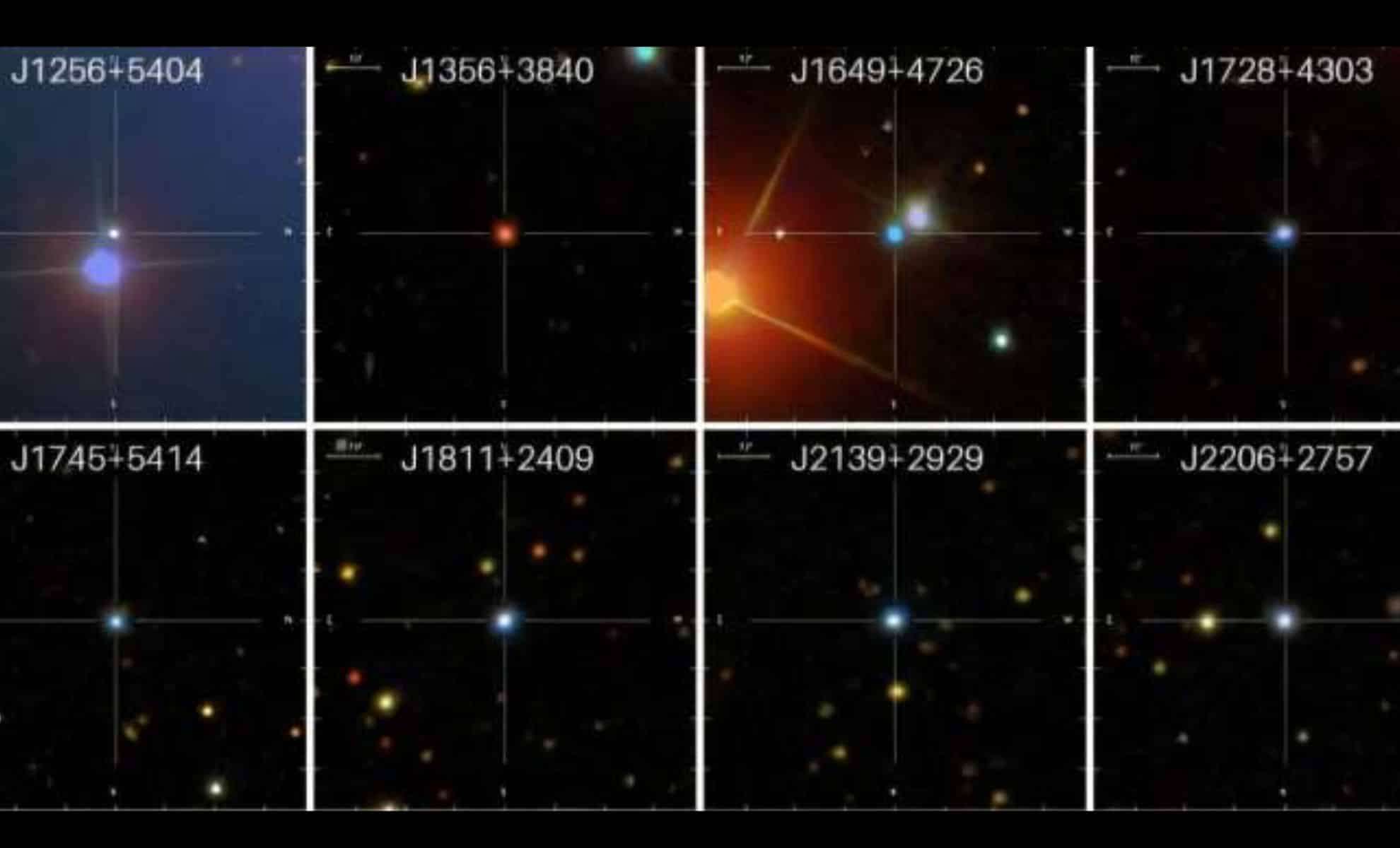
A recent study released on arXiv unveils the discovery of 62 luminous quasars by a research team from Seoul National University alongside international collaborators. Part of the All-sky BRIght, Complete Quasar Survey (AllBRICQS), this August 2025 paper marks a substantial leap in our comprehension of quasars—highly energetic regions powered by supermassive black holes at galaxy centers.
Quasars Explained: Illuminating the Universe’s Energetic Cores
Quasars—also known as quasi-stellar objects (QSOs)—are extraordinarily bright galactic nuclei fueled by supermassive black holes. These objects emit intense radiation over a broad spectrum, from radio frequencies to X-rays, making them detectable across vast cosmic distances. Investigating quasars allows scientists to delve into the mechanisms of black hole growth and their dynamic interactions with nearby cosmic matter.
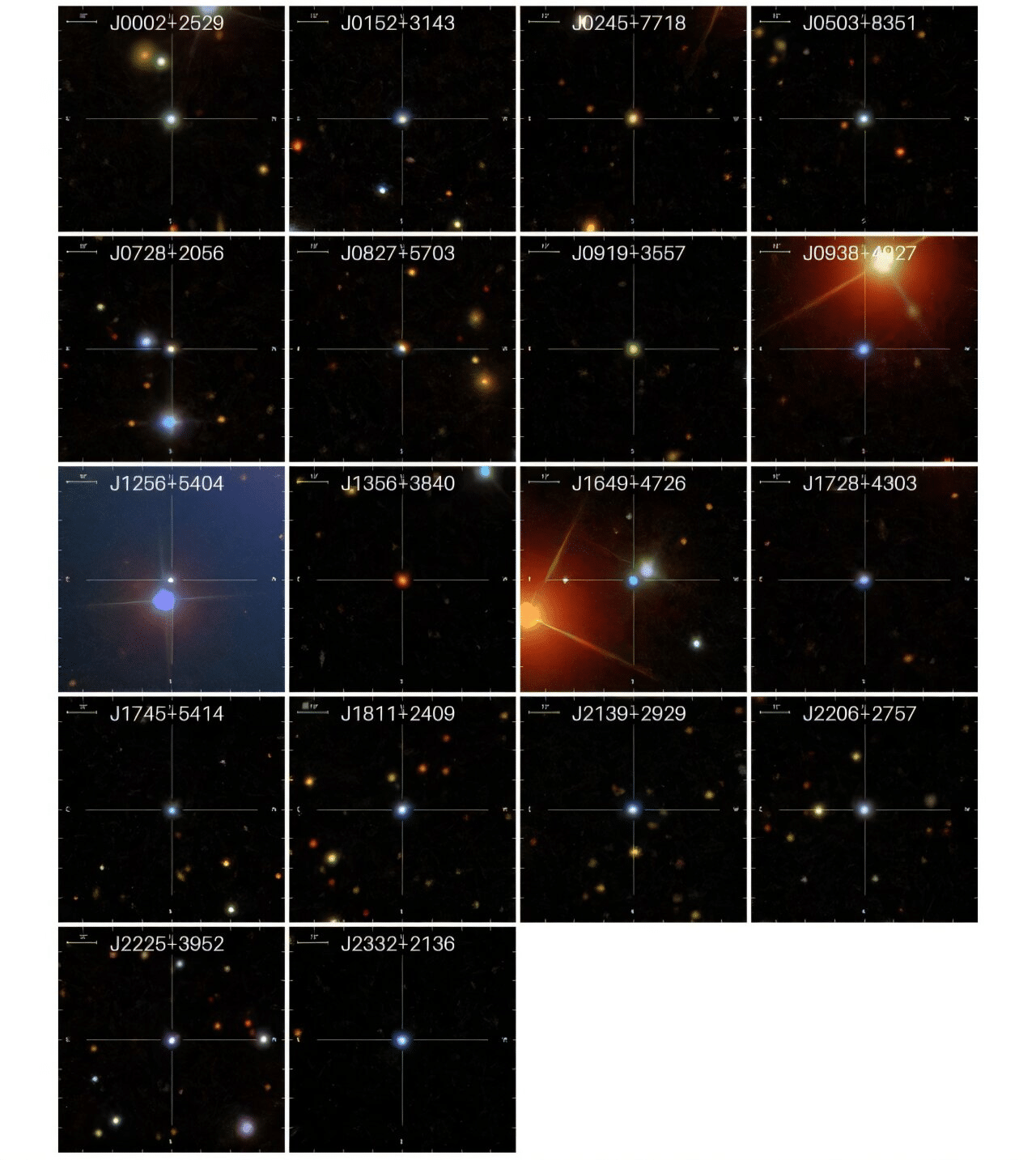
The latest AllBRICQS publication emphasizes the value of discovering and characterizing these mysterious cosmic beacons. The authors state, “Here, we report 62 new AllBRICQS quasars spanning various types, which include typical broad emission line quasars and the most luminous iron low-ionization broad absorption line quasars discovered to date.” This assortment broadens insights into quasar diversity and their unique features, enriching our understanding of these extraordinary phenomena.

How the AllBRICQS Survey Enhances Quasar Identification
The AllBRICQS project applies state-of-the-art methods and tools to detect previously unrecognized quasars, improving upon earlier detection strategies. By integrating data from the infrared-focused WISE catalog and precise astrometric information from the Gaia mission—especially parallax and proper motion—the survey has successfully pinpointed quasars missed by conventional approaches.
This endeavor has led to the confirmation of 156 spectroscopically verified quasars and significantly expanded the known quasar population with 62 fresh additions. This expanded sample of bright and optically visible quasars offers an enhanced dataset, advancing our grasp of quasar properties, their evolution, black hole activity, and the galaxies they inhabit.
Implications of the Newly Found Quasar Candidates
Among the 62 recently detected quasars are some exceptional and rare types that hold key positions in cosmology and astrophysical research. For instance, the quasar J0919+3557 was initially mistaken for a galaxy but has now been reclassified as a weak-line quasar—a rare group distinguished by faint high-ionization emission lines. This reclassification highlights ongoing progress in quasar research and the importance of detailed spectral analyses.
Another noteworthy find is the iron low-ionization broad absorption line quasar (FeLoBAL) J1356+3840, which stands as the most luminous specimen of its category discovered so far. FeLoBAL quasars display broad absorption features that provide crucial clues about the surrounding materials near their central black holes. These discoveries create new possibilities for probing quasar physics and the behavior of black hole environments.
Future Research Potential: Quasars as Probes into Black Hole and Galaxy Dynamics
The AllBRICQS survey’s expanded quasar catalog not only enriches cosmic inventories but also opens new avenues for in-depth investigations. These quasars offer natural test beds for studying black hole formation, galaxy evolution, and the feedback effects shaping cosmic structures. Examining the diverse types of quasars, including those differing in redshift and brightness, enables researchers to delve further into the factors driving supermassive black hole development.
“These confirmed AllBRICQS quasars provide a valuable resource for future research into quasar evolution, black holes, their environments, and their host galaxies across multiple wavelengths,” the team concludes. This wide-ranging quasar sample will help illuminate the physical processes governing black holes, their surrounding matter, and the larger galaxies they influence, furnishing extensive data for forthcoming explorations.
- Categories:
- News











0 comments
Sign in to Comment