
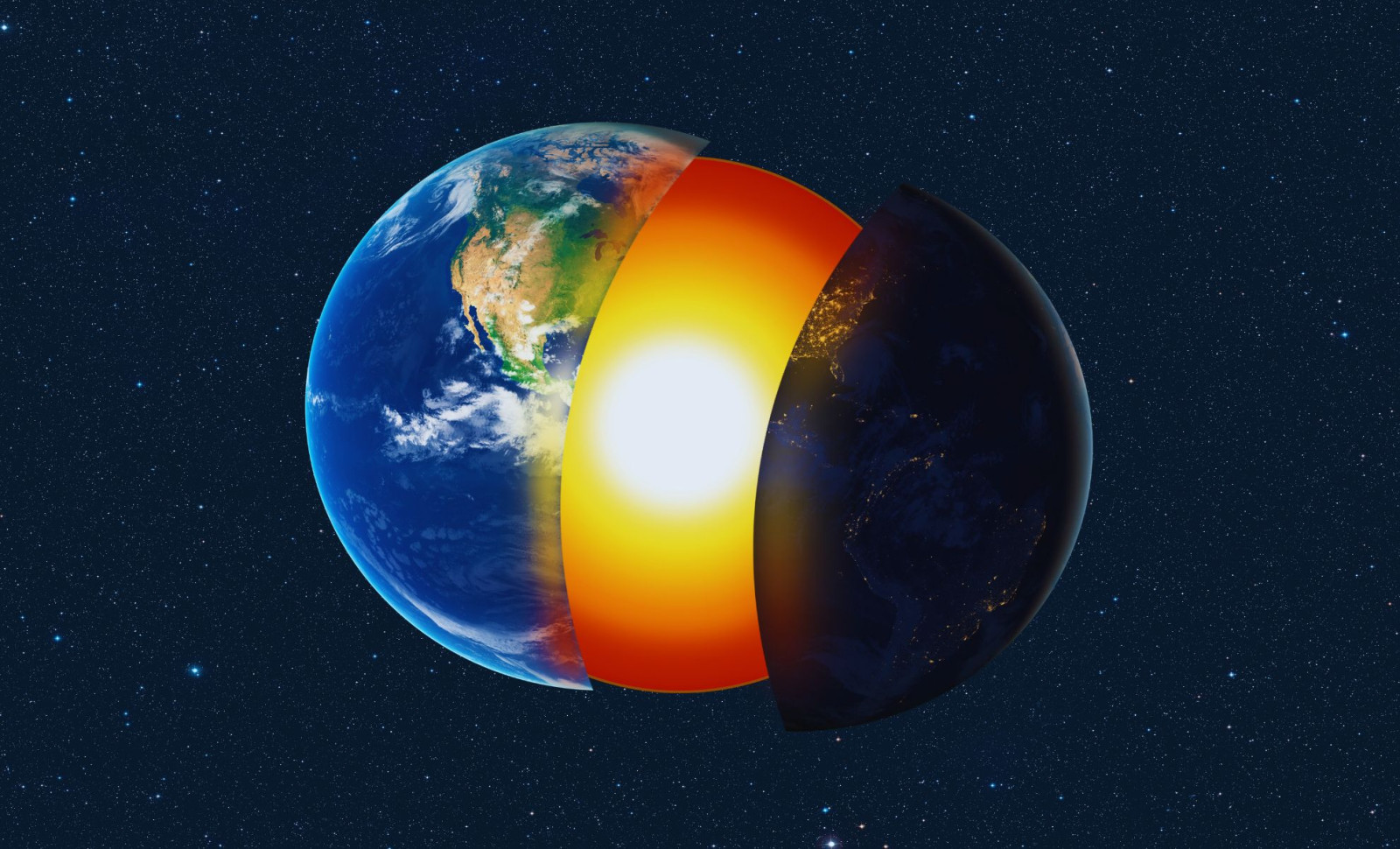
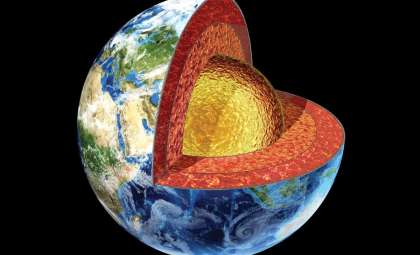
Recent investigations propose that Earth’s solid inner core may be less rigid than previously thought. Instead, it could exist in an extraordinary “buttery” material state that challenges traditional ideas about the planet’s deep interior.
Published in National Science Review, a study from Sichuan University researchers sheds light on unusual seismic wave patterns recorded over many years. By simulating the extreme conditions deep beneath the surface, they discovered that a solid iron and carbon mixture can become remarkably soft without reaching its melting point.
Is Earth’s Inner Core Soft and Buttery?
Seismologists have long observed that earthquake-generated shear waves slow down dramatically—by up to 23 percent—when passing through the innermost core. This effect defies explanations based on the idea of a solid, rigid iron core alone.

Researchers tackled this problem using a laboratory method involving intense shock compression to mimic the enormous pressures and temperatures found there. Their findings reveal a new physical behavior: the solid matter’s softened state arises from the mobility of lighter atoms embedded within its framework.
The Role of Carbon in Softening Iron
Led by Professor Youjun Zhang, the team used shock compression testing to explore how an iron-carbon alloy responds at core-like conditions—around 140 gigapascals and approximately 4,200°F. Utilizing a two-stage gas gun to accelerate projectiles at immense speeds, they captured real-time data on the material’s response.
At these extreme states, carbon atoms were found to move within the solid iron lattice, reducing its shear strength. This motion slowed sound waves, and Poisson’s ratio—which measures how materials deform laterally under stress—increased to match values recorded from seismic surveys of the Earth’s core. As Zhang remarked:
“For the first time, we’ve experimentally shown that iron-carbon alloy under inner core conditions exhibits a remarkably low shear velocity.”
This atomic mobility occurred without disturbing the crystal integrity of iron, indicating a superionic phase—a type of solid where light atoms move freely within the heavier atomic matrix.
Seismic Evidence Points to a Soft Core
One longstanding puzzle in seismology is the unexpectedly low speeds of shear waves, or twisting vibrations, within the Earth’s inner core. This new research suggests that the motion of light atoms like carbon adequately explains these slowdowns without needing to assume partial melting.
Computer models also reveal that the directional movement of carbon atoms between iron layers might be responsible for seismic anisotropy, where wave velocities differ depending on their travel direction. Even subtle alignment of mineral grains during core formation could produce these directional variations.
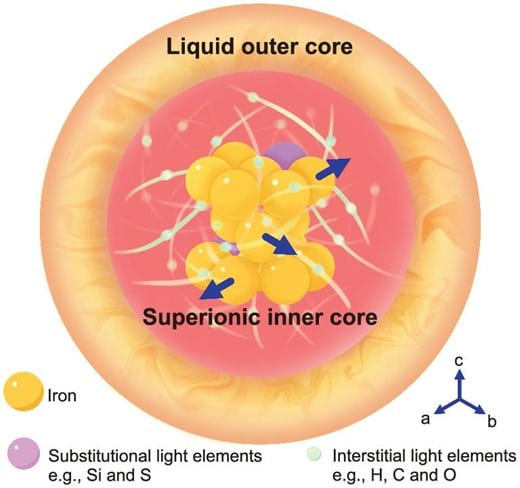
The revelation that a solid can harbor atomic mobility without melting enriches our interpretation of seismic readings. It emphasizes the need for improved models that incorporate both crystal structures and mobile light elements.
Implications for Earth’s Magnetic Field
This discovery offers fresh insights into how the Earth’s magnetic field might be driven. Although the liquid outer core generates the magnetic field, energy release from the solid inner core—notably as it cools and crystallizes—also plays a crucial role.
Dr. Yuqian Huang, quoted in Earth.com, noted that the mobility of light atoms such as carbon could drive convection currents in the outer core. This fluid-like dynamics may help sustain the geodynamo, the process responsible for Earth’s magnetic properties. While the precise impact on energy budgets remains unknown, it introduces a compelling new aspect in understanding geomagnetic persistence.
Ongoing experiments exploring different light elements under even higher pressures aim to sharpen our picture of Earth’s inner workings and magnetic evolution.
- Categories:
- Science










0 comments
Sign in to Comment