
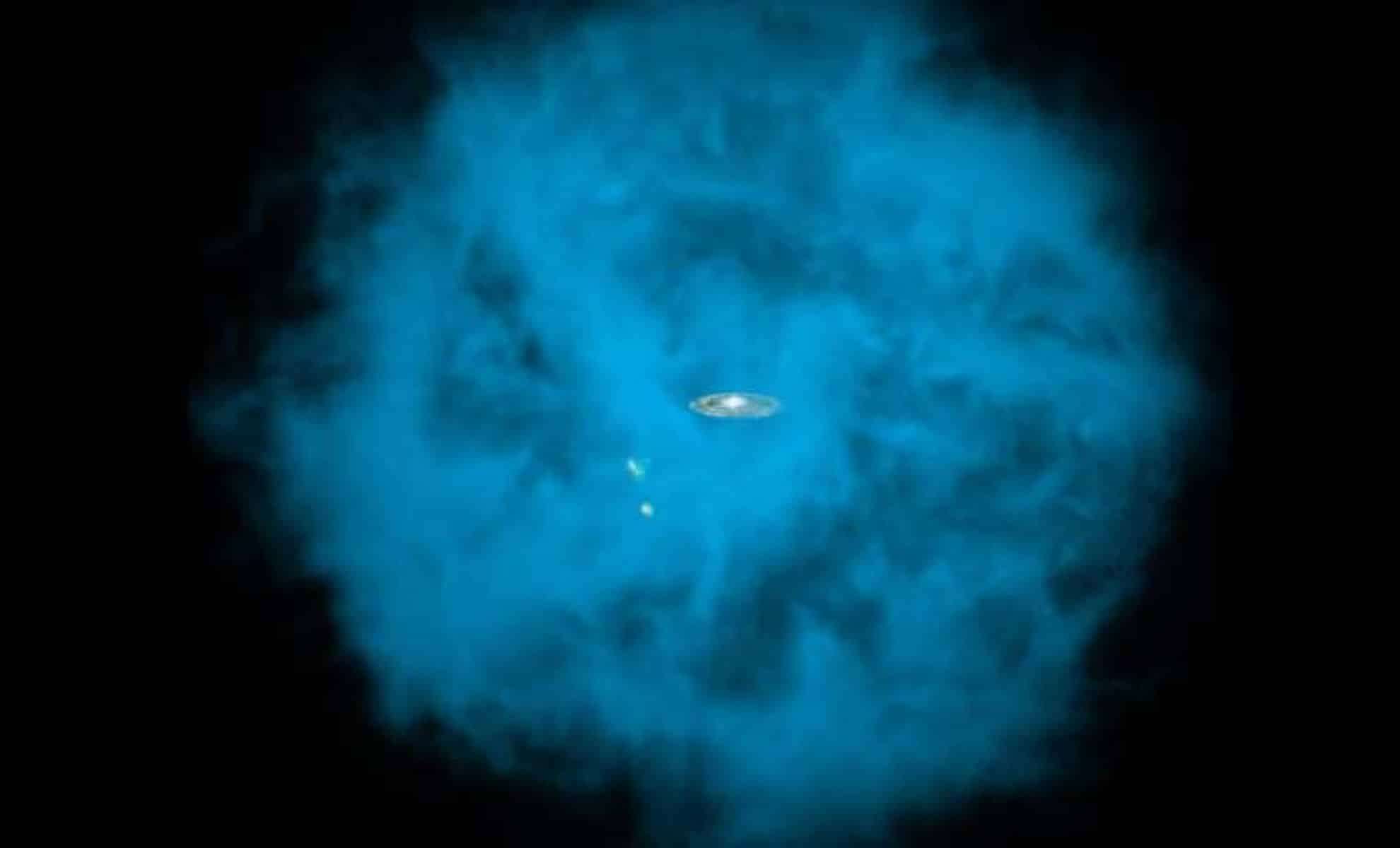
For many years, researchers have been confounded by the mystery of unaccounted matter in the cosmos. While it’s established that dark matter comprises roughly 85% of all matter in the universe, the remaining 15% consists of ordinary (baryonic) matter such as stars, gas, and galaxies. However, a significant fraction of this baryonic content, particularly hydrogen gas, had remained undetected. A groundbreaking study published in Science Advances has now provided confirmation of this missing matter, revealing ionized hydrogen gas that evaded detection by conventional observational techniques.
Astronomers have long suspected that such hydrogen gas could be found within the halos surrounding galaxies as well as along the cosmic web’s filaments linking these galaxies. The newly observed gas offers vital clues to the distribution of baryons, a challenge that has persisted since early cosmological studies. This hidden matter plays a key role in shaping galaxy formation and the broader evolution of the universe.
Understanding the Ionized Hydrogen Component
The ionized hydrogen detected belongs to a widespread medium called the warm-hot intergalactic medium (WHIM). This gas, present between galaxies, weaves together the cosmic structures in a vast filamentary network. Due to its diffuse nature and relatively cool temperature, it had remained invisible to optical telescopes. The breakthrough arose from analyzing the kinematic Sunyaev-Zel’dovich effect, whereby electrons in ionized gas scatter remnants of the cosmic microwave background radiation.

The team achieved this by stacking data from over seven million galaxies located within 8 billion light-years, capturing subtle distortions imprinted on the cosmic microwave background. This method provided the inaugural direct indication of the once-missing hydrogen gas, marking a key step in understanding the cosmos’ large-scale framework.
“We think that, once we go farther away from the galaxy, we recover all of the missing gas,” said Boryana Hadzhiyska, a Miller postdoctoral fellow at the University of California, Berkeley. She is the first author of the study and explained that a more detailed analysis with simulations would further refine these findings. “To be more accurate, we have to do a careful analysis with simulations, which we haven’t done. We want to do a careful job.”
This breakthrough addresses the enduring missing baryons issue. For decades, astronomers have grappled with accounting for half of the normal matter that doesn’t appear in stars or galaxies. The identification of this hidden hydrogen gas could be the missing key to resolve this cosmic enigma.
Impact of Cosmic Feedback and Active Galactic Nuclei
Findings from the study also highlight the influential role of active galactic nuclei (AGNs), which are supermassive black holes at galaxy centers, in regulating gas distribution. Contrary to earlier beliefs that AGNs are mostly active during the early phases of galaxies while consuming matter, new evidence suggests AGNs might switch on and off intermittently, contributing to ongoing gas expulsion across a galaxy’s lifespan.
“One problem we don’t understand is about AGNs, and one of the hypotheses is that they turn on and off occasionally in what is called a duty cycle,” said Hadzhiyska. This new information could have significant implications for how astronomers model galaxy evolution, suggesting that the feedback mechanisms responsible for gas expulsion might be much more dynamic than previously thought.
Such insights challenge the idea that gas simply traces the distribution of dark matter in galaxies. Incorporating this new hydrogen gas data will require rethinking current cosmological models related to galaxy development and the process of star formation.
Enhancing Cosmological Understanding with New Observations
The ability to detect this previously hidden gas has profound consequences for cosmology. It not only sheds light on the missing baryons but also opens doors for answering fundamental questions about the early universe’s inception, including how galaxies and stars came to be. Pinpointing the location of this gas is critical for resolving several outstanding mysteries in cosmic evolution.
“The measurements are certainly consistent with finding all of the gas,” said Simone Ferraro, a senior scientist at Lawrence Berkeley National Laboratory and UC Berkeley. He highlighted how the cosmic microwave background (CMB), which acts as the “backlight” for all cosmic observations, plays a crucial role in tracking this gas. “The cosmic microwave background is in the back of everything we see in the universe. It’s the edge of the observable universe. So you can use that as a backlight to see where the gas is.”
These discoveries not only resolve a fundamental astrophysical puzzle but also pave the way for new studies into cosmic feedback and more precise galaxy formation simulations.
Looking Ahead: Implications for Future Research
Uncovering the hidden hydrogen gas marks a vital milestone in piecing together the universe’s full narrative. Scientists now aim to enhance these findings by integrating sophisticated simulations to delineate exactly how this gas influences large-scale structures. International collaboration will continue driving progress, illuminating longstanding cosmic mysteries.
As the exploration of the universe advances, this milestone clarifies the elusive baryonic mass, bringing us closer to understanding the fundamental components shaping the cosmos.
- Categories:
- News







0 comments
Sign in to Comment