
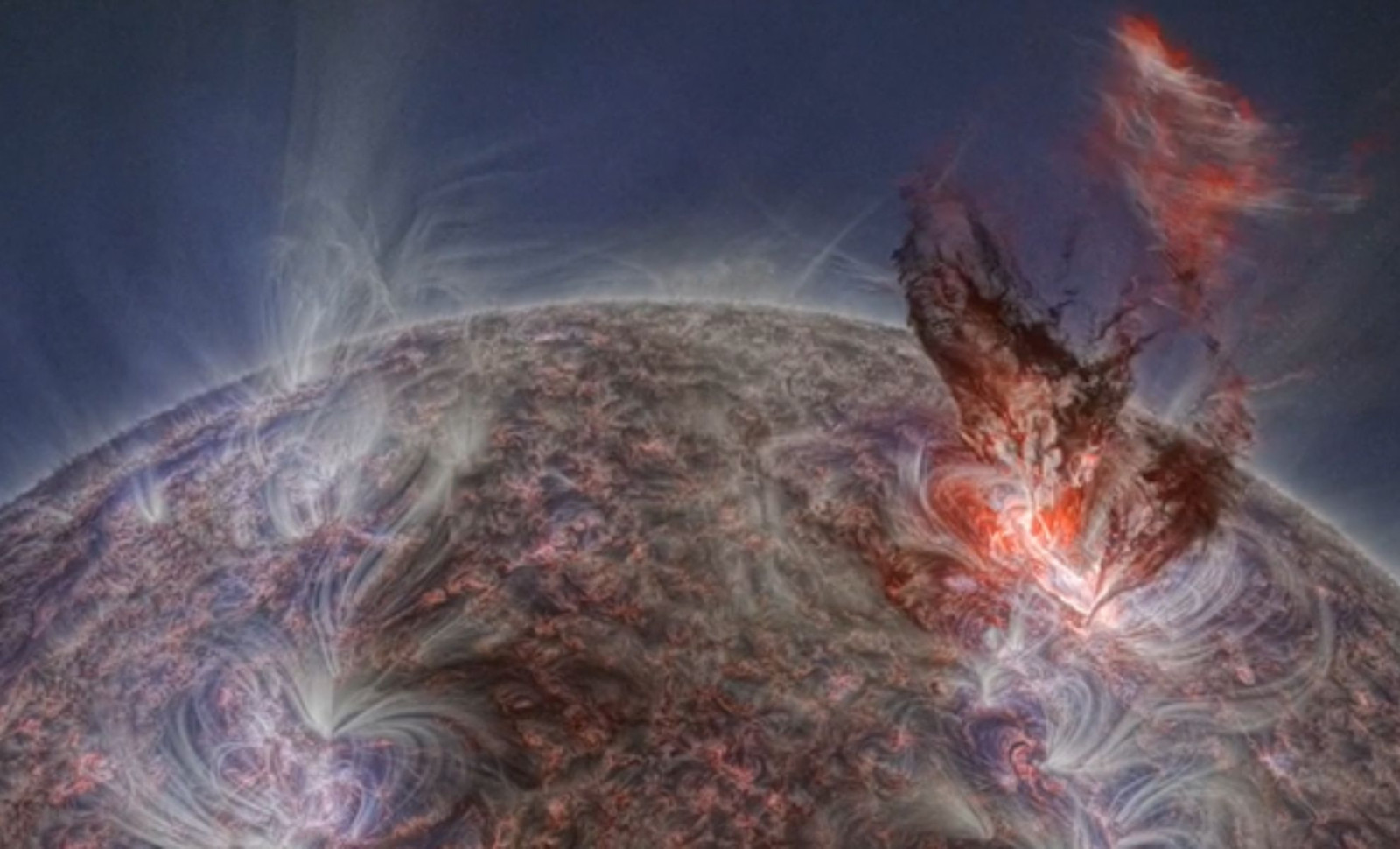
Scientists at the University of Hawaiʻi have harnessed the unique moments provided by rare total solar eclipses to explore the turbulent nature of the sun’s outermost layer, known as the corona. After more than ten years of detailed study, they uncovered how these previously elusive turbulent structures can persist across immense distances and significantly contribute to the origins of the solar wind.
For the first time, the research team, spearheaded by Shadia Habbal from the Institute for Astronomy, detected turbulent formations in the solar corona that endure far beyond the sun’s surface. Their groundbreaking results, published in The Astrophysical Journal, illuminate new aspects of the solar wind’s generation and progression.
Revealing the Sun’s Atmospheric Complexity
During a total solar eclipse, the Moon temporarily blocks the Sun’s intense brightness, allowing researchers to observe the fainter corona in exquisite detail. Unlike ordinary observations, these fleeting events unveil the corona’s delicate, thread-like patterns shaped by magnetic forces emerging beneath the Sun’s surface. As Shadia Habbal noted:

“This work helps us understand how the Sun transfers energy into space. That process ultimately affects space weather, which can disrupt satellites, communications, and power systems on Earth.”
She also highlighted that these detailed images of the corona expose a far more energetic and dynamic system than previously known. The intricate magnetic interactions and energetic phenomena within the corona have long puzzled scientists; this recent study marks a pivotal advancement in understanding these mysteries.
Insights into Turbulence from Eclipse Observations
Through examination of data gathered over nearly 12 years, covering an entire solar cycle, the team identified distinct turbulent motions in the corona. These turbulent elements include vortex-like rings resembling smoke rings and oscillating wave patterns akin to cloud formations on Earth.
The research showed that prominences—large, cooler, and denser structures emerging from the solar surface—drive the turbulence. The stark contrasts in temperature and density between these prominences and their surrounding plasma ignite turbulent behaviors.
“For the first time, we were able to watch these turbulent structures form near the Sun and then follow them as they flowed outward with the solar wind,” Habbal stated.
Tracking the Solar Wind’s Turbulent Journey
A key breakthrough of this research is the ability to trace these turbulent patterns as they travel outward with the solar wind. Observations reveal that these turbulent formations persist unchanged even as they voyage far into space.
“Seeing the same features later in space-based images tells us they remain intact over enormous distances,” he concluded.
By mapping the journey of these turbulent structures from their creation near the Sun’s surface to their outward flow, this study offers vital clues about the processes responsible for solar wind generation and coronal heating.
- Categories:
- Science






0 comments
Sign in to Comment