
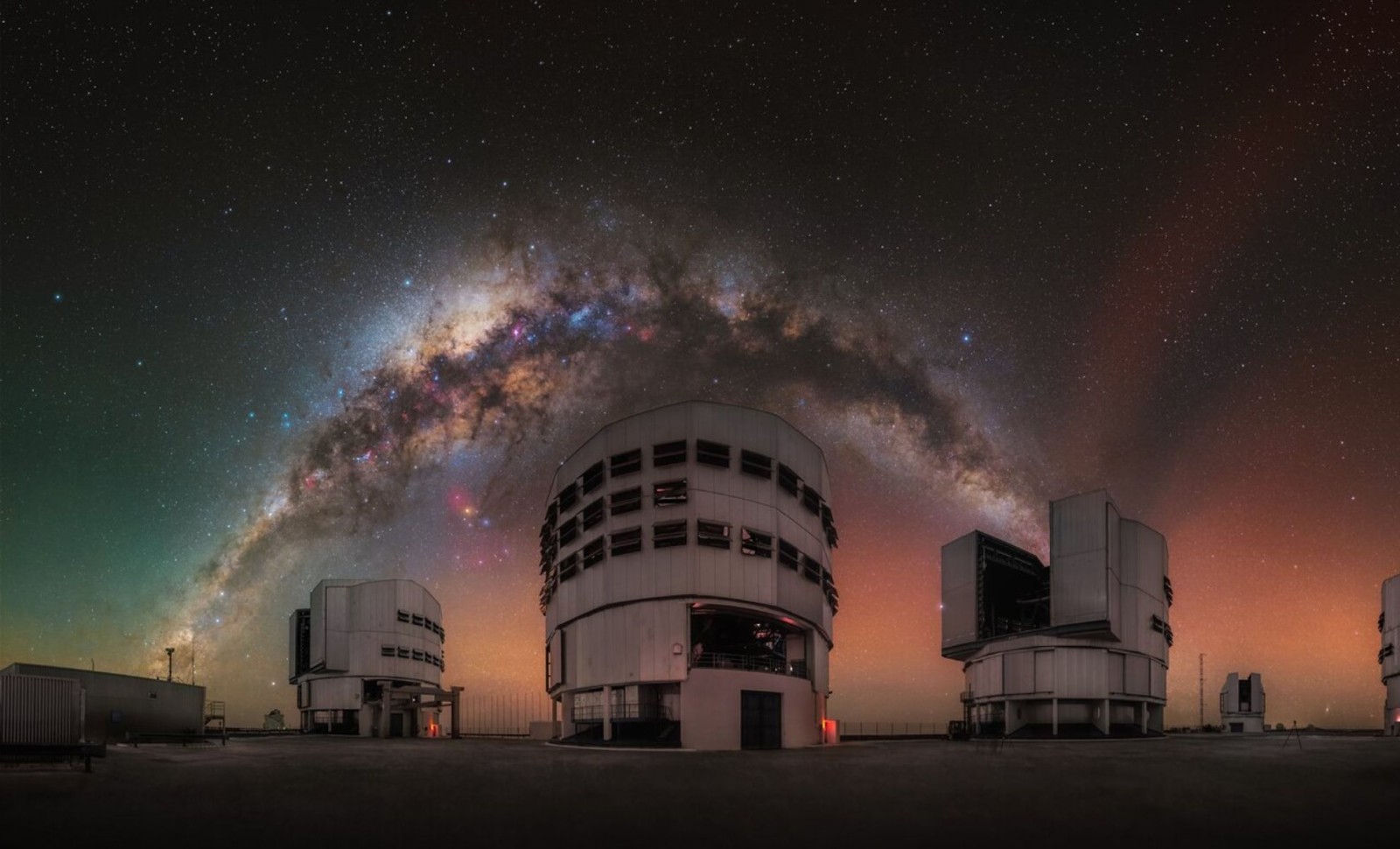
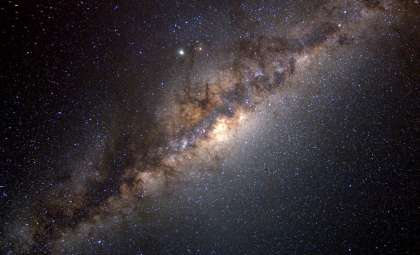
Have you ever gazed up at the night sky and been awestruck by the countless stars? Imagine witnessing the Milky Way in its full splendor, arching across the heavens like a dazzling band of light. This remarkable sight was recently captured by one of the most sophisticated instruments on our planet—the Very Large Telescope (VLT).
Perched atop the Chilean Atacama Desert, the VLT has spearheaded many astronomical breakthroughs over the years. Its latest image, showcasing our home galaxy in stunning detail, was unveiled in a study published by the European Southern Observatory (ESO), highlighting a major milestone in cosmic observation.
The Milky Way Shines Brighter with Atmospheric Airglow
The photograph released by ESO features the Milky Way glowing magnificently above the telescope’s structure. A unique element in this picture is the faint, ethereal airglow that softly illuminates the background. While many might be unfamiliar with airglow, it’s a subtle natural light created within the Earth’s atmosphere. It’s an incredibly delicate glow that is easily overwhelmed by the glow of urban lighting.

What’s fascinating is that airglow can only be observed in the darkest regions of our planet, such as the Atacama Desert. The telescope’s elevated location in the Andes mountains offers an ideal vantage point to capture this rare atmospheric phenomenon.
This luminous effect stems from solar energy interacting with atmospheric particles. The photographer, Julien Looten, reflects:
“This photo holds symbolic meaning for me, as it signifies the end of the night.”
What Makes the VLT’s Site Ideal for Astronomy?
The awe-inspiring photo owes much to its location. The VLT is nestled high in the Andes Mountains within the Atacama Desert, an area prized for its elevated terrain, extremely arid climate, and absence of light pollution. These qualities make the desert an astronomer’s paradise.
The desert’s dry, clear atmosphere minimizes distortions caused by the air, enabling the telescope to capture razor-sharp images of galaxies, stars, and nebulae far across the cosmos.
Capturing this level of fine detail would be nearly impossible without the Atacama’s exceptional observational conditions. Furthermore, the VLT’s placement contributes significantly to the striking image of the Milky Way, as light pollution from cities elsewhere often obscures such views.
Threats to the Darkness: Light Pollution and Satellites
Unfortunately, the pristine conditions enjoyed by the VLT aren’t guaranteed indefinitely. Urban expansion and the growing number of satellites orbiting Earth are increasing light pollution even in remote regions like the Atacama Desert. This emerging problem threatens to diminish the quality of astronomical observations.
Astronomers are increasingly warning about the ramifications of expanding cities and burgeoning satellite networks on astrophysical research. The creep of artificial light into once-pristine areas not only compromises scientific discovery but diminishes a natural treasure.
Since observatories like the VLT rely heavily on the natural night darkness to make pivotal discoveries about the cosmos, any degradation of these dark skies could hinder future breakthroughs.
- Categories:
- Astronomy






0 comments
Sign in to Comment