
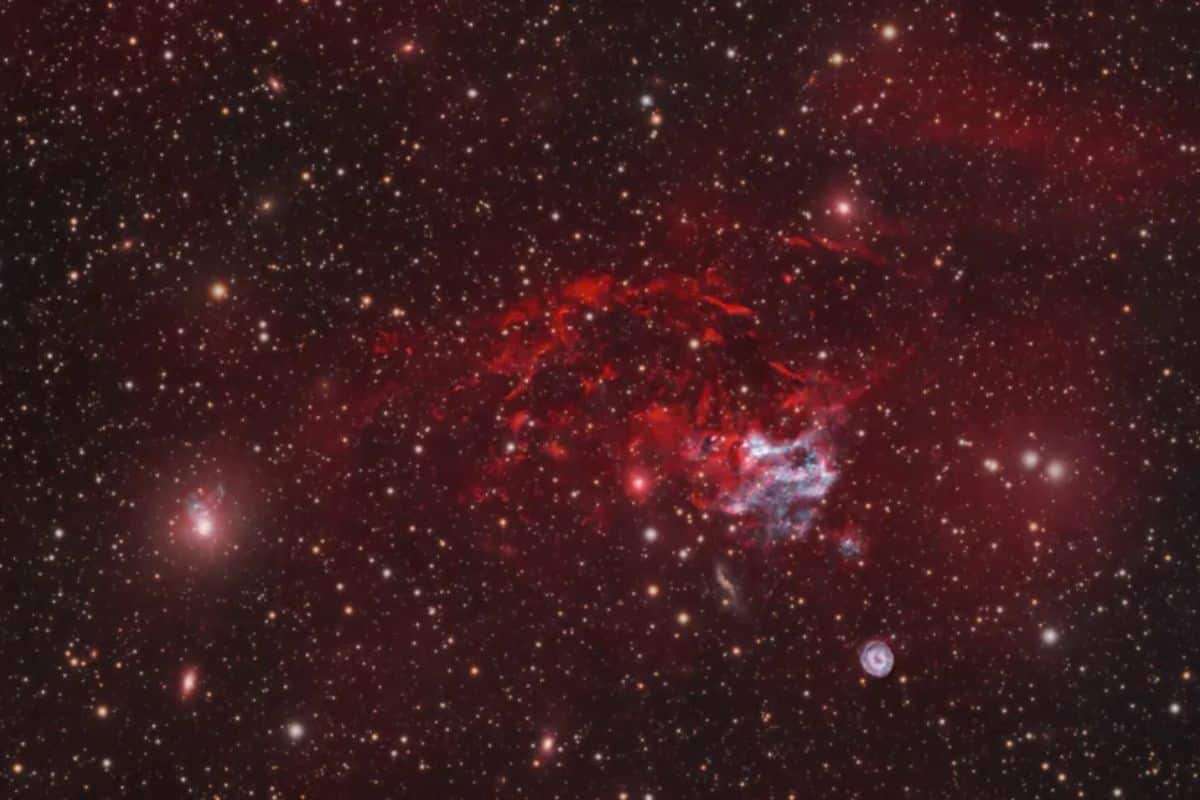
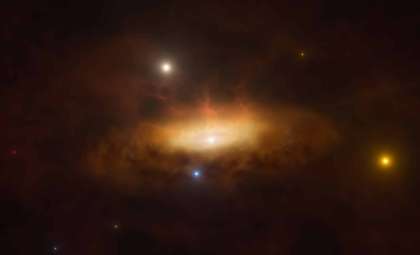
A 17-year-old student from New York has made a remarkable astronomical discovery — a cosmic light echo that may extend over an area nearly double the Milky Way's diameter. While analyzing space for remnants of fading stars, Julian Shapiro found a luminous formation that is actually the lingering glow of a once-active black hole.
A Surprising Discovery in the Depths of Space
While reviewing data from the DECaPS2 survey, Julian Shapiro, a pupil at The Dalton School, was initially searching for signs of supernova remnants — the faint, gaseous traces of long-exploded stars.
However, he encountered a peculiar object that did not match the typical characteristics of such remnants, lacking signs like central explosion debris or filamentary structures.

“There are these outer regions of gas being ionized by a supermassive black hole, which results in this echo,” he said during his presentation at the 2025 American Physical Society Global Physics Summit.
The phenomenon he detected is known as a light echo — a ghostly glow produced when radiation from a black hole continues to illuminate surrounding material even after the black hole ceases active emissions.
A Celestial Signature of a Dormant Giant
With assistance from the Southern African Large Telescope, Shapiro observed elevated concentrations of ionized sulfur and oxygen, which indicate gas excited by powerful radiation.
These findings point strongly to a supermassive black hole that was active in the past, emitting energy that energized the surrounding gas. Although it has since gone dormant, the black hole's influence endures in this expansive light echo. “Discovering this was truly unexpected,” Shapiro commented.
Potentially the Largest Light Echo Identified
The dimension of this light echo is truly breathtaking, extending an estimated 150,000 to 250,000 light-years.
For context, the full width of the Milky Way galaxy spans about 100,000 light-years. If verified, this would represent the largest light echo ever observed.
The enormous scale also allows astronomers to capture detailed images more easily, a rare benefit in this research area. Experts say findings like Shapiro’s help reveal the hidden histories of galactic nuclei.
“Light echoes such as this give us a powerful window into understanding black hole activity,” explained Sasha Plavin from Harvard University. “They reveal how black holes behaved prior to becoming inactive.”
These echoes act as cosmic records, showing how long a black hole emitted energy and how far that energy spread throughout space.
A Young Researcher Breaking New Ground
Julian Shapiro’s passion for astrophysics has already propelled him to notable achievements. Amid his schoolwork and college preparations, he is actively sharing his research on global platforms.
He aims to deepen his analysis of the light echo's chemical makeup and geometry, utilizing data from various parts of the glowing cloud.
“My involvement in this area of research came as a bit of a surprise to me,” he said.” But I hope this object, in particular, helps expand the knowledge of galaxy activities that we don’t have too great of an understanding of.”
The Power of Curiosity on a Galactic Scale
This discovery highlights more than just chance — it underscores how accessible modern astronomy has become. Thanks to publicly available data and sophisticated tools, ambitious young scientists can contribute significantly to our understanding of the universe. Shapiro’s identification of this gigantic light echo demonstrates that major breakthroughs aren’t confined to large observatories alone.
- Categories:
- Space




0 comments
Sign in to Comment