
Mars has always intrigued scientists as a potential site for human colonization, yet its hostile conditions—extreme cold, minimal atmosphere, and absence of readily available liquid water—have hindered such ambitions. New research introduces an innovative solution: deploying engineered aerosols to raise surface temperatures, potentially making Mars hospitable within just 15 years. This novel strategy could revolutionize our approach to turning the Red Planet into a viable environment for future explorers.
Challenges and Controversies in Making Mars Livable
For many years, researchers have explored ways to create a more Earth-like climate on Mars. The planet endures harsh average temperatures around -55°C, with lows plunging to -125°C during dust storms. Mars’ thin atmosphere, dominated by carbon dioxide, and the lack of surface liquid water pose significant obstacles for human survival.
Previous proposals, including melting polar ice caps or detonating nuclear devices to simulate artificial suns, have faced skepticism. Even high-profile ideas like those from Elon Musk involving nuclear explosions have been criticized; climate models suggest such tactics would only minimally enhance the greenhouse effect, insufficient for sustaining liquid water.

Now, the spotlight turns to engineered aerosols. This approach involves dispersing particles that interact with infrared radiation, leveraging Mars’ natural dust to trap heat and incrementally warm the planet. If successful, this could herald a new era in planetary engineering with a more consistent and effective warming process.
Innovative Approach: Aerosol Engineering to Heat the Martian Surface
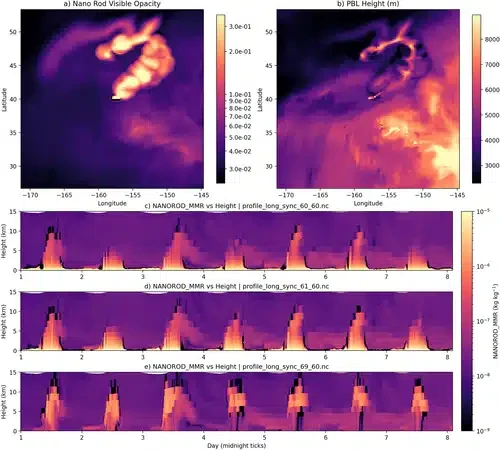
Under the leadership of Mark I. Richardson at Aeolis Research, a study published in Geophysical Research Letters models aerosols not as fixed particles but as dynamic elements within Mars’ atmosphere. The researchers simulated the effects of ultra-small graphene discs and aluminum rods, which absorb and reflect thermal infrared radiation emitted by Mars’ surface, causing a gradual temperature increase.
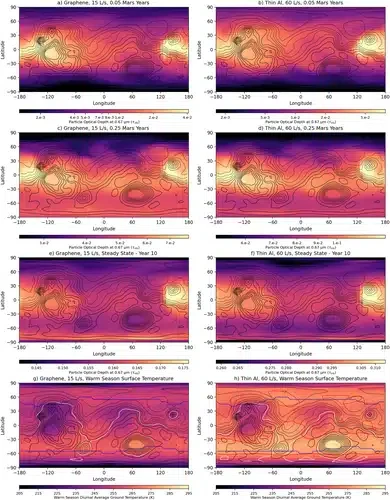
The findings suggest a continuous release of these particles could raise surface temperatures significantly. After about 8 Martian years, the surface temp might climb by 25°C, and within 15 years, it could settle near 35°C. Such a thermal shift could create conditions conducive to liquid water, offering a hopeful prospect for future habitability.
Detailed Modeling: Unpacking the Study’s Methodology
The research applies a comprehensive 3D global model simulating aerosol distribution over time. For the first five years, particles were released at a modest 3 liters per second, increasing twentyfold to 60 liters per second afterward. The model integrates Mars’ natural dust activity and assumes a stable atmosphere without dust storms.
Remarkably, after 8 Mars years, surface temperatures soared from a baseline near 3°C to roughly 25°C above normal levels. By year 15, the climate stabilized close to 35°C, potentially permitting liquid water to exist—an essential factor for any human settlement.
Though promising, the study underscores its preliminary nature. Researchers acknowledge,
“This study addresses only some aspects of the question of how IR‐active particle release might modify Mars’ climate: atmospheric processes are inherently complex, and many open questions remain.”
Challenges include understanding feedbacks from Mars’ water cycle and the clumping behavior of aerosols, which could decrease their heating efficiency.
Looking Ahead: Remaining Puzzles and Obstacles in Mars Terraforming
Despite encouraging results, uncertainties persist regarding aerosol dynamics in the Martian atmosphere. Key concerns include how the planet’s water cycle will react to warmer temperatures. Introducing more water vapor could amplify warming, but aerosols might also serve as nuclei for ice or clouds, leading particles to precipitate out and potentially limit their warming impact.
Moreover, Mars’ frequent and prolonged dust storms could either enhance or counteract aerosol effects. These storms may loft additional dust, triggering feedback loops that intensify warming or, alternatively, diminish aerosol longevity. Comprehensive future studies must address these factors to accurately predict outcomes.
In summary, this research provides an exciting glimpse into how Mars might be warmed to support life. However, scientists emphasize that many complex atmospheric processes remain poorly understood, requiring ongoing investigations to realize the goal of terraforming the Red Planet.
- Categories:
- Astronomy




0 comments
Sign in to Comment