
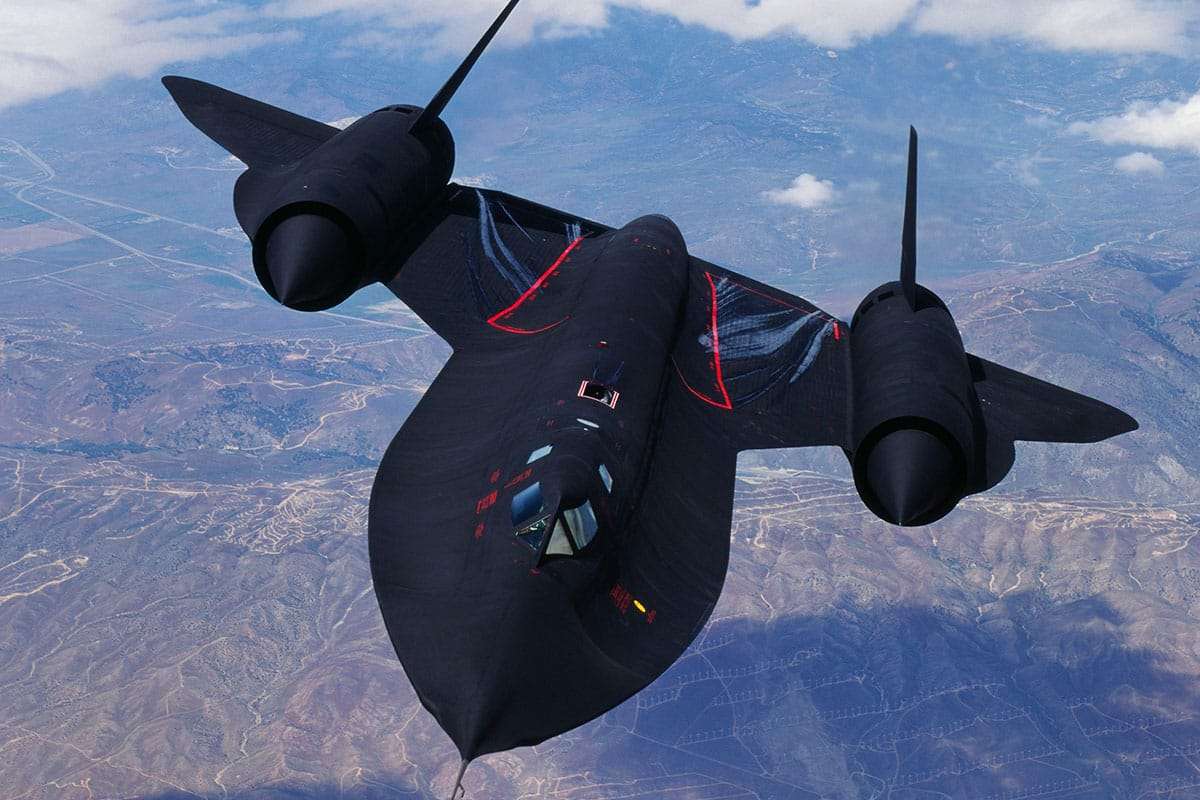
Following World War II, the global divide between East and West intensified, ushering in the Cold War era marked by fierce technological rivalry and an arms race between the United States and the Soviet Union.
To enhance surveillance capabilities, the United States initially deployed the U-2 reconnaissance aircraft. Yet, as enemy defenses advanced, the demand for a faster, higher-flying aircraft led to the creation of the SR-71 Blackbird by Lockheed.
Crafted by the expert Lockheed Skunk Works, headed by Clarence “Kelly” Johnson, the SR-71 took flight for the first time in 1964. Its signature black coating wasn’t merely for looks—it helped to manage the intense heat generated during hypersonic speeds, a factor that earned it the nickname “Blackbird.”

Though an engineering masterpiece, just 32 SR-71 units were produced from 1964 until its retirement in 1998, adding to its enigmatic reputation and legendary appeal.
Breaking boundaries: The unparalleled speed of the SR-71
The SR-71 Blackbird is renowned for its staggering velocity. It was capable of reaching speeds exceeding Mach 3 (nearly 3,500 km/h or 2,200 mph), soaring beyond the reach of contemporary missile systems.
This astonishing speed enabled record-breaking achievements such as the 1974 flight between New York and London in under two hours, a phenomenal contrast to the typical seven-hour commercial flight.
Key specifications of the SR-71 included:
- A maximum takeoff weight of 65 tons
- A wingspan measuring 16.94 meters (55.6 feet)
- A length stretching 32.74 meters (107.4 feet)
- An operational ceiling near 25,000 meters (82,000 feet)
Equipped with two Pratt & Whitney J58 turbojet engines with afterburners, the Blackbird could cruise at altitudes nearing 20,000 meters (65,600 feet), rendering it nearly invulnerable to enemy interception.
Engineering brilliance: Distinctive features of the SR-71
The SR-71’s extraordinary capabilities stemmed from innovative design elements and advanced technology, such as:
FeatureFunctionTitanium airframeEndures extreme heat caused by supersonic flightChinesEnhances lift and reduces radar visibilityCorrugated skin panelsAccommodate thermal expansion at high speedsSpecialized fuel (JP-7)Designed with a high flash point to resist intense heat
The SR-71's structure expanded several inches during flight due to heat-induced expansion, which led it to leak fuel on the ground since the tanks only sealed fully when warmed to flight temperatures.
The SR-71 Blackbird’s enduring influence and heritage
Though decommissioned in 1998, the SR-71 Blackbird remains an emblem of innovation and imagination. Its streamlined design and unmatched speed have cemented its place in pop culture, featured in multiple movies, television series, and video games.
Beyond entertainment, the aircraft has inspired countless aerospace professionals and contributed technologies that extend into materials science and propulsion advancements.
Several SR-71 Blackbird planes are preserved in American museums as a tribute to the technological feats of the Cold War period and America's engineering prowess.
Today, the SR-71 Blackbird stands as a powerful symbol of human ingenuity and achievement, a breathtaking example of how daring designs can redefine the limits of aviation.
- Categories:
- Aircraft








0 comments
Sign in to Comment