
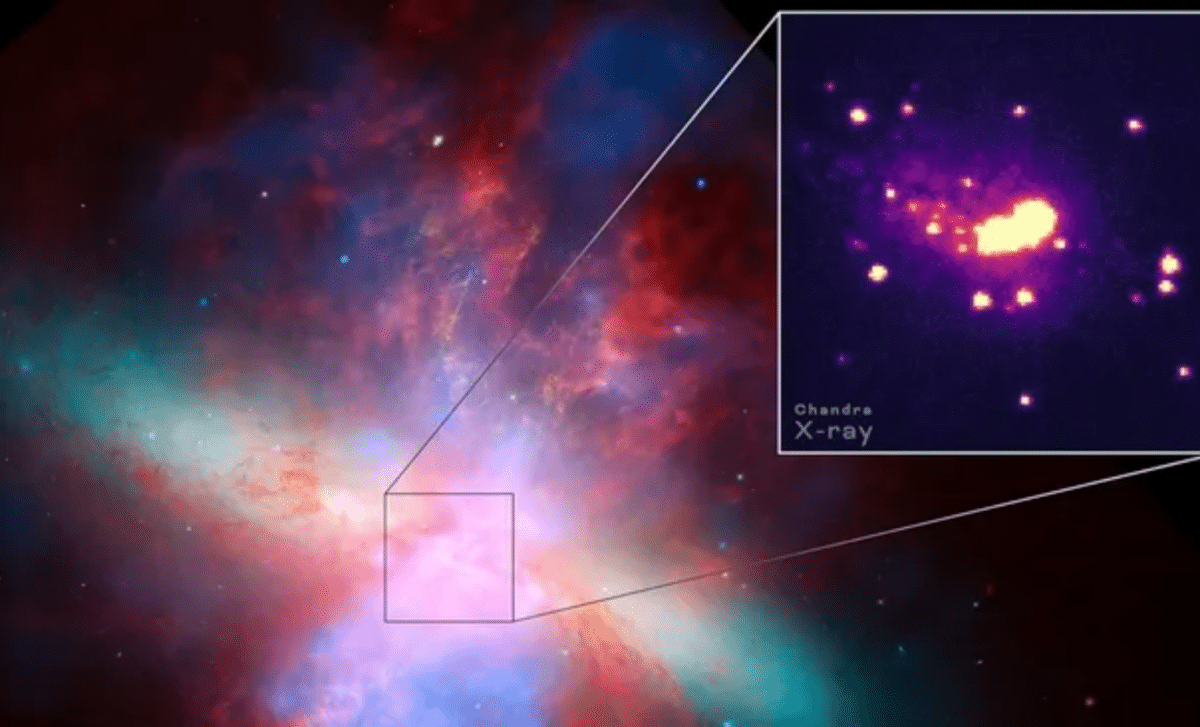
For the first time, scientists have recorded winds from the starburst galaxy M82 moving at incredible speeds, challenging previous assumptions. Using data from NASA’s XRISM observatory, researchers have confirmed wind speeds surpassing 2 million miles per hour, much faster than earlier estimates.
Featured in Nature, this discovery not only pushes the limits of current astrophysical knowledge but also questions existing theories about the lifecycle and structure of galaxies like M82.
The Astonishing Winds Originating from M82
M82, often called the Cigar Galaxy, is famous for its vigorous star-forming activity. Recent insights from NASA’s XRISM mission have highlighted an even more remarkable phenomenon: massive winds flowing outward from the galaxy. These streams of gas and dust extend roughly 40,000 light-years from the galactic center and reach speeds of over 2 million miles per hour.

Previously, scientists relied heavily on theoretical frameworks to estimate the intensity and velocity of such galactic outflows. Typically, intense star formation and nearby supernova explosions produce shock waves that heat gas and trigger these powerful winds. However, before XRISM, the technology to measure actual wind speeds was unavailable.
“Prior to XRISM, we didn’t have the ability to measure the velocities needed to test that hypothesis,” says Erin Boettcher, a member of the research team from the University of Maryland and NASA’s Goddard Space Flight Center. “Now we see the gas moving even faster than some models predict, more than enough to drive the wind all the way to the edge of the galaxy.”
This revelation offers far-reaching implications beyond mere curiosity. Understanding M82’s powerful outflows brings us closer to uncovering the essential mechanisms behind galaxy formation and cosmic evolution.
The Driving Force Behind the Galactic Winds
At M82’s core resides an extraordinary hub of stellar creation, bursting with activity from star births, supernova blasts, and intense cosmic radiation—all fueling the potent winds observed. NASA’s XRISM mission has determined not only the speed of these winds but also the extreme temperatures reaching 45 million degrees Fahrenheit (25 million degrees Celsius) near the galaxy’s center. This incredible heat produces high pressure, propelling winds outward much like atmospheric air flows on Earth.
The winds streaming from M82 exhibit both remarkable velocity and significant energy potential.
“If the wind blows steadily at the speed we’ve measured, then we think it can power the larger, cooler wind by driving out four solar masses of gas a year,” explains Edmund Hodges-Kluck, a member of the XRISM team in a statement. “But XRISM tells us much more gas is moving outward. Where do the three extra solar masses go? Do they escape out of the galaxy as hot gas some other way? We don’t know.”
This enigma highlights the complexity of the galactic wind system, motivating further research into the mechanisms that expel material from M82 and the forms in which it leaves.
Fresh Insights and Emerging Mysteries
XRISM’s observations have not only clarified existing theories but have introduced new puzzles concerning galaxy dynamics. The revelation of faster winds and unexpected mass ejection calls for updates to traditional starburst galaxy models. “Many of our original starburst galaxy theories date back to the 1980s, and XRISM now enables us to test them with unprecedented precision,” notes Skylar Grayson from Arizona State University, also part of the research team. “This opens doors to uncovering why prior models might miss key aspects of real galactic behavior.”
As XRISM continues monitoring M82, astronomers anticipate refining the frameworks that explain its extraordinary activity, potentially uncovering more surprises that deepen our comprehension of galaxy evolution throughout the cosmos.
- Categories:
- Space





0 comments
Sign in to Comment