

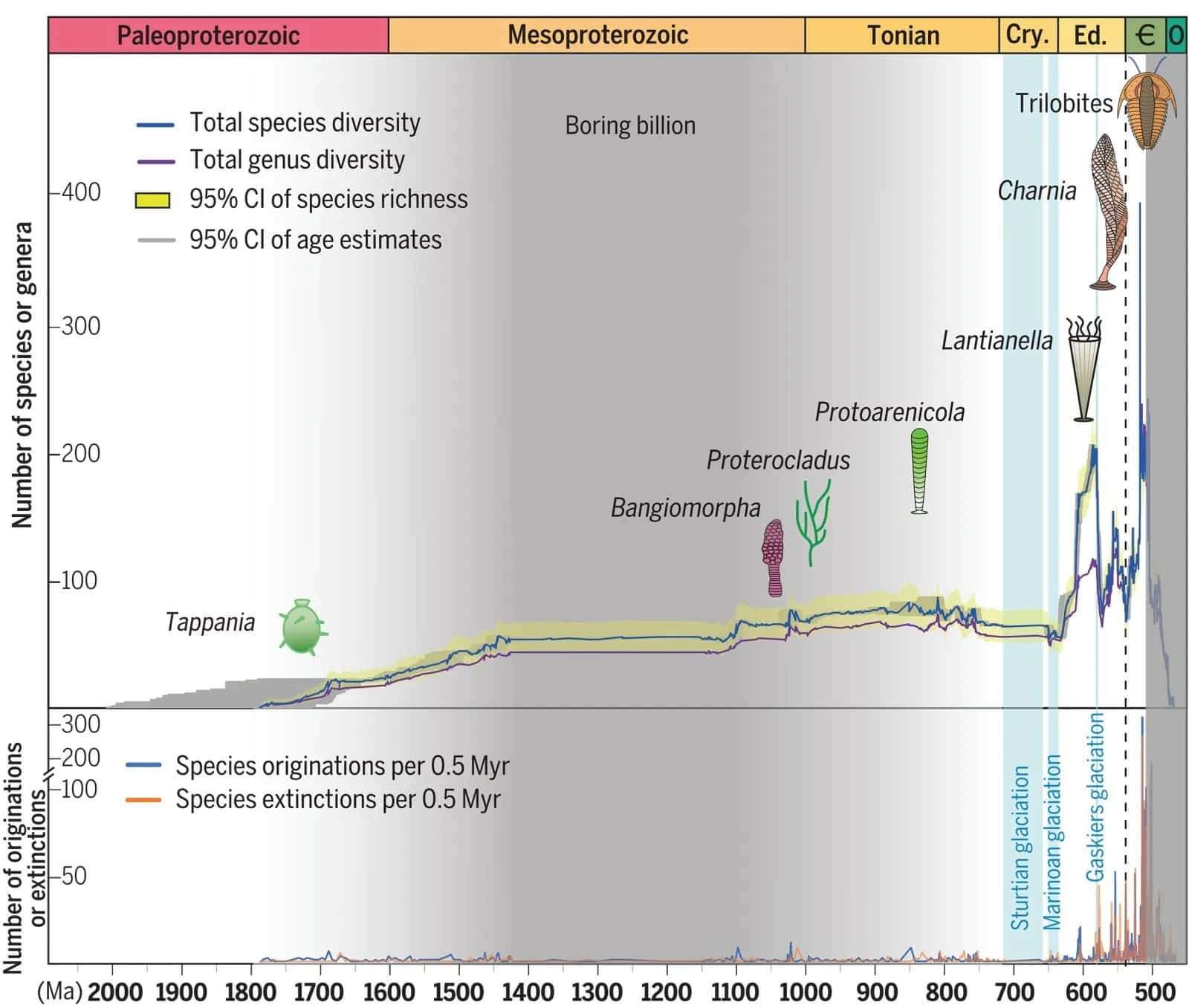
The saga of life’s evolution on Earth features periods of gradual change interrupted by sudden bursts of innovation, influenced by shifts in the environment and biological adaptability. A team at Virginia Tech has charted nearly two billion years of life’s history, revealing a remarkable phase of evolutionary dormancy termed the “Boring Billion,” which was eventually succeeded by a remarkable surge in species variety after ancient glaciations. Their research, published in Science, illuminates the repeated cycles of life’s development and the environmental catalysts that shape evolutionary progress.
Investigating marine eukaryotic fossils—organisms with nucleated cells—the scientists uncovered that although eukaryotes first appeared around 1.8 billion years ago, their diversity stayed largely unchanged for over a billion years. The evolutionary impasse was overcome by the drastic climatic shifts of the “Snowball Earth” ice ages, events that redefined Earth’s biological trajectory and set the stage for rapid diversification.
This study enhances our grasp of Earth’s early biodiversity and provokes deeper inquiry into the dynamics between life and environmental change. Why did evolution nearly stall during the “Boring Billion”? What spurred the explosion of life following the planet’s icy crises? These questions remain central to piecing together life’s complex evolution.

Evolution on Hold: Decoding the “Boring Billion” Era
The “Boring Billion” describes a stretch from roughly 1.45 to 0.72 billion years ago where eukaryotic diversity showed little fluctuation. Evolutionary shifts were scarce, and species turnover was minimal—signaling a period of pronounced biological stability. But what contributed to this evolutionary standstill?
This era’s calm is largely attributed to steady environmental factors. Persistent oxygen concentrations in the atmosphere and oceans meant fewer pressures to drive species change, allowing many organisms to persist unchanged for extensive spans of time.
Nonetheless, this stagnation puzzles scientists because it sharply contrasts with other dynamic chapters in Earth’s biological history. Gaining insight into this interval is essential for understanding what conditions limit or catalyze evolutionary progress and what factors ultimately revived diversity.
Ice Ages as a Catalyst for Evolutionary Change
The intense “Snowball Earth” glaciations between approximately 720 and 635 million years ago stand out as some of the most severe climate episodes in our planet’s past. Far more than just reshaping landscapes, these glacial periods reconfigured the evolutionary path of life.
Glacial expansion decimated numerous ecosystems, eliminating many species and opening fresh ecological opportunities. When warmth returned and ice melted, it triggered a cascade of evolutionary activity spurred by rising atmospheric oxygen levels.
Higher oxygen availability supported advanced cellular respiration, which was critical for the development of increasingly complex and varied organisms. Consequently, multicellular life emerged and eukaryotic diversity surged. These ice ages effectively wiped the slate clean, enabling new evolutionary possibilities.
Implications for Evolutionary Research and Understanding
Virginia Tech’s comprehensive study of fossil records represents a major advancement in piecing together Earth’s ancient biodiversity. Employing sophisticated graphical correlation methods has allowed for finer chronological clarity, revealing intricate evolutionary patterns and mechanisms.
The research provokes essential questions about evolutionary pacing and triggers: Why was the pace so slow during the “Boring Billion”? What specific environmental or biological changes sparked the rapid diversification after the glaciations? Continued investigation into these mysteries will sharpen our understanding of life’s history.
This work also underscores the deep relationship between geological events and biological evolution, illustrating how drastic climatic shifts can simultaneously cause extinctions and innovations. By decoding the ancient past, this research lays a foundation for interpreting the forces that have been shaping life over billions of years.
Reading Earth’s Biological Chronicle
Life’s journey on Earth is defined by endurance and transformation amid constant environmental shifts. The “Boring Billion” period and subsequent ice ages exemplify transformative episodes that cast new light on evolutionary drivers. As scientific inquiry delves further into these ancient epochs, findings such as these highlight the profound synergy between life and the planet.
Source: Science
- Categories:
- Science








0 comments
Sign in to Comment