
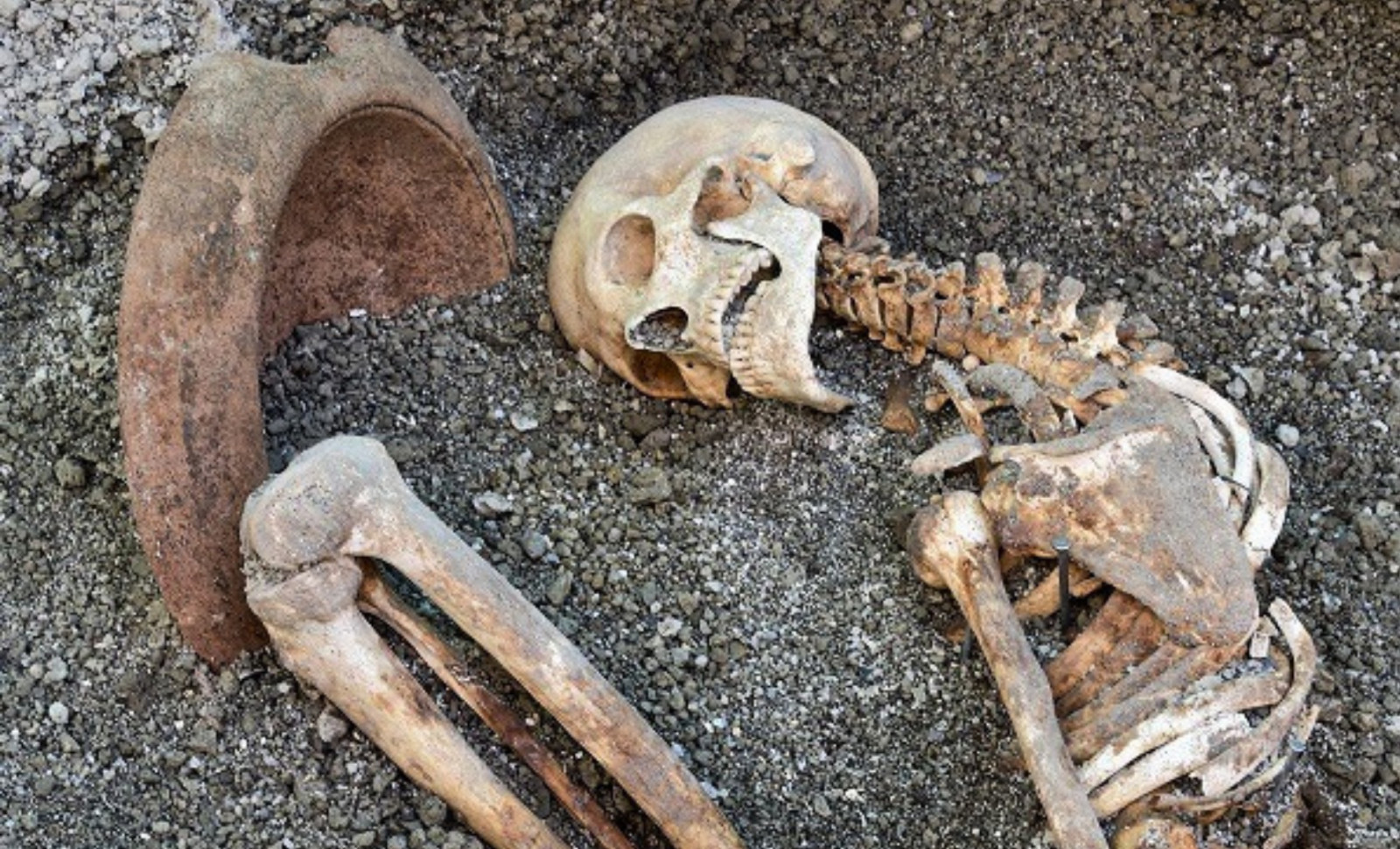
Nearly two millennia after Mount Vesuvius catastrophically buried Pompeii under layers of ash and pumice, scientists have employed artificial intelligence to recreate the visage of a man who perished while escaping the deadly eruption. This reconstruction is based on skeletal remains uncovered in a newly excavated necropolis just beyond the ancient city's fortifications.
Discovered near the Porta Stabia gate, the remains belonged to a man who shielded himself from volcanic debris with a large terracotta cooking mortar held above his head, an improvised protective measure against falling stones and lapilli, according to the Pompeii Archaeological Park's April 27, 2026 statement.
The AI-generated artwork, named “Fuga dall’eruzione” (Escape from the Eruption), depicts the man sprinting along a rubble-strewn path, with Mount Vesuvius erupting ominously behind him. A younger companion is visible nearby, likely another victim who was soon overtaken by a swiftly advancing pyroclastic flow, the park explained.

Personal Artifacts Tell a Story
The male victim’s skeleton was excavated during recent digs at the Porta Stabia necropolis, which lies just outside the city walls of Pompeii. The remains of a second individual were found adjacent to his, the park reported.
He died in the initial stages of Vesuvius’s eruption, prior to the lethal pyroclastic flows that eventually enveloped much of Pompeii. As he sought refuge toward the coastline, he was struck by falling volcanic material, according to archaeological reconstructions.
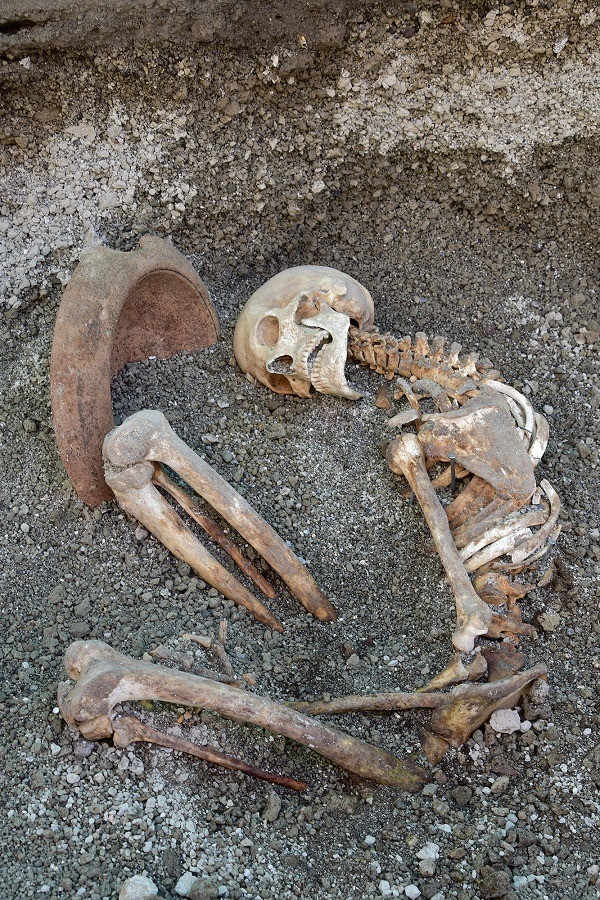
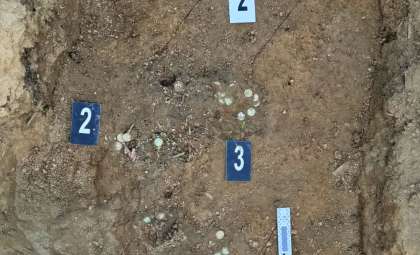
Associated objects helped piece together his final moments: a ceramic oil lamp, used to light his way through the ash-darkened environment; ten small bronze coins; and a small iron ring still gripping the pinky finger of his left hand, the park stated.
The heavy terracotta mortar, normally employed in food preparation, was the most unusual find. It served as a helmet-like shield against the raining volcanic debris.
Steps Behind the Reconstruction Process
Scientists began by compiling detailed anthropometric measurements from the skeleton. Using specialized AI technology, these anatomical markers were translated into a credible facial model, the archaeological park detailed.
Following the AI’s initial render, researchers applied sophisticated photo-editing methods to enhance the image’s anatomical precision and historical authenticity. This technical work was conducted at the University of Padua’s laboratory.
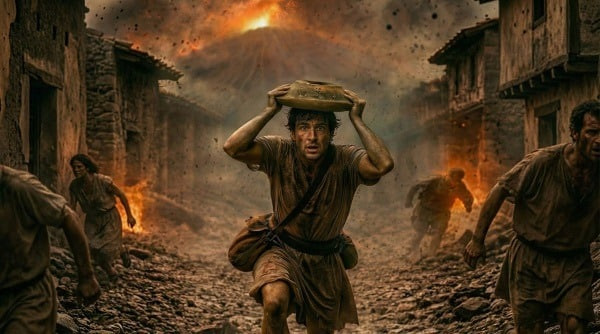
Reuters reports that experts gathered comprehensive data on the skeletal remains and burial context prior to AI analysis. The final two-dimensional image was then refined using graphic editing to ensure historical and anatomical fidelity.
Italian Culture Minister Alessandro Giuli described Pompeii as “perhaps the most prestigious place in the world for archaeological research, where every new discovery sheds vibrant light on ancient life.”
Gabriel Zuchtriegel, director of the archaeological park, remarked that when properly applied, artificial intelligence "can spark a revival in classical studies, offering a more immersive glimpse into the ancient world,” as noted in the park’s release.
Additional Discoveries at the Porta Stabia Necropolis
This facial reconstruction complements a series of recent findings in the Porta Stabia necropolis, per the official Pompeii Archaeological Park announcement.
Excavations there have unearthed several graves and funerary monuments just outside one of Pompeii’s main city gates. This site was traditionally used for burials before the 79 A.D. eruption, in keeping with Roman customs that forbade interments inside city walls.
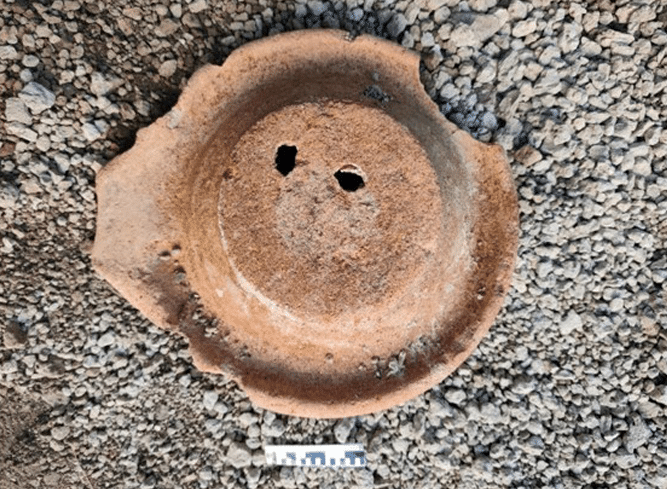
The two individuals appeared to have perished during the eruption’s early stages, inferred from their burial positions and volcanic materials covering their remains, the park indicated. The man’s makeshift shield and oil lamp suggest he actively tried to survive, contrasting with many Pompeii victims who were trapped indoors.
The park has not disclosed the precise number of burials found during this excavation phase. Details about the younger figure’s age remain limited to the description of “younger.”
Contemplating the Ethics of AI Reconstructions
The project has stirred debate over whether digitally recreating the appearances of disaster victims honors their memory or risks exploitation. The park recognizes that generating “digital twins” of ancient individuals evokes complex ethical issues, as the deceased cannot consent to such portrayals.
The park emphasizes that this reconstruction is intended solely as an educational resource designed to foster empathy and connection with ancient history, rather than for entertainment or commercial purposes.
In July 2026, the park will host an event called “Orbits – Dialogues with Intelligence” that aims to delve into the philosophical, ethical, and practical roles of artificial intelligence in archaeology, according to their announcement.
- Categories:
- News








0 comments
Sign in to Comment