
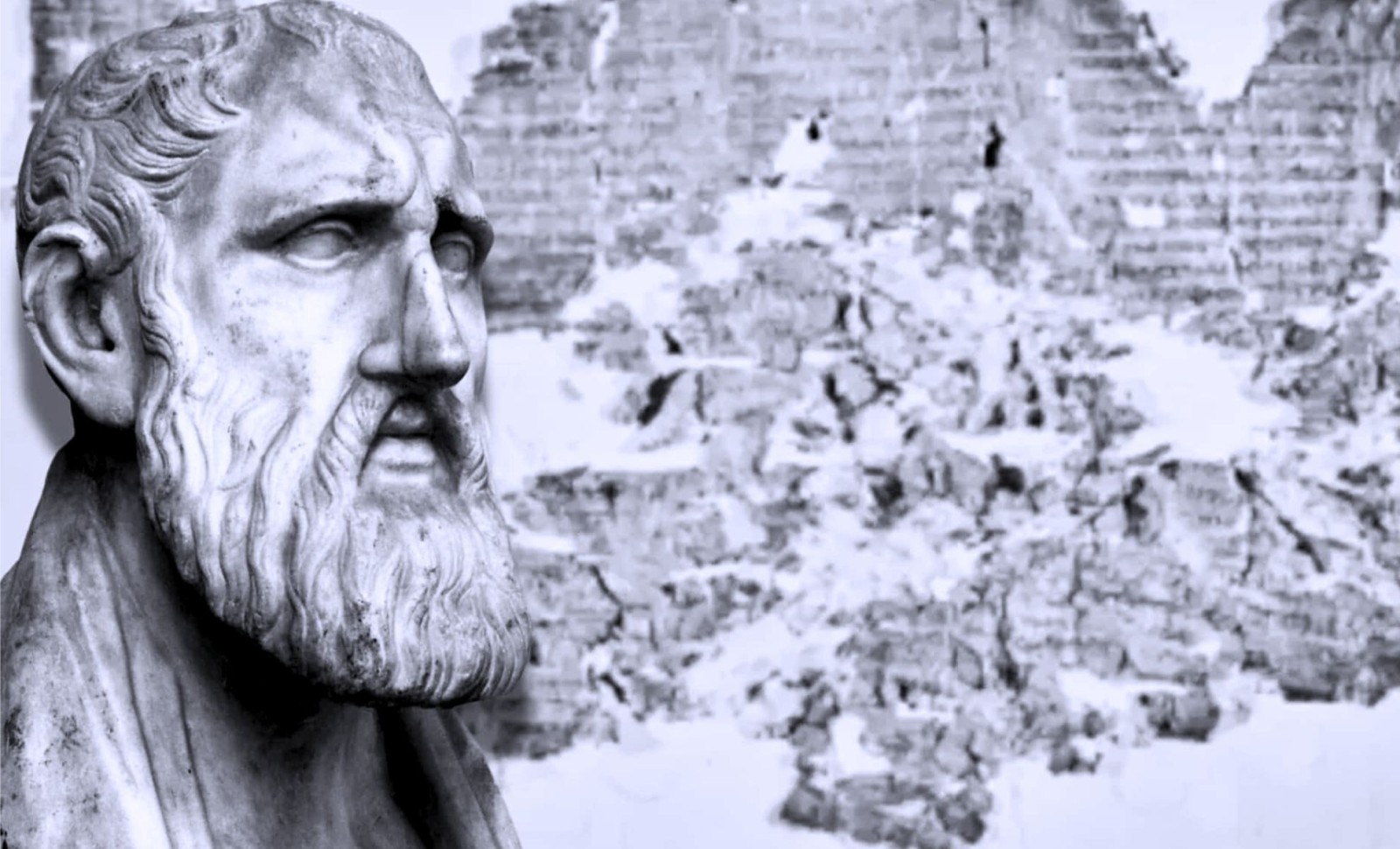
For almost 2,000 years, a once-glorious library entombed beneath the volcanic ash of Mount Vesuvius lay silent. Within its charred remains were fragile, ink-stained scrolls blackened beyond recognition. One such manuscript from Roman Herculaneum was assumed lost—sealed by disaster, yet rendered undecipherable.
That changed recently when Italian scientists adapted a technique from aerospace engineering to reveal the scroll’s contents without physically opening it. Utilizing pulsed thermography, they successfully extracted the writing hidden inside the scroll—a breakthrough never before accomplished in classical archaeology. The message uncovered upends long-held views about Stoic philosophy.
The text originates from The History of the Stoa, penned by the 1st-century BCE thinker Philodemus of Gadara. His narrative delivers a new perspective on Zeno of Citium, Stoicism’s founder. Contrary to portrayals of Zeno as a venerable sage, he emerges here as a political outsider whose radical social ideas were systematically suppressed by later Stoics.

Revolutionizing Ancient Text Recovery with High-Tech Imaging
The scroll was discovered at the Villa dei Papiri, a luxurious Roman estate linked to Julius Caesar’s father-in-law. When volcanic ash buried the site in 79 AD, it preserved the library yet rendered its texts unreadable. Unlike stone or parchment, papyrus reacts drastically to intense heat, becoming fragile, carbonized tubes that crumble when touched.
Previous efforts over two centuries to access these scrolls largely ended in damage. Recently, a team at the University of Pisa, led by Graziano Ranocchia, applied pulsed thermography: a technique adapted from detecting microcracks in aircraft. A momentary heat flash followed by high-precision thermal imaging highlighted subtle differences in cooling between ink and papyrus.
This allowed patterns invisible to the eye to appear clearly. As detailed in a GB News article, these thermal contrasts enabled scholars to decipher the text without unrolling the fragile scroll—a groundbreaking achievement in manuscript preservation.
The Radical Roots of Stoicism Revealed
Philodemus’s text casts Zeno of Citium not as the noble philosopher but as a marginalized Phoenician immigrant in Athens, afflicted by frailty, poor diet, and social exile. His accent and background exposed him to derision.
Most provocative are Zeno’s ideas, which his successors sought to erase. The recovered passages show Zeno challenging fundamental practices such as marriage, family structure, ownership, legal systems, and money. He famously supported communal sharing of partners, dismantling private marriage, and embracing same-sex relationships—views highly controversial in both Athens and Rome.
Philodemus mentions that early Stoics regarded Zeno’s proposals as “morally questionable.” As reported by GB News, these contentious doctrines were deliberately excised from later Stoic philosophy, which refocused on personal virtue and civic responsibility in harmony with Roman elite ideals.
This transformation was far from coincidental—it served political interests.
How Imperial Rome Shaped Stoic Thought
By the era of Marcus Aurelius, Stoicism was embraced by emperors, legislators, and generals. Its teachings on discipline and reason reflected the values of Rome’s ruling class. However, Zeno’s original teachings—melding metaphysics with revolutionary social theory—clashed with imperial order.
The newly revealed scroll confirms that Stoicism’s most subversive ideas were methodically expunged. What initially advocated gender equality, property abolition, and a stateless society governed by reason was reshaped into a philosophy of moderation and public duty. These radical beginnings were effectively buried—first politically, then beneath volcanic rubble.
Additionally, the find highlights the value of direct archaeological evidence. Philodemus’s writing offers a counter-narrative challenging the sanitized version of Stoic history preserved by those in power.
With about 1,800 scrolls still entombed at Herculaneum, per the University of Pisa’s Herculaneum Papyri Project, many more may await rediscovery. These texts might reveal other suppressed or forgotten philosophies—whether political, literary, or philosophical. As imaging methods advance, scholars anticipate a decades-long endeavor to restore the lost voices of ancient civilization.
- Categories:
- News









0 comments
Sign in to Comment