
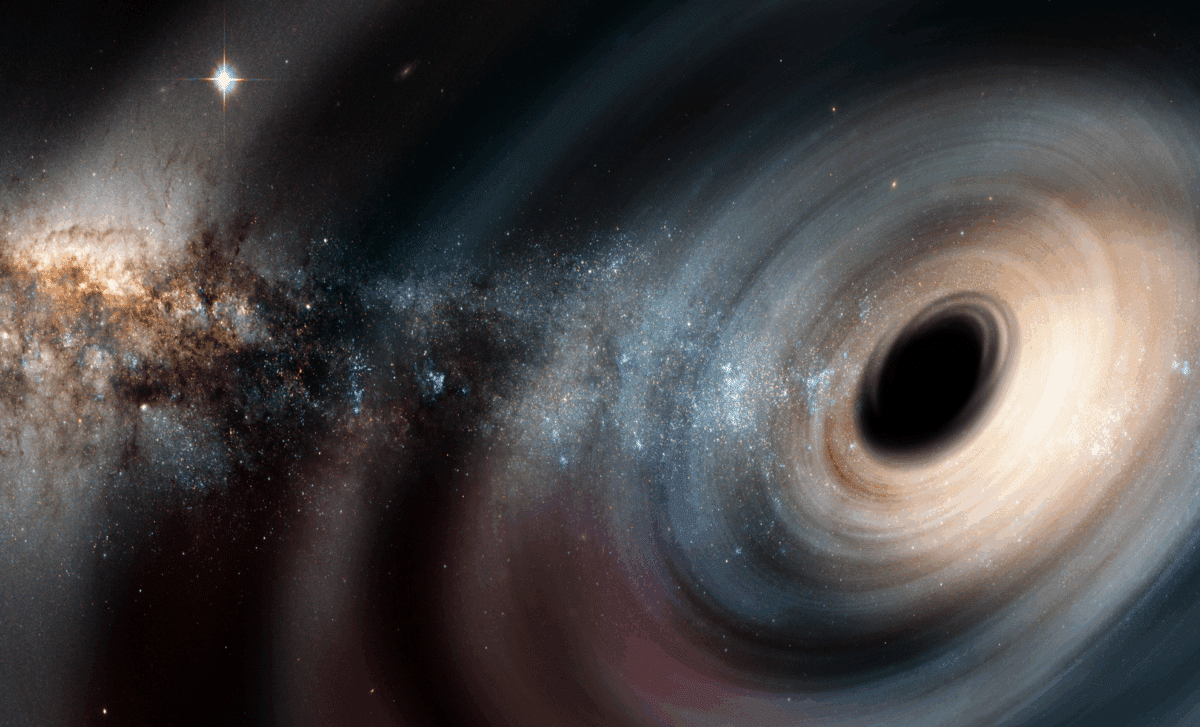
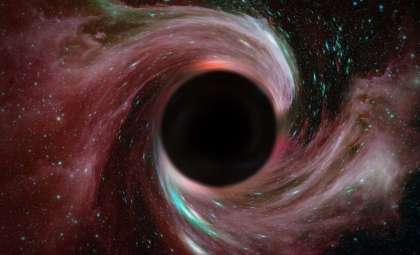
A recent breakthrough study published in PRX Quantum showcases how a team led by Enrico Rinaldi harnessed artificial intelligence and quantum computing to model the quantum composition of black holes. This pioneering method enables scientists to examine these enigmatic cosmic entities beyond the event horizon, opening new avenues to harmonize two foundational theories in physics: general relativity and quantum mechanics.
Uniting General Relativity with Quantum Theory
For decades, physicists have faced the challenge of uniting general relativity—which governs gravity at cosmic scales—with quantum field theory that explains particle interactions at the smallest scales. Though both frameworks excel in their domains, they appear fundamentally incompatible. As Enrico Rinaldi states,
“In Einstein’s General Relativity, space-time exists but there are no particles. In the Standard Model, particles exist, but there’s no gravity.”
Add Cosmo Herald as a Preferred Source

This tension has hindered the formulation of a consistent theory of quantum gravity. Rinaldi's research advances the field by applying the holographic principle, which posits that three-dimensional gravitational phenomena can be represented by two-dimensional quantum systems. This conceptual bridge brings renewed optimism for combining these disparate theories.
Matrix Models: Unlocking Black Hole Mysteries
Central to this investigation are matrix models, complex mathematical frameworks originating from string theory. These models treat particles as tiny vibrating strings rather than points. Applied to black holes, matrix models depict the dense string structures that make up these celestial bodies. Directly solving these models is a formidable challenge.
The team leveraged quantum computing, employing quantum circuits and neural networks to test algorithms on simplified but representative versions of these models. Their goal was to identify the system’s “ground state”—the lowest energy condition that is thought to reflect the core features of space-time. Rinaldi elaborates,
“It’s really important to understand what this ground state looks like, because then you can create things from it. For a material, knowing the ground state is like knowing, for example, if it’s a conductor, or if it’s a super conductor, or if it’s really strong, or if it’s weak.”
Quantum Algorithms: Orchestrating the Universe’s Fundamental Patterns
Simulating these matrix models using advanced quantum algorithms is a complex endeavor. The process can be compared to composing a grand symphony: every qubit acts as a distinct wire, and quantum gates represent musical notes that change the qubit states in a carefully ordered sequence. Unlike classical music, this quantum composition evolves in intricate and unpredictable ways, demanding precise tuning to achieve the intended outcome.
“You can read them as music, going from left to right,” Rinaldi says. “If you read it as music, you’re basically transforming the qubits from the beginning into something new each step. But you don’t know which operations you should do as you go along, which notes to play. The shaking process will tweak all these gates to make them take the correct form such that at the end of the entire process, you reach the ground state. So you have all this music, and if you play it right, at the end, you have the ground state.”
The “shaking process” mentioned refers to the iterative refinement in the quantum algorithm as it adjusts gate operations to find the system’s optimal state. This successful simulation marks a major advance in our quest to decode black holes, gravitational phenomena, and the fundamental nature of space and time.
- Categories:
- News






0 comments
Sign in to Comment