
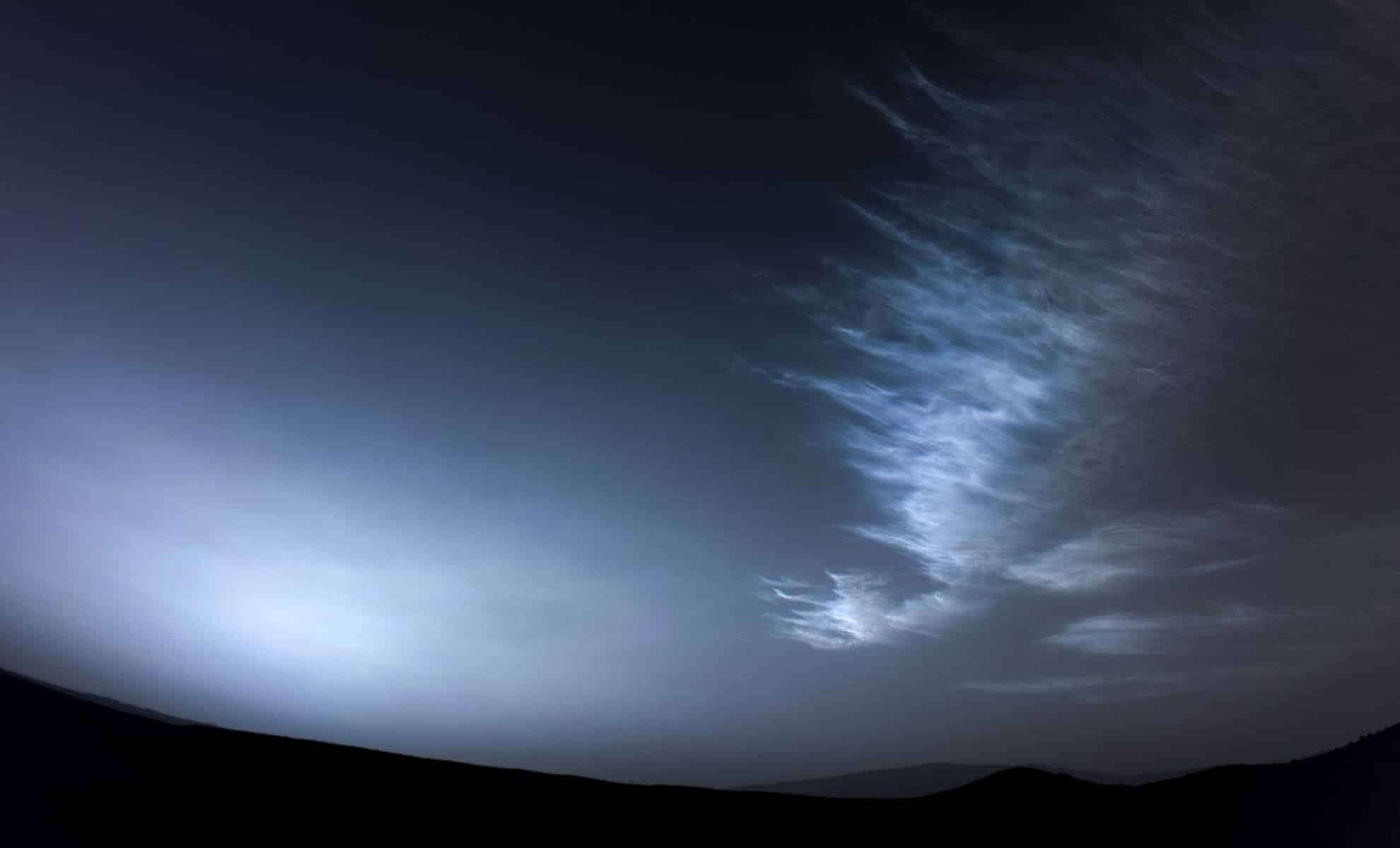
For years, Mars has intrigued scientists due to its Earth-like qualities, but new findings reveal that the planet’s atmospheric dynamics differ sharply from those on Earth. A recent study identifies gravity waves—not Rossby waves—as the primary drivers of Martian wind behavior, challenging previous assumptions and offering fresh insights for forecasting Mars’ weather.
Revolutionizing Our Understanding of Martian Winds
Kaoru Sato and the team at the University of Tokyo published their findings in the Journal of Geophysical Research: Planets on March 6, 2025. Their research demonstrates that Mars’ atmospheric circulation, particularly at mid to high latitudes in the middle atmosphere, is primarily influenced by gravity waves. This stands in contrast to Earth, where large-scale Rossby waves—formed by planetary rotation—dominate weather patterns.
Gravity waves on Mars arise as air is displaced and restored under gravitational forces. Generated by terrain features, storms, and other disturbances, these waves are essential for transferring energy and momentum through the Martian atmosphere, unlike the Rossby waves shaping Earth’s weather systems.

What Distinguishes Mars’ Atmospheric Behavior?
Utilizing data from the Ensemble Mars Atmosphere Reanalysis System (EMARS), which compiles observations from various orbiters and missions, researchers gained new perspectives on how gravity waves influence wind circulation on Mars, especially in mid and high-latitude regions where atmospheric dynamics diverge from Earth’s norm.
Kaoru Sato, lead author, clarifies: “On Earth, Rossby waves primarily govern circulation in the stratosphere. However, our data reveals that on Mars, gravity waves take precedence at mid and high latitudes within the middle atmosphere.”
The team emphasized that gravity waves operate on much smaller scales compared to Rossby waves. Their subtlety makes direct observation difficult, compelling scientists to infer their effects through indirect measurements.
Gravity Waves’ Impact on Martian Climate Systems
Gravity waves enable rapid vertical movement of angular momentum, crucial for the north-south atmospheric flows in Mars' middle atmosphere. This resembles Earth’s mesosphere processes more than its stratosphere, marking a distinct atmospheric characteristic for Mars.
The findings imply that current Martian atmospheric models should be updated to better incorporate gravity wave influences, potentially enhancing the precision of Mars weather predictions. The research highlights the value of comparative planetology, considering Mars shares attributes like rotation rate and tilt with Earth, offering a unique window into planetary atmospheres.
Influence of Dust Storms on Mars’ Atmospheric Behavior
Additionally, the study draws attention to the profound effect Martian dust storms have on atmospheric conditions. Upcoming research aims to explore how these storms might amplify gravity wave activity and thereby alter wind patterns.
Understanding the interplay between dust storms and gravity waves is vital for improving weather forecasts on Mars, a crucial step toward planning safe and successful human exploration missions.
- Categories:
- News





0 comments
Sign in to Comment