
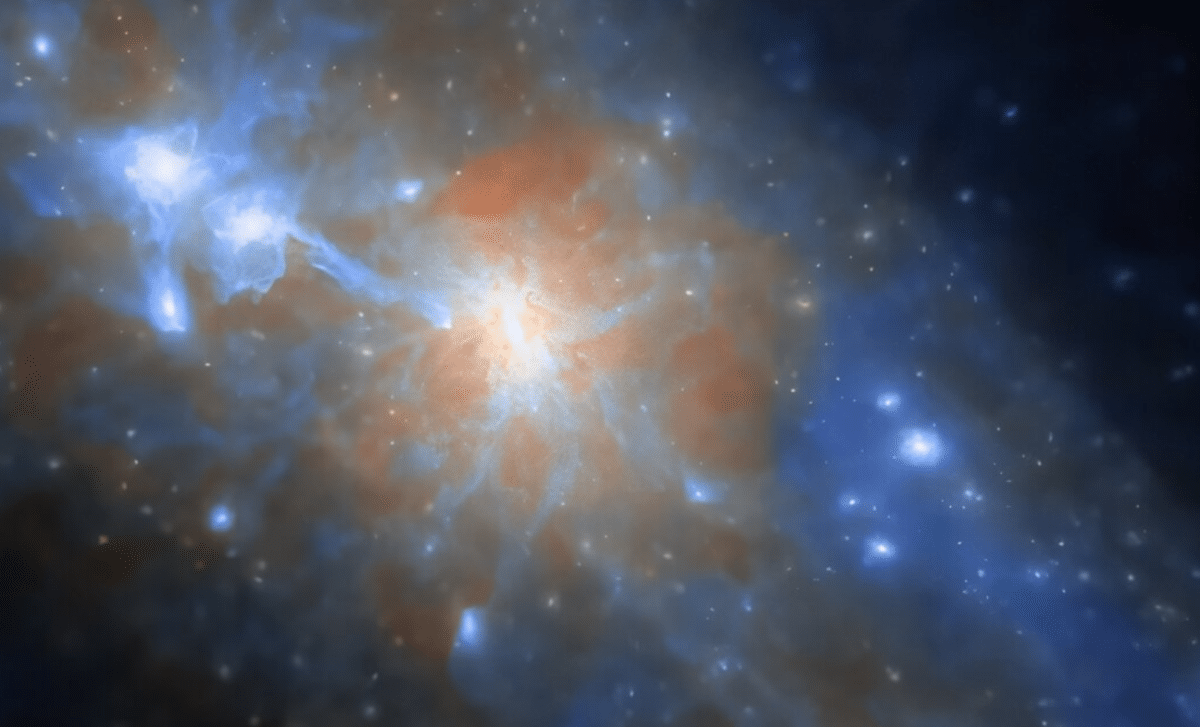
Nearly 11 billion years ago, the Milky Way underwent a monumental collision that profoundly influenced its rotating stellar disk. This early cosmic encounter ignited powerful waves of star formation and significantly altered the galaxy’s structure. Utilizing advanced simulations alongside detailed observations of star clusters, astronomers are now piecing together the events of this turbulent epoch, revealing how massive mergers drive the evolution of galaxies, as reported in the Monthly Notices of the Royal Astronomical Society.
Decoding the Milky Way’s Disk and Its Rotation Emergence
The Milky Way’s disk resembles a vast, flattened swath of stars, including our sun, spinning at speeds exceeding 220 kilometers per second. For years, researchers have aimed to pinpoint when this ordered rotation, known as the galaxy’s spin-up, first took hold. Initially, stars followed erratic orbits, but eventually they began moving in a synchronized fashion, marking the disk’s establishment.
Despite its serene appearance today, the Milky Way’s infancy was marked by violence. Clues point to a dramatic merger with a smaller galaxy early in its lifetime. Data from the Gaia mission in 2018 uncovered a distinctive group of stars with peculiar trajectories, attributable to a massive event known as the Gaia, Sausage, Enceladus (GSE) collision. This upheaval disrupted the young galactic disk, erasing much of its initial layout and indicating that the current rotation is more a consequence of the disk’s recovery than its formation.

Modeling Galactic Impacts
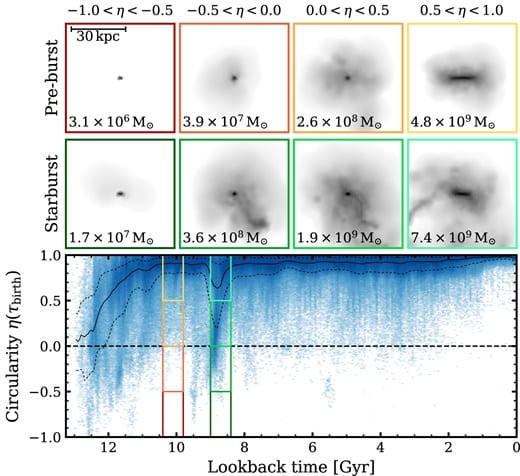
Scientists at the Institute of Cosmos Sciences of the University of Barcelona (ICCUB) and the Institute of Space Studies of Catalonia (IEEC) employed Auriga simulations to recreate the evolution of galaxies akin to the Milky Way, examining disk formation under diverse scenarios. Their results suggest that stellar disks can form earlier than expected but are vulnerable to disruption during significant mergers. Understanding these responses allows for better reconstruction of the timing and effects of ancient galactic collisions.
Triggered Star Formation from Galaxy Mergers
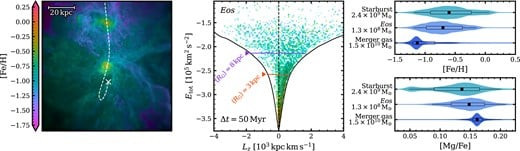
The research establishes a clear connection between the GSE merger and sudden, intense episodes of star birth in the early galaxy. “Simulations of the Gaia–Sausage–Enceladus merger predict a galactic fireworks display following the collision, marked by elevated star formation and enhanced globular cluster creation. This is the first evidence directly linking the two,” notes co-author Chervin F. P. Laporte from the French National Centre for Scientific Research (CNRS). The dramatic gas compression during the merger triggered these stellar eruptions, contributing to the abundance of star clusters seen today.
Tracing the Milky Way’s Evolutionary Path
Matthew D. A. Orkney, the study’s lead scientist at ICCUB and IEEC, states, “Understanding the interplay between galactic morphology and historic collisions is essential to unraveling our galaxy’s past.” Investigating the results of these encounters enables a clearer timeline of key merger events and reveals how galaxies like ours rebuild their structure over billions of years. These findings highlight the delicate balance of destruction and renewal driving galactic growth.
Probing Early Galaxies for Insights
While direct observation of the Milky Way’s distant past is impossible, astronomers can examine similar early-stage galaxies in the cosmos. Instruments like the James Webb Space Telescope (JWST) and the Atacama Large Millimeter/submillimeter Array (ALMA) furnish detailed views of star-forming galaxies as they appeared billions of years ago, offering parallels that help decode how primordial collisions impacted their disks and star formations.
Integrating Simulations with Observations
The combination of detailed simulations and star cluster data, as featured in the Monthly Notices of the Royal Astronomical Society, delivers a fuller understanding of the Milky Way’s violent formation history. This fusion of theory and observation confirms that significant collisions like the GSE merger leave enduring effects on galactic structure, star creation, and stellar motion.
- Categories:
- Astronomy





0 comments
Sign in to Comment