
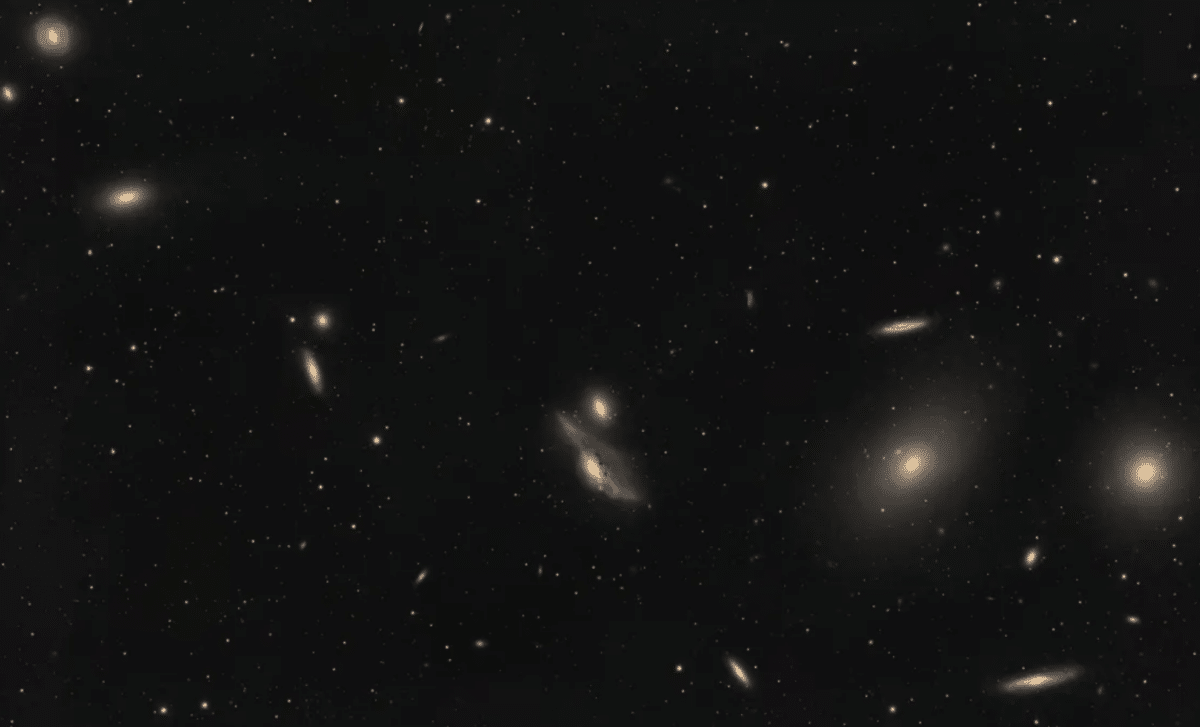
A striking new deep-space photograph by astrophotographer Ronald Brecher has captivated the astronomy world by showcasing the delicate and complex beauty of Markarian’s Chain, a well-known formation of galaxies within the Virgo Cluster. This captivating scene, featuring the distinctive interacting duo dubbed “The Eyes”, provides an extraordinary view into one of the densest galaxy groups observable from Earth. As described on the astronomy resource Messier Objects, the Virgo Cluster may host around 2,000 galaxies co-moving through space, elevating this work beyond a typical astrophotography milestone.
A Radiant Stream of Galaxies Illuminates the Spring Night
Markarian’s Chain is celebrated among stargazers for compacting an immense concentration of galaxies into a narrow section of the night sky. Situated between the constellations Leo and Virgo, this chain forms part of the extensive Virgo Galaxy Cluster, a gravitationally-bound ensemble of elliptical, spiral, and irregular galaxies. Brecher's image captures this packed celestial environment with remarkable sharpness, revealing fine color variations and subtle dust lanes that often elude casual observers.
The Chain is named after astronomer Benjamin E. Markarian, who identified the shared coherent motion of these galaxies as they traverse space. According to Messier Objects, this alignment is far from coincidental—it reflects the cluster’s gravitational evolution over billions of years. In Brecher’s photograph, some dominant galaxies immediately catch the eye, including the colossal elliptical galaxies M84 and M86, first charted by Charles Messier in 1781. Their luminous nuclei anchor the right portion of the frame, set against countless smaller galaxies scattered like distant sparks.

The image’s allure lies in its juxtaposition of peaceful elliptical galaxies alongside visibly disrupted systems undergoing cosmic interaction. Stellar streams and warped formations reveal the gravitational turmoil actively molding the cluster. Rather than isolated islands, these galaxies display an interconnectedness driven by invisible tidal forces continuing to sculpt their structures across cosmic epochs.
The 'Eyes' Galaxies Spotlight a Turbulent Gravitational Dance
At the heart of the composition is one of Markarian’s Chain’s most intriguing features: the close interacting pair NGC 4438 and NGC 4435, affectionately termed “The Eyes.” These galaxies appear entwined in a powerful gravitational event, resulting in significant twisting and disruption of their original forms. Extended streaks of dust and stars radiate outward, marking material being extracted during their intimate encounter.
“Note the striking colour and detail in NGC 4438 and NGC 4435, which make a close pair of galaxies known as ‘The Eyes’, just below centre in this image”, noted Brecher in a post on his website.
The larger among them, NGC 4438, exhibits some of the most intense distortions in the Chain, with its once-classic spiral shape now significantly warped, featuring dark lanes of dust disrupting a chaotic disk. Such galaxy interactions often spark waves of star formation, redistribute gas, and may even fuel centralsupermassive black holes. Here, their encounter acts as a vivid record of gravity’s transformative power in the cosmos.
The moniker “The Eyes” comes from these galaxies’ bright cores that resemble glowing eyes peering through interstellar darkness when seen through telescopes. Brecher’s meticulous image processing greatly intensifies this effect, making the pair the emotional heart of the photo. The interplay of hues, textures, and visible tidal disturbances invites viewers to witness galaxies as dynamic and evolving entities.
Over Nine Hours of Exposure Captured from a Residential Observatory
Remarkably, Brecher’s photograph was taken not at a major research facility but from his backyard setup in Guelph, Canada. Employing a Skywatcher Esprit 120 telescope alongside a specialized astronomy camera and various filters, he gathered data across ten nights from April 17 to April 27. The resulting image integrates over nine and a half hours of exposure, unveiling extremely faint galactic features that would otherwise remain invisible against the night sky.
Long-duration astrophotography requires precision and perseverance. Each additional hour of exposure builds detail unattainable by the naked eye. High-performance tracking compensates Earth's rotation with exacting accuracy while atmospheric steadiness preserves image sharpness. Brecher’s final piece exemplifies how modern amateur equipment can deliver images rivaling those from professional observatories.
His processing also respects the natural palette of galactic bodies without pushing colors to unnatural extremes. Warm-toned elliptical galaxies contrast with bluer spiral ones, reflecting differences in their stellar population ages and star formation rates. Older systems rich in mature stars glow golden or orangish, while younger, star-forming galaxies emit cooler blue light. These color nuances elevate the photo from mere spectacle to a meaningful portrayal of galactic evolution.
Locating Markarian’s Chain in the Night Sky
For stargazers eager to spot Markarian’s Chain, springtime offers prime viewing conditions. The cluster rises after sunset in the southwestern sky. A helpful starting point is the constellation Leo, a familiar spring figure in the Northern Hemisphere. From Leo, seek out the bright star Denebola at the lion’s tail, then move toward Vindemiatrix in Virgo.
Markarian’s Chain lies approximately midway between these landmarks. Under dark conditions, a modest 6-inch telescope can begin to reveal several of the brighter cluster members. Binoculars may detect the glow of larger galaxies like M84 and M86, but resolving structures requires stronger magnification and optimal viewing conditions. Many observers find it astonishing how numerous galaxies emerge within a single telescope field once the chain is located.
This experience conveys a profound sense of scale, as each faint smudge represents a galaxy containing billions of stars, located millions of light-years away. Brecher’s image beautifully conveys this vast depth, transforming a small patch of the spring sky into a bustling cosmic tableau filled with motion, collisions, and ancient star systems still evolving today.
- Categories:
- Astronomy




0 comments
Sign in to Comment