

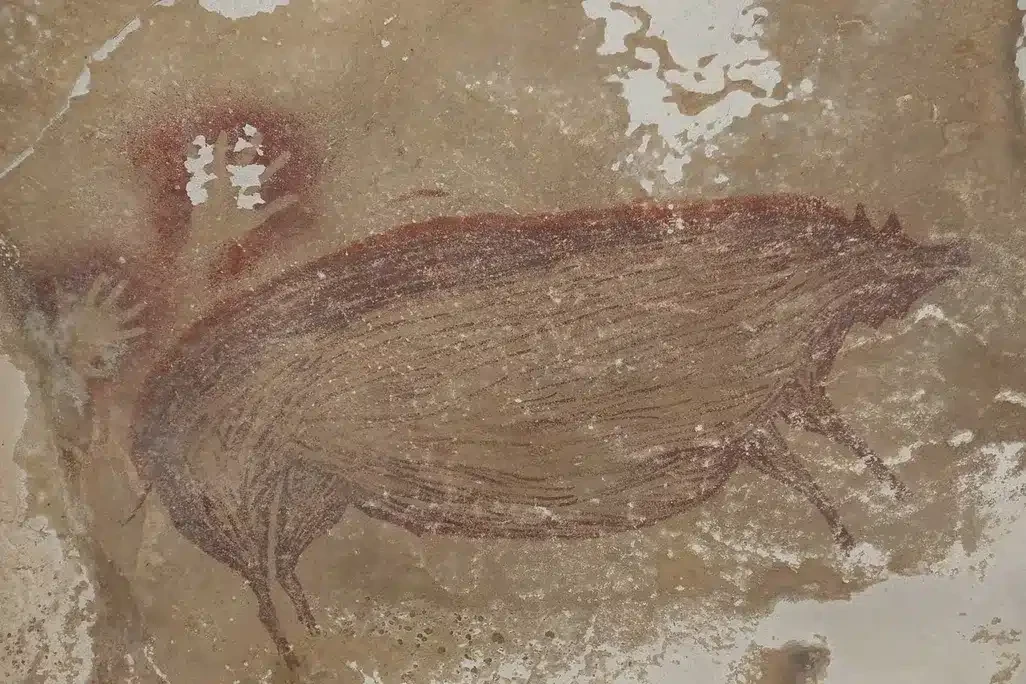
Researchers have identified the oldest piece of cave art to date on Sulawesi, an Indonesian island, estimated to be 51,200 years old. This remarkable painting, which features a depiction of a pig and human figures, significantly extends the timeline of when early humans began expressing narratives through visual art.
An Australian-Indonesian research collaboration made this outstanding discovery, marking it as the earliest example of figurative cave art currently known, surpassing previous finds by more than 5,000 years. This finding illuminates an important milestone in the evolution of human cognition and symbolic communication.
Unveiling a Prehistoric Scene
Within the Leang Karampuang cave, the artwork portrays a wild pig standing with its mouth slightly open, surrounded by three human-like figures. One individual holds a stick near the pig’s throat, another is positioned close to its snout, while the third figure is upside down, reaching toward the pig’s head. Professor Adam Brumm from Griffith University states that the image is:

“the oldest known dated, evidenced—currently—of a rock art depiction of wildlife. But it can be superseded by an earlier claim, either in this part of the world or somewhere else in the not so distant future.”
Tracing the Origins of Symbolic Thought
The age of this painting implies that our ancestors possessed advanced cognitive abilities far earlier than previously believed. Researchers publishing in aScience Advances paper emphasize that the depiction of humans engaging with animals reveals an early understanding of relationships and possibly storytelling.
Dr. Henry Gee, senior editor at Nature — the journal that reported this discovery — suggests:
“Something seems to have happened around 50,000 years ago, shortly after which all other species of human, such as Neanderthals and the so-called Hobbit died out.” He added, “It is very romantic to think that at some point in that time something happened in the human brain, but I think it is more likely that there are even earlier examples of representational art”.
Sulawesi’s Role in the Dawn of Creativity
New finds from Sulawesi continue to highlight Southeast Asia’s critical influence on the emergence of human artistic expression. The island is home to some of the oldest hand stencils and animal depictions, but this latest discovery reveals a more complex form of prehistoric storytelling.
Researcher Brumm points out that the discovery’s significance lies in its plot-like arrangement of figures.
“These are small native pigs that are endemic to Sulawesi and are still found on the island, although in ever-dwindling numbers,” he said. “The common portrayal of these warty pigs in the ice age rock art also offers hints at the deep symbolic significance and perhaps spiritual value of Sulawesi warty pigs in the ancient hunting culture,”
Innovative Laser Techniques Revolutionize Dating
Instead of traditional carbon dating, which can't be applied directly to ancient paintings, scientists employed laser technology to remove minute samples from the artwork. This approach allows detailed analysis of the layers involved, providing more precise dating results. This advanced technique promises new insights into other ancient cave art sites as well.
“The site is a very beautiful, essential, untouched, pristine environment,” Brumm said. “The local heritage agency is doing what it can to manage a control system that will safeguard the site over time.”
Although this dating method is still emerging, it is already transforming archaeological research.
“In fact, some of the known rock art sites in this area could be that old; they just haven’t yet been scientifically dated,” he concluded. “So humanity’s earliest art could be hiding in plain sight.”
- Categories:
- Science











0 comments
Sign in to Comment