
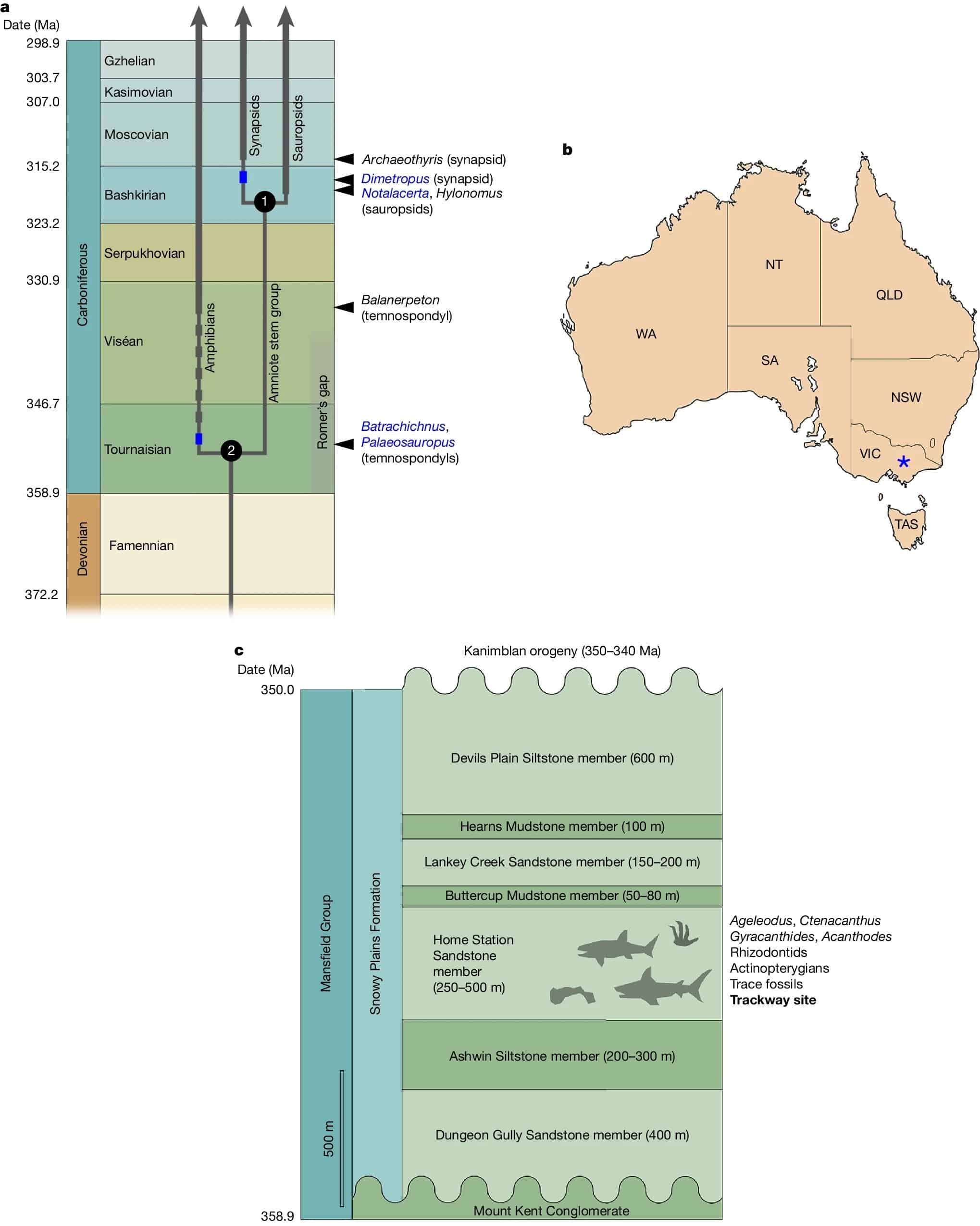
Unearthed within the Snowy Plains Formation of the Mansfield Basin in southeastern Australia, a sandstone slab preserves what are now recognized as the earliest reptile footprints discovered to date. Estimated to be approximately 356 million years old, dating back to the early Carboniferous period, these tracks reveal five clearly defined toes ending in sharply curved claws. Lead researcher Per Ahlberg, in the study featured in Nature, states, “It is beyond doubt that these are claws typical of the earliest reptiles, pushing back their appearance by at least 35 million years.” This finding distinctly advances the timeline for the emergence of amniotes, previously believed to have arisen about 320 million years ago.
Detailed Characteristics of the Australian Footprints and Their Implications
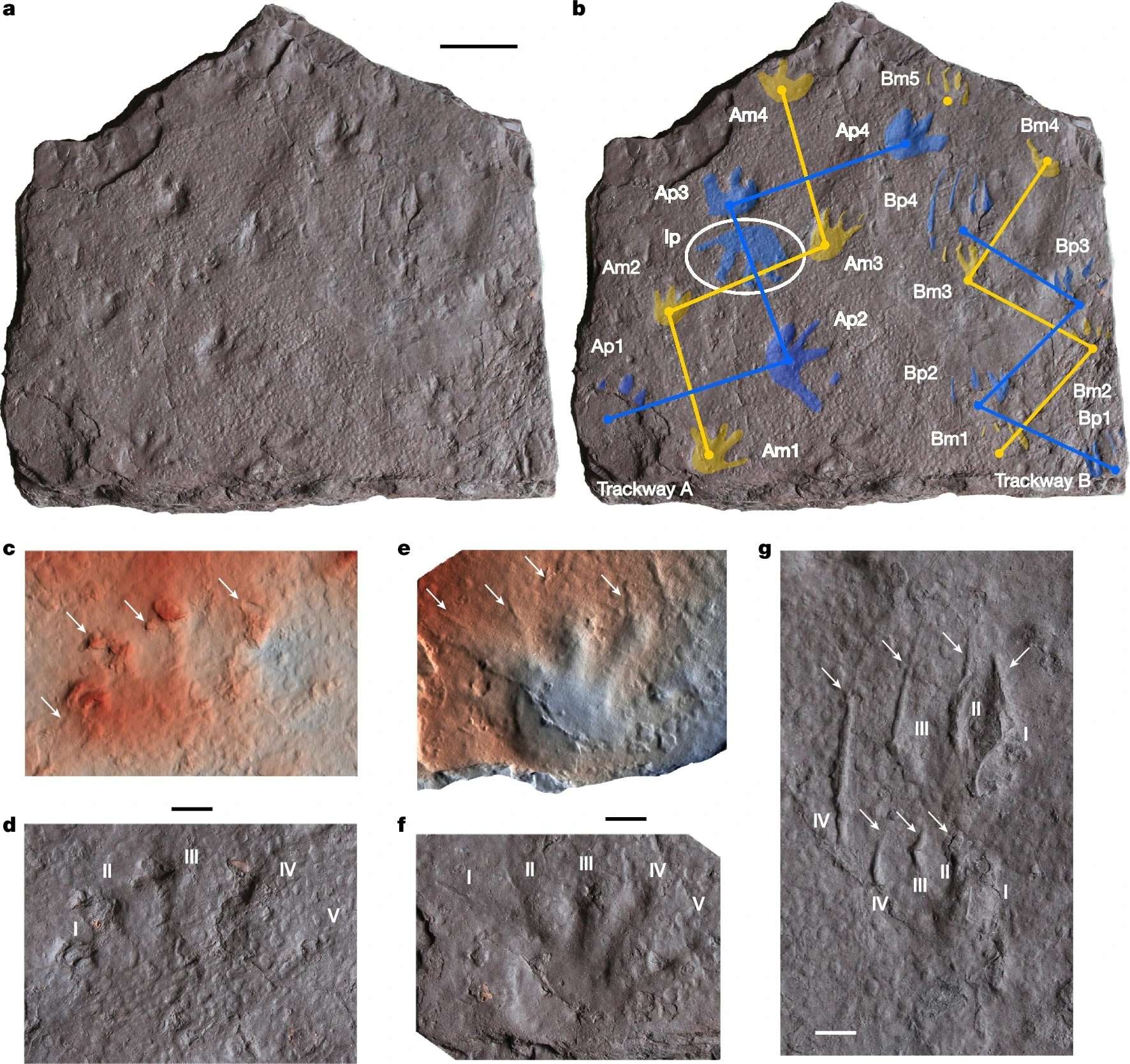
The impressions display a strikingly clear anatomy: five separate digits fanning out, each ending with an inward-curved claw that created an inverted “J” shape in the sediment. These claw marks, both sharp and distinct, strongly resemble amniote footprints from later geological sources like Notalacerta, Varanopus, and Dromopus. Registered as specimen NMV P258240 and originating from Broken River on Taungurung Country in Victoria, the slab was initially found by citizen scientists Craig A. Eury and John Eason, who collaborated with professional paleontologists — illustrating the valuable role of citizen science in advancing paleontological discoveries.
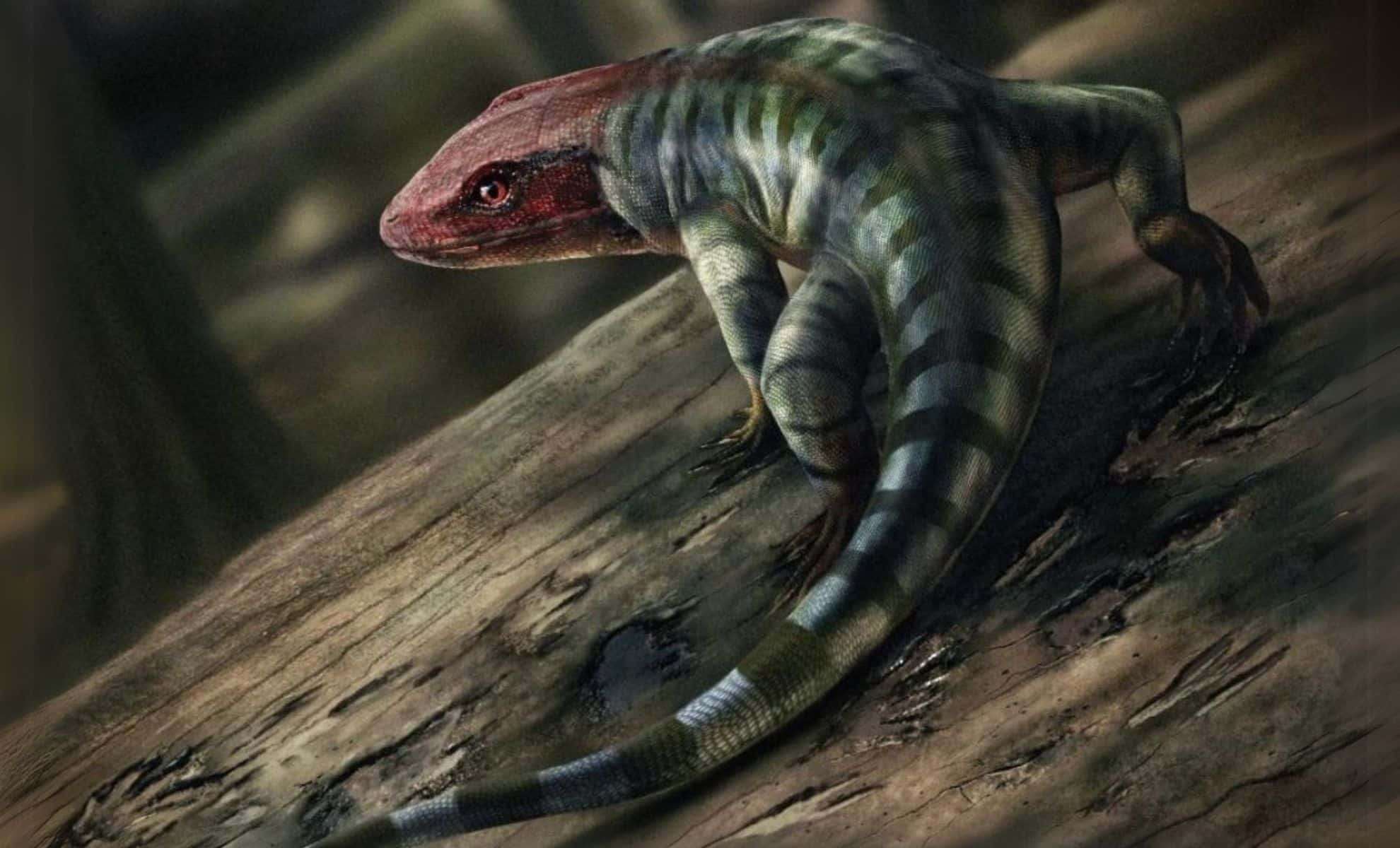
Based on trackway measurements and comparisons to modern water monitor lizards (Varanus salvator), the animal that left these tracks was estimated at around 80 centimeters in length. The footprints’ detailed features, including distinct claw impressions and the size disparity between forefoot (manus) and hind foot (pes), provide compelling evidence that these tracks originated from an early crown amniote — a lineage encompassing reptiles, birds, and mammals.

Revising the Timeline for Vertebrate Land Colonization
This pivotal find shifts the origin of crown amniotes back into the early Carboniferous period, potentially even overlapping with the final stages of the Devonian. The interval required for the transition from aquatic to fully terrestrial life now appears to be about 50 million years, rather than the earlier estimate of 80 million years. This underscores the gaps in the Devonian fossil record, indicating that “advanced groups must already have been present during this period but remain to be discovered,” as Ahlberg observes.
Moreover, this evidence challenges the prevailing notion that the end-Devonian Hangenberg extinction event drove the rise of modern tetrapods. Instead, it seems the extinction acted as a selective force, eliminating more primitive lineages and enabling already established groups to endure and diversify post-event.
Broader Paleobiogeographic Implications and Comparative Analysis
Alongside the Australian footprints, comparable but slightly younger reptile tracks from the Wałbrzych Formation in Silesia, Poland, dating to the mid-Serpukhovian to early Bashkirian stages, extend the known amniote record in Euramerica by around eight million years. Together, these finds imply that early amniotes had a broad geographical range and a deeper evolutionary history stretching into the Devonian than previously traced.
Geographically, the Australian locality, positioned close to 17° south latitude during deposition, situates these earliest amniotes in tropical zones, akin to those of the Polish sites near the equator. This weakens assumptions that early amniote distribution was climate-limited, suggesting instead their occupancy across tropical Gondwana and Euramerica.
The Snowy Plains Formation tracks thus provide crucial evidence that the tetrapod crown group, including amniotes, originated much earlier than body fossils alone suggest. The combination of diagnostic claw impressions and firm dating reshapes our understanding of early vertebrate evolution and highlights how trackway fossils can fill substantial gaps in the fossil record.
- Categories:
- Science






0 comments
Sign in to Comment