

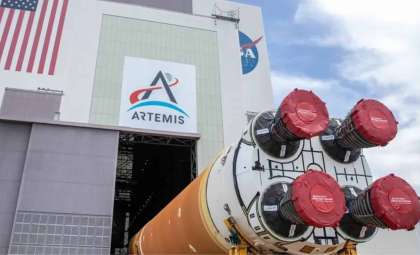
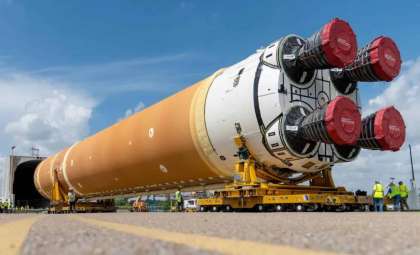
On March 23, 2025, NASA reached an important milestone for the Artemis II mission by completing the integration of the Space Launch System (SLS) core stage at Kennedy Space Center in Florida. This accomplishment brings the agency closer to launching the first crewed flight in the Artemis program. The achievement was highlighted in a NASA update on March 24, 2025, underscoring the mission’s steady progress (NASA, 2025).
The integration connected the towering 212-foot core stage with the solid rocket boosters already assembled inside the Vehicle Assembly Building. This core component will propel the Orion spacecraft and its crew on a 10-day voyage around the Moon during Artemis II. Besides testing critical systems, this flight lays groundwork for future human missions to the lunar surface and deeper into space, including Mars exploration.
Central Role of the SLS Core Stage
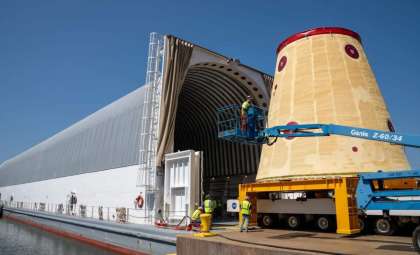
The SLS core stage serves as the structural heart of the rocket, supporting the launch vehicle stage adapter, interim cryogenic propulsion stage, Orion stage adapter, and the crewed Orion capsule. Successfully joining this main element is vital for integrating all spacecraft components seamlessly.

Using one of five overhead cranes within Kennedy’s Vehicle Assembly Building, NASA’s Exploration Ground Systems team and contractor Amentum carefully lifted and positioned the core stage between the already stacked solid rocket boosters atop the mobile launcher. This precise operation required expert coordination to ensure the core stage securely serves as the key foundation for the Artemis II rocket.
Following this step, preparations will begin to mount the Orion stage adapter on top of the core stage, finalizing the framework that will support the Orion crew module on its lunar journey.
Artemis II: Advancing Human Spaceflight Beyond Earth
Artemis II is NASA’s inaugural crewed mission in the Artemis initiative, aimed at sustaining human presence on the Moon by the mid-2020s and eventually enabling Mars exploration. The mission will carry four astronauts on a lunar orbit flight lasting approximately 10 days, validating the spacecraft’s vital systems for future surface missions.
This critical test will verify the spacecraft and launch vehicle’s readiness and safety, providing indispensable data as NASA pursues crewed lunar landings. Success here is fundamental to ensuring subsequent human missions beyond Earth are both achievable and sustainable.
Integral to NASA’s deep space goals, the SLS rocket and Orion spacecraft integration marks a pivotal stage on the path toward sending humans beyond low-Earth orbit. Artemis II will offer unprecedented opportunities to evaluate crewed spaceflight capabilities in deep space.
Upcoming Steps for Artemis II
With the core stage now integrated, focus shifts to assembling the remaining elements. Next in line is attaching the Orion stage adapter, which will secure the crew module during lift-off. The rocket will then undergo rigorous testing to verify all systems are functioning as intended before launch.
NASA’s engineering and ground teams will continue their thorough preparations, including finalizing the cryogenic propulsion stage installation, conducting engine tests, and confirming the operational integrity of the SLS rocket. Once these tasks conclude successfully, Artemis II will be poised for its historic mission, advancing humanity’s return to the Moon and exploration beyond.
- Categories:
- News




0 comments
Sign in to Comment