
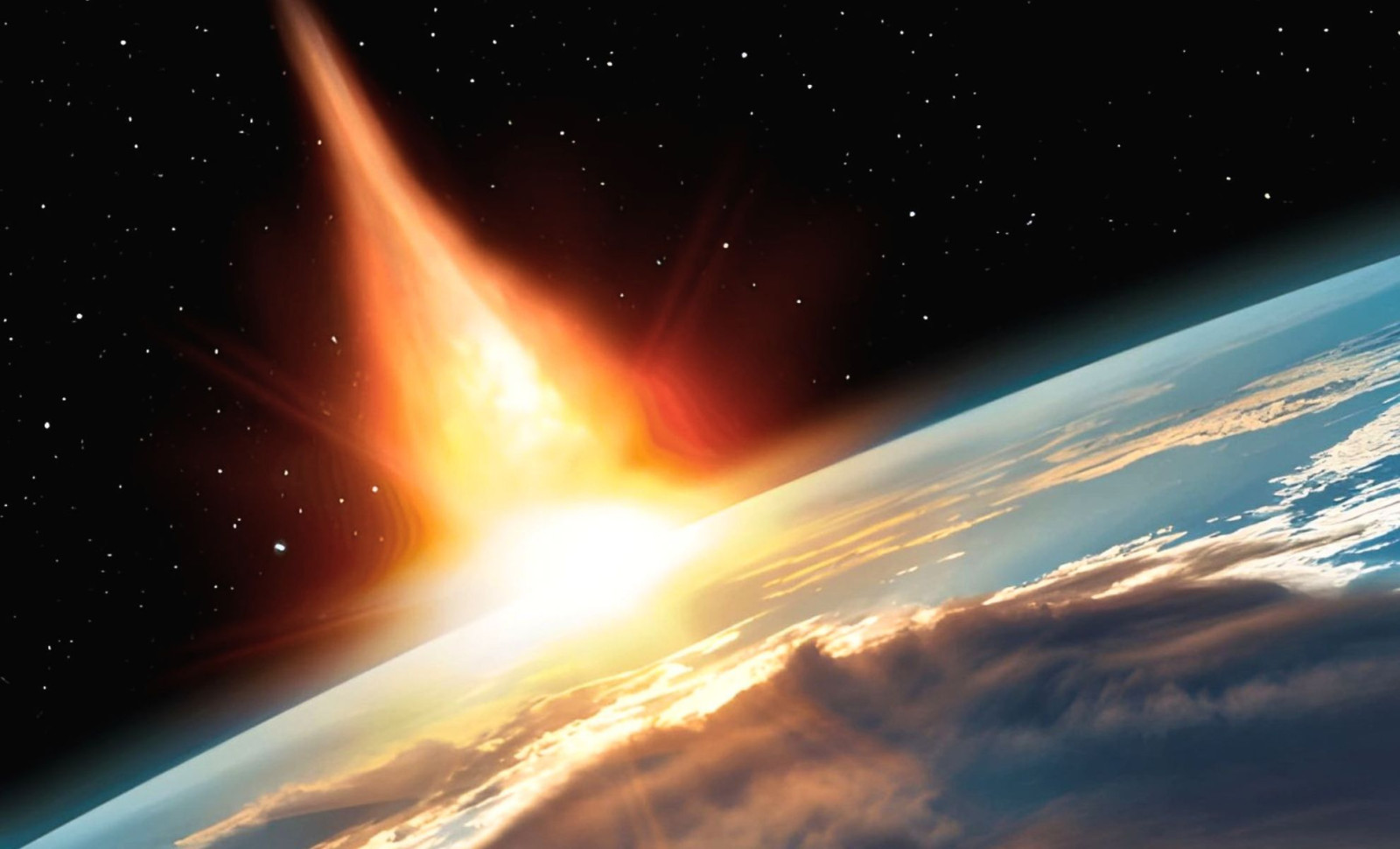
After years of debate, scientists have confirmed the origin of a massive crater hidden beneath the North Sea seabed. Tiny "shocked" crystals, which only form under the intense pressures of an asteroid impact, have provided the crucial evidence. Researchers from Heriot-Watt University verified that the Silverpit Crater, located 700 meters under the seafloor about 80 miles off Yorkshire’s coast, was formed by a high-speed asteroid collision dating back between 43 and 46 million years.
The study, published this September in Nature Communications, finally settles a controversy that began when the crater was discovered in 2002. This finding places Silverpit among a rare group of approximately 33 verified marine impact structures found on ocean floors worldwide.
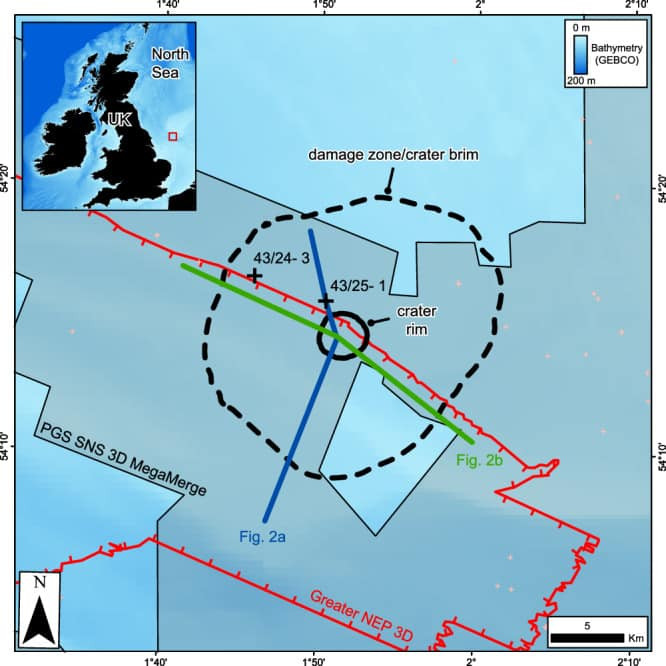
Supported by the Natural Environment Research Council, the research involved cutting-edge three-dimensional seismic imaging combined with meticulous examination of rock fragments recovered near an oil well. This detailed study revealed the crucial hallmark of an asteroid impact: quartz and feldspar grains exhibiting microscopic planar deformations caused by sudden, extreme pressure.

Dr. Uisdean Nicholson, sedimentologist at Heriot-Watt University and study lead, called the search a “needle in a haystack” that conclusively confirms the impact event.
New Seismic Data Sheds Light on the Crater’s Features
The impact site lies beneath thick sediment layers, inaccessible for direct observation. Earlier, blurry seismic data allowed alternative theories such as salt tectonics or volcanic shifts to explain the crater’s formation—and even led to a 2009 majority rejection of the asteroid hypothesis.
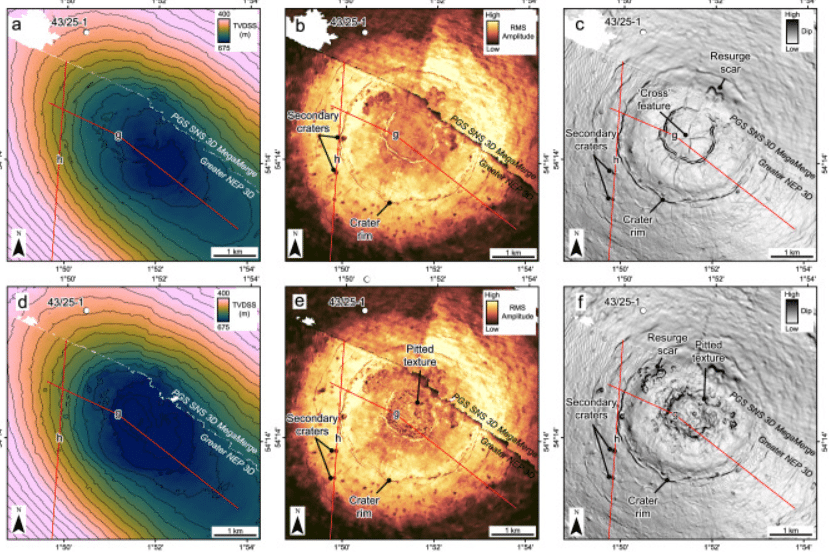
The latest seismic images reveal unmistakable characteristics: a well-defined central peak, a surrounding depression, and an expansive zone of fractured rock. Secondary craters scattered across the ancient Eocene seabed and fault patterns suggest a low-angle impact from the west.
Imperial College London’s Professor Gareth Collins created numerical simulations replicating the impact damage observed. “Finding the definitive evidence is incredibly rewarding,” Collins said. “We can now leverage this new data to better understand how impacts affect planetary interiors.”
An Enormous Wave Over 100 Meters High
Collins’s models reconstruct a dramatic event in the mid-Eocene epoch. A roughly 160-meter-diameter asteroid collided at ultra-high speed with a shallow marine environment, instantly vaporizing surrounding rock and water. A colossal plume of debris and vapor surged 1.5 kilometers into the sky.
When this cloud collapsed, it generated a tsunami exceeding 100 meters in height. At the time, the North Sea basin would have been transformed by this colossal wave, reshaping ancient shorelines throughout the region.
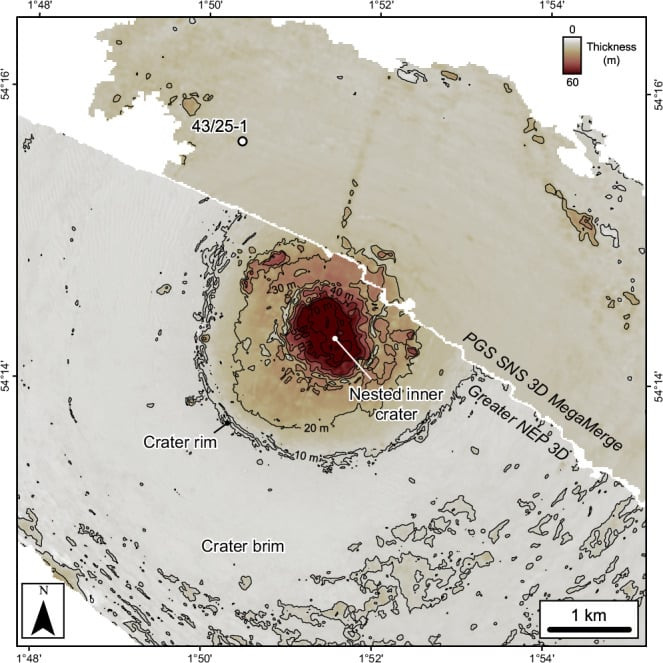
The seismic data also shows a pitted, flat-topped central uplift in the chalk layer struck by the impact. This suggests rapid gas loss in carbonate rock caused by the intense heat, a reaction familiar from other limestone-impact craters.
The Two Mineral Fragments That Resolved the Debate
The absence of shock metamorphic features previously left room for skepticism. Without internal fractures from immense pressure, the crater might have been attributed to geological folding. The breakthrough came from a box of well cuttings labeled 43/25-1.
Among these fragments were two mineral grains that changed the narrative. Under microscopic examination, both showed distinct sets of shock lamellae — fine fractures that form only under pressures of 10 to 13 gigapascals, far beyond natural geological forces. This evidence aligned seamlessly with impact pressures predicted by the Silverpit model, conclusively supporting the asteroid origin.
Dr. Nicholson pointed out that while nearly 200 impact craters exist on land, those preserved under oceans are rare due to tectonic activity and erosion. Silverpit’s burial shielded it, making it a valuable subsurface case study. It provides insight into impact dynamics useful for interpreting craters on the Moon and Mars, where direct investigation is impossible.
This discovery associates Silverpit with other significant marine craters such as the Nadir Crater near West Africa and the massive Chicxulub Crater in Mexico, linked to the dinosaurs' extinction 66 million years ago.
- Categories:
- Science




0 comments
Sign in to Comment